Please Wait a Moment
X

Infor LX Tips, Infor LN Tips, BPCS Tips, Baan Tips, Infor M3 Tips & Infor ERP News

Crossroads Connections

Infor ERP Tips & News from the Experts

Infor LX | Infor LN | BPCS | Baan | Infor M3

BPCS/LX Tip of the Week: Inventory Control

Anthony Etzel 0 93240 Article rating: No rating

In Infor LX you need to determine how inventory will be moved in and out of warehouse storage locations, and which of the following transactions to use for inventory control:


  • A transfer transaction can be used to move inventory from one warehouse location to another warehouse location.
  • A production receipt transaction is used to add inventory to a warehouse location.
  • A material issue or backflush is used to reduce inventory from a warehouse location.

New Definition of Insanity: Collect data the same old way

Anthony Etzel 0 93870 Article rating: 5.0

Just because you've always done it this way doesn't mean it's the best way. The old way of doing things may get the job done, but is the job being performed efficiently, accurately, and on a timely basis?

People resist change because there is an element of fear behind change and having to learn something new. Sometimes it’s just that you’re comfortable with how things are done, and you don’t see the need to make any changes. 


Are you stuck in manual?

Improve Profit and Cut Costs at the Same Time

Crossroads RMC 0 44425 Article rating: No rating

Want to Improve Profit and Cut Costs at the Same Time?

“Real-time executives averaged a 14% improvement in operating cash flow and achieved a 6% reduction in operating costs” According to the Aberdeen Group.

So, how do you accomplish this great feat? By streaming real-time data to the executives.

The need for visibility into what is happening in the trenches, and the comprehensive understanding of key metrics and their implications for overall performance, are critical for an organization to be at the “top of their game”.   read full article>

Learn how Crossroads RMC can provide for this data streaming with Analytics Dashboards.

Industry News: How Small and Mid-Sized Manufacturers Can Harness the Transformative Power of Technology…

Crossroads RMC 0 47888 Article rating: No rating

Industry-Specific Technology Changes the Game:

"One of the most significant changes has been the development of software and enterprise-wide technology that is designed to specifically meet the needs of particular industries. This has multiple advantages. The technology doesn’t have to be “over-configured” to be functional; the functionality is built-in. It can also be deployed quickly and cost-effectively, with less effort and less risk." Industry Week Article by Kelly McGowan, American Securities.


Crossroads RMC has software that has been built specifically for your industry. Learn how Analytics Dashboard can improve your efficiency, productivity, and quality while driving down costs.

Industry News: Technology - The Secret Life of the American Factory

Crossroads RMC 0 46867 Article rating: No rating

New Data: New Fruit…that’s the promise of finding new data sitting right there under your nose on the factory floor.

Doug Woods, president of the Association for Manufacturing Technology and MTConnect champion says it this way:
"At the end of the day," he explains, "after you've invested in hardware and machines, at some point it all comes down to how do you wring the maximum amount of productivity out of them? How do you get the ultimate efficiency out of the facility?" The only way to be confident you're doing that, he says, is to really understand what is going on with all of the equipment in the factory all of the time. And that, he says, comes down to having "really good data." 

Read Full Article>

Discover How Crossroads RMC can meet this need with Analytics Dashboard.

Baan/LN Tip of the Week: Project Templates

Kathy Barthelt 0 90387 Article rating: No rating

Project templates are useful because you can specify all of the information that you would normally want to include when creating a new project such as project structure, budget, and so on.

In Baan IV/V, project templates do not exist, but you can set up a project template by creating a regular project, and setting the status to simulated or free. This is done so that the project does not create plans. Under this scenario, you can easily copy one project to another.

In LN, when you create a new project, a template can be used as the starting point. This is similar to copying a normal project, but unlike normal projects, no costs or revenues can be posted on a template.

BPCS/LX Tip of the Week: Work Center - Cells

Anthony Etzel 0 91258 Article rating: No rating
The LMP module (Lean Manufacturing Process) uses work centers but refers to them as production cells.

A cell is one or more work centers that produces an end item. So when a company decides to adopt the lean manufacturing philosophy, the concept of work centers takes on a new meaning.

In lean terms, the work center, or group of work centers, becomes a production cell. In other words, a mini-factory producing end items with similar characteristics.

BPCS/LX Tip of the Week: The Machine Master Part 2

Anthony Etzel 0 88015 Article rating: No rating
Understanding:

The Machine Master File

Do your machines have a fixed asset tag? The machine master file has a field called Fixed Asset.

BPCS does not use this field, so you can use this field for anything. You can record your fixed asset tag in this field and use the effective date. You can create a custom fixed asset list by using a DFU or Query program.

First129130131132134136137138Last

Tips:  LX | BPCS | M3

Tips: LN | Baan

Kathy Barthelt

Infor LN & Baan Tips & Tricks for EXECUTIVES

TECHNOLOGY: Using the Data Access Layer (DAL)

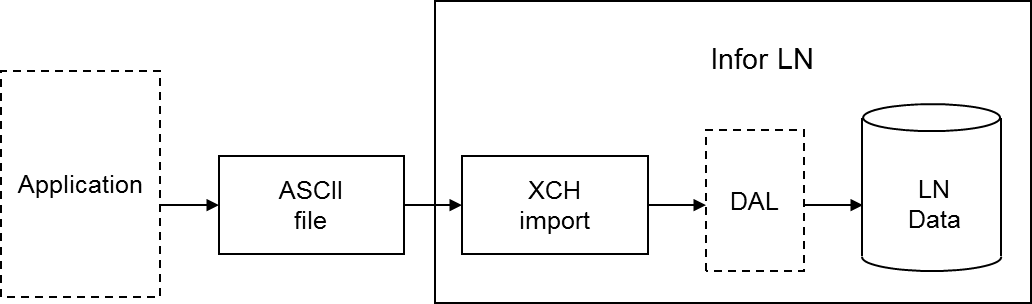
During an Exchange import, you can use all the functionality programmed into the Data Access Layer (DAL). If you use the DAL, Exchange carries out all the constraint checks, integrity checks, and side effects, for example, updates on other tables, that are programmed into the DAL. Database integrity is guaranteed automatically.

Using the DAL reduces the costs of interface development. You can use the DAL to import standard interfaces developed by Infor for partner products, as well as for specific interfaces built by customers, for example, to integrate LN with legacy systems. You can use the DAL in both single site and multisite environments.

The checks or additional actions specified in the DAL are carried out for each row that is imported. Database errors are logged in the same way for DAL and non-DAL import. DAL hook errors are also logged. You can specify whether the DAL property checks are or are not carried out.

If you specify the use of the DAL for a table relation for an import, the dal.new, dal.update, and dal.destroy functions are used instead of db.insert, db.update, and db.delete. You can choose to use DAL for particular tables and not for other tables, therefore, an import batch can contain both types of table relations simultaneously. The import through DAL works for both the import based on audit or indicators (inserts, updates, deletes), and the full import (inserts only).

DAL settings are run time aspects, which means you can change these aspects without having to regenerate the import program. DAL settings are also logged in the log table at batch line level, to enable you to find out what the DAL settings were when the import was run.

Important to realize is that an update through the DAL can result in a number of side effects. Actions performed by the DAL must not be carried out twice. For example, if the DAL updates the available to promise (ATP) quantity for an item when importing order data, the ATP quantity must not be updated in a condition script as well.

For this reason, you must not add any actions in condition scripts, or import additional data, that are already handled in the DAL.
FINANCE: Set Up and Calculate Currency Differences

To set up and calculate currency differences for foreign currencies:

  • Use the Company Parameters (tfgld0503m000) session to specify the profit and loss ledger accounts, 12 profit and loss dimensions, and transaction type for a posting exchange rate differences that is calculated using the FIFO method. To specify this data, use the Currency Diff. FIFO tab. The reports printed from the Print Company Parameters (tfgld0404m000) session, include the Currency Differences FIFO fields.
  • Use the Calculate Currency Differences (tfgld5201m000) session to calculate the currency differences resulting from transactions posted on accounts for which the field Currency Analysis in the session Chart of Accounts (tfgld0508m000) is set to Required.

OPERATIONS: Subcontracting Overview

Companies can decide to involve a subcontractor and subcontract part of their activities. The subcontractor carries out the work and returns the products to your company.

In Infor LN, subcontracting is considered as purchasing labor from a third party. Therefore, if a manufacturer wants to subcontract work, he must generate a purchase order to start the subcontracting process. These are the types of subcontracting:

  • Subcontracting with material flow
    • Operation subcontracting: For operation subcontracting, a part of the production process (one or more operations) is subcontracted.
    • Item subcontracting: For item subcontracting, an item's entire production process is subcontracted. Therefore, it is always used with material flow support.
  • Subcontracting without material flow: The simplest form of subcontracting is to generate a subcontracting purchase order to record the operations outsourced to a subcontractor. The subcontracting purchase order only represents the administrative handling of the subcontracting process. When the subcontracted item is received back from the subcontractor, you must close the subcontracting purchase order, which initiates the production process.
  • Unplanned subcontracting: Unplanned subcontracting is applicable when you subcontract after generating a production order. For unplanned subcontracting, a purchase order is generated from the production order and the material supply lines are populated by Shop Floor Control.
  • Service subcontracting: For service subcontracting, work on an item to be maintained or repaired is subcontracted. This work entails the entire repair process, or only a part of it. Service subcontracting can be used with or without material flow support.

To start the subcontracting process, a purchase order is required.

Previous Article Infor LN & Baan Tips & Tricks for FINANCE: Moving calendar periods
Next Article Infor LN & Baan Tips & Tricks for TECHNOLOGY: Using the Data Access Layer (DAL)
Print
2098 Rate this article:
5.0
Kathy Barthelt

Kathy BartheltKathy Barthelt

Other posts by Kathy Barthelt

Contact author

x

Categories