Please Wait a Moment
X

Infor LX Tips, Infor LN Tips, BPCS Tips, Baan Tips, Infor M3 Tips & Infor ERP News

Crossroads Connections

Infor ERP Tips & News from the Experts

Infor LX | Infor LN | BPCS | Baan | Infor M3

Crossroads RMC to Exhibit at Manufacturing Matchmaking 2014

Crossroads RMC 0 46497 Article rating: No rating
Crossroads RMC will exhibit at the inaugural Illinois Manufacturing Excellence Center (IMEC) Manufacturing Matchmaking Event 2014 on September 23, 2014. Manufacturers from across the state of Illinois will come together at this event to discuss ways to improve the productivity and competitiveness of Illinois' small and mid-sized manufacturing firms.

BPCS/LX Tip of the Week: What is the bubble number and how do I maintain it?

Anthony Etzel 0 81842 Article rating: No rating

The bubble number is maintained at the component level for each component defined on the Bill of Material. It is an extra user-defined reference number that you can use to re-sequence the maintenance screen display or bills of material listings.

In Infor LX, the system displays the bubble number for the existing child items. Engineering drawings often use a bubble number at the component level on the drawing so that same bubble number can be used on the Bill of Material for a link of the component to the drawing. Alternatively, you may use it simply as a method to sequence the BOM.

Be careful of how you assign the number. It is a good idea to assign the number with a consecutive count by 10 leaving room to allow for component additions to the Bill of Material.

Baan/LN Tip of the Week: Setting Up New Employees in LN

Kathy Barthelt 0 123406 Article rating: No rating

In LN, the People package is used to register the employee’s hours and expenses. To support the People package, the Employees - General (tccom0101m000) session only contains the general employee data.

The title of the Employees - General (tccom0101m000) session was changed to Employees – General (tccom0101m000).

From the Employees - General (tccom0101m000) session, users can start the following sessions to define the more specific employee data:

  • Employees - People (bpmdm0101m000).
  • Employees - Project (tppdm8101m000).
  • Employees - Service (tsmdm1140m000).
  • Skills by Employee (tcppl0120m000).
  • Employees by Team (tcppl0150m000).
  • Roles by Employee (tcppl0170m000).

After users define the employees, users can also start the listed sessions from the Employees Dashboard (bpmdm0101m100) session in People.

Baan/LN Tip of the Week: Month End - Miscellaneous To-Do's

Kathy Barthelt 0 76510 Article rating: No rating
  • Print Sales Order History Information
    • all invoices processed through sales
  • Check Inventory Valuation
    • this should tie out to your inventory accounts
  • Print Integration Information
    • see all postings from WIP to finished goods
  • Print G/L Transaction Information
    • print specific transaction types for any GL account
  • Print Lot Control Information
    • will show where serial numbers were used

BPCS/LX Tip of the Week: Why Define Location Fields in the Work Center File

Anthony Etzel 0 76611 Article rating: No rating

If you setup the “From” and “To” Location fields in the Work Center file, this will determine the locations for material issue transactions and production reporting transactions.

The reporting of the transactions happen through production reporting, JIT600, or using the Shop Floor labor posting, SFC600, or Shop Floor Posting from SFC650.

Remember, any location used in the work center file must first be set up in the location master file. Using an MES solution by-passes the need to key any of the data to Infor LX.

If ERP is plumbing for the Enterprise; How do we unplug it and keep it from making a huge mess?

David Dickson 0 56944 Article rating: 5.0

I have been working with ERP in various roles for over 30 years, directly involved in over a hundred implementations, while my company has been involved with over 300 more. Of course, in many ways the systems we use today are completely different from what we used in the ‘80s – back then it was green screens, simple transaction entry forms, and cumbersome updates (at best) to link what one department did with all the other areas that needed access to that information. Then there were those planning programs that took all the information along with various parameters the users needed to set and told us what to do.

The More Things Change, the More They Stay the Same

Baan/LN Tip of the Week: The Product Configurator

Kathy Barthelt 0 101241 Article rating: No rating

What is it?
The configurator consists of a set of features (questions). The options (answers) to these questions are used to generate the custom bill of material and routing. These questions may be answered at the time of order entry, prior to order entry (in a project or quote) or after order entry (in the project). The order of the questions do not need to have any relationship to the bill of materials. The configurator may also calculate the selling price, create a unique “smart” item number, custom description and text. Simple rules are used to interpret the answers.

Who uses the configurator?
Companies whose products have options. The configurator eliminates the need for part numbers for all combinations of options. The configurator ensures that the pricing and bills are correct. The configurator also keeps statistics on the frequency the options are selected.

BPCS/LX Tip of the Week: Understanding What Goes On – Out on the Factory Floor

Anthony Etzel 0 17146 Article rating: No rating

Ok… so you want to know the status of a specific shop order that was released two days ago.

What do you do?

It’s a sure bet that you have a manager, supervisor, or planner who can walk the floor and find the order at whatever work center it happens to be at. He/she can then answer “what operations have been completed and how many were completed?” All this requires leg work, and of course, a fair amount of time.

Now, if you have set up your BPCS master files properly, and you report transaction activity, you should be able to get those shop order statuses much faster using the SFC300 Shop Order Inquiry Screen.

At your fingertips you can see:

  • Release date & due date
  • How many hours remain in total and at each operation
  • The quantity required, what was finished, and the remaining quantity
  • What components (materials) have been issued

Pretty basic information, right? Are you getting what you need to know? If not, then you may want to reexamine how your BPCS files are set up and what transactions along with their frequency are captured.

First130131132133134135137139

Tips:  LX | BPCS | M3

Tips: LN | Baan

Kathy Barthelt

Infor LN & Baan Tips & Tricks for EXECUTIVES

TECHNOLOGY: Using the Data Access Layer (DAL)

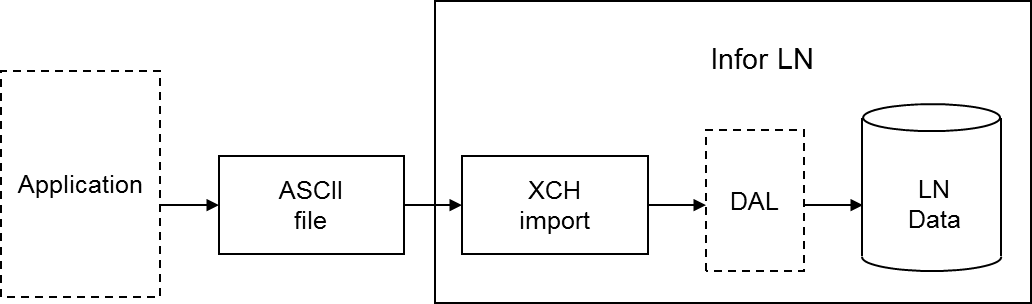
During an Exchange import, you can use all the functionality programmed into the Data Access Layer (DAL). If you use the DAL, Exchange carries out all the constraint checks, integrity checks, and side effects, for example, updates on other tables, that are programmed into the DAL. Database integrity is guaranteed automatically.

Using the DAL reduces the costs of interface development. You can use the DAL to import standard interfaces developed by Infor for partner products, as well as for specific interfaces built by customers, for example, to integrate LN with legacy systems. You can use the DAL in both single site and multisite environments.

The checks or additional actions specified in the DAL are carried out for each row that is imported. Database errors are logged in the same way for DAL and non-DAL import. DAL hook errors are also logged. You can specify whether the DAL property checks are or are not carried out.

If you specify the use of the DAL for a table relation for an import, the dal.new, dal.update, and dal.destroy functions are used instead of db.insert, db.update, and db.delete. You can choose to use DAL for particular tables and not for other tables, therefore, an import batch can contain both types of table relations simultaneously. The import through DAL works for both the import based on audit or indicators (inserts, updates, deletes), and the full import (inserts only).

DAL settings are run time aspects, which means you can change these aspects without having to regenerate the import program. DAL settings are also logged in the log table at batch line level, to enable you to find out what the DAL settings were when the import was run.

Important to realize is that an update through the DAL can result in a number of side effects. Actions performed by the DAL must not be carried out twice. For example, if the DAL updates the available to promise (ATP) quantity for an item when importing order data, the ATP quantity must not be updated in a condition script as well.

For this reason, you must not add any actions in condition scripts, or import additional data, that are already handled in the DAL.
FINANCE: Set Up and Calculate Currency Differences

To set up and calculate currency differences for foreign currencies:

  • Use the Company Parameters (tfgld0503m000) session to specify the profit and loss ledger accounts, 12 profit and loss dimensions, and transaction type for a posting exchange rate differences that is calculated using the FIFO method. To specify this data, use the Currency Diff. FIFO tab. The reports printed from the Print Company Parameters (tfgld0404m000) session, include the Currency Differences FIFO fields.
  • Use the Calculate Currency Differences (tfgld5201m000) session to calculate the currency differences resulting from transactions posted on accounts for which the field Currency Analysis in the session Chart of Accounts (tfgld0508m000) is set to Required.

OPERATIONS: Subcontracting Overview

Companies can decide to involve a subcontractor and subcontract part of their activities. The subcontractor carries out the work and returns the products to your company.

In Infor LN, subcontracting is considered as purchasing labor from a third party. Therefore, if a manufacturer wants to subcontract work, he must generate a purchase order to start the subcontracting process. These are the types of subcontracting:

  • Subcontracting with material flow
    • Operation subcontracting: For operation subcontracting, a part of the production process (one or more operations) is subcontracted.
    • Item subcontracting: For item subcontracting, an item's entire production process is subcontracted. Therefore, it is always used with material flow support.
  • Subcontracting without material flow: The simplest form of subcontracting is to generate a subcontracting purchase order to record the operations outsourced to a subcontractor. The subcontracting purchase order only represents the administrative handling of the subcontracting process. When the subcontracted item is received back from the subcontractor, you must close the subcontracting purchase order, which initiates the production process.
  • Unplanned subcontracting: Unplanned subcontracting is applicable when you subcontract after generating a production order. For unplanned subcontracting, a purchase order is generated from the production order and the material supply lines are populated by Shop Floor Control.
  • Service subcontracting: For service subcontracting, work on an item to be maintained or repaired is subcontracted. This work entails the entire repair process, or only a part of it. Service subcontracting can be used with or without material flow support.

To start the subcontracting process, a purchase order is required.

Previous Article Infor LN & Baan Tips & Tricks for FINANCE: Moving calendar periods
Next Article Infor LN & Baan Tips & Tricks for TECHNOLOGY: Using the Data Access Layer (DAL)
Print
2098 Rate this article:
5.0
Kathy Barthelt

Kathy BartheltKathy Barthelt

Other posts by Kathy Barthelt

Contact author

x

Categories