Please Wait a Moment
X

Infor LX Tips, Infor LN Tips, BPCS Tips, Baan Tips, Infor M3 Tips & Infor ERP News

Crossroads Connections

Infor ERP Tips & News from the Experts

Infor LX | Infor LN | BPCS | Baan | Infor M3

Industry Insights: Planning Your Cloud Journey Together

Crossroads RMC 0 584 Article rating: 5.0

Cloud migration can feel overwhelming, especially for organizations that have invested years in building and refining their ERP environment.

Infor's Leap program was designed to help organizations evaluate modernization opportunities through cloud readiness planning, industry-specific best practices, and a structured implementation approach.

The most successful cloud journeys begin with a clear understanding of your business objectives, integrations, reporting requirements, and long-term growth plans.

Whether you're actively evaluating cloud options or simply planning for the future, Crossroads RMC can help you assess your current environment and understand the available paths forward.

Learn more about Infor Leap

→ Contact Crossroads RMC to discuss your modernization strategy

Is Your ERP Environment Ready for What's Next?

Crossroads RMC 0 442 Article rating: 5.0

For many manufacturers, ERP has been the foundation of their business for years. It manages orders, inventory, production, purchasing, and financials. But as technology and business demands continue to evolve, many organizations are beginning to ask a different question:

Is our ERP environment ready for what's next?

For some, that conversation includes cloud migration. For others, it's about integration, visibility, analytics, or supporting future growth.

The good news is that modernization doesn't have to start with a major migration project.

Start with the Business, Not the Technology

One of the biggest misconceptions about modernization is that it begins with selecting a new platform.

In reality, the most successful projects begin by understanding the business challenges you're trying to solve.

Questions worth asking include:

Integration Services: Connecting What Matters

Kathy Barthelt 0 558 Article rating: 5.0

Disconnected systems don’t just create inefficiencies, they limit visibility, increase risk, and slow growth.

Across Infor LN/Baan and LX/BPCS environments, we help manufacturers connect their ERP with key business platforms so data flows accurately and in real time.

Quick Insight

Integration challenges are rarely about tools, they’re about how systems are connected and how data flows between them. When integration is built around your ERP, it creates a reliable foundation for efficiency, visibility, and scalability.

Real-World Example

A leading U.S. based pharmaceutical manufacturer needed to connect their Infor ERP with external platforms to eliminate manual processes and support growing volume.

Crossroads RMC implemented an ION-based integration that automated data exchange and created a secure, bi-directional flow of information.

The result:

  • Eliminated high-volume manual entry
  • Reduced errors and improved accuracy
  • Increased visibility into key processes
  • Enabled scalable growth without adding resources

→ Read the full case study


If you’re looking to connect systems more effectively or support growth without added complexity, we’d be happy to share what’s working.

Talk with our team 1.800.762.2077

Industry Insights: Simplifying Integration Across LN and LX with Infor ION

Kathy Barthelt 0 1582 Article rating: 5.0

Why this matters

Many integration challenges come from systems that don’t communicate effectively. Data is often duplicated, delayed, or manually transferred between applications, creating inefficiencies and limiting visibility.

What this solves

Infor ION provides a structured way to connect applications and enable consistent data flow across your environment, helping reduce manual processes and improve how information is shared.


How it works

Infor ION acts as a central integration layer, allowing systems to communicate using standardized messages.

In Infor LN, ION is natively integrated, enabling streamlined data exchange across applications.
In Infor LX environments, ION can be used as part of an integration strategy to connect ERP with external systems and platforms.

This enables:

Case Study: Driving Real-Time Performance with NextTrack Insights

Kathy Barthelt 0 1537 Article rating: 5.0

NextTrack Insights

Where teams struggle:

  • Limited visibility into production performance
  • Delayed or inconsistent reporting
  • Difficulty tracking scrap and efficiency
  • Data spread across systems

Quick insight
When production and scrap data are visible in real time, teams can identify issues earlier and take action before they impact performance.

Real-World Example
Manufacturers using NextTrack Insights are improving visibility, reducing delays, and driving performance across production.

→ Read the full case study

If improving visibility is a priority, we’d be happy to help.

Talk with our team 1.855-410-2334

Infor ERP Tips & Tricks: Gain Insight into Inventory Variances with Cycle Counting Analytics

Applies to: Infor LN Baan environments

Kathy Barthelt 0 2572 Article rating: 5.0

Why this matters

Inventory discrepancies are often identified, but not fully understood. Without clear visibility into where and why variances occur, teams are left reacting instead of improving processes.

What this solves

The Cycle Counting Variances session (whinh8352m000) provides a visual way to analyze inventory discrepancies, helping teams identify patterns and root causes across warehouses and counting activities.


How it works...

Infor ERP Tips & Tricks: Improve MRP Visibility with WebTop Grid Support

Applies to: Infor LX BPCS environments

George Moroses 0 2103 Article rating: 5.0

Why this matters

In MRP inquiries, limited visibility and paging behavior can make it difficult to review data efficiently—especially when working with larger datasets or modern web interfaces.

What this solves

This enhancement enables full compatibility between MRP320D Master Schedule Detail Inquiry and the WebTop Grid, allowing users to view and work with complete datasets more effectively.


How it works

1345678910Last

Tips:  LX | BPCS | M3

Tips: LN | Baan

Kathy Barthelt

Infor LN & Baan Tips & Tricks for EXECUTIVES

TECHNOLOGY: Using the Data Access Layer (DAL)

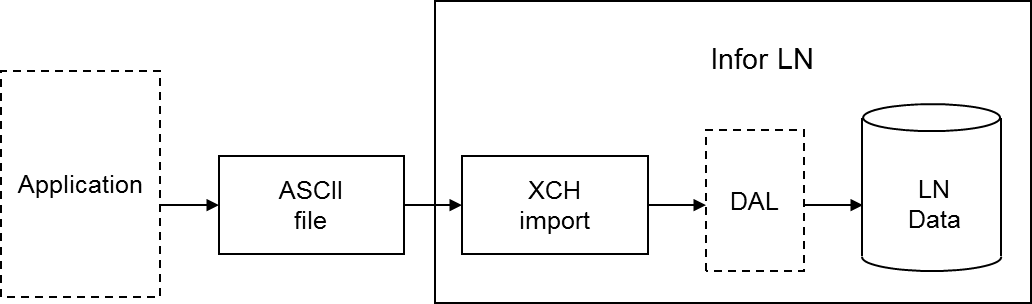
During an Exchange import, you can use all the functionality programmed into the Data Access Layer (DAL). If you use the DAL, Exchange carries out all the constraint checks, integrity checks, and side effects, for example, updates on other tables, that are programmed into the DAL. Database integrity is guaranteed automatically.

Using the DAL reduces the costs of interface development. You can use the DAL to import standard interfaces developed by Infor for partner products, as well as for specific interfaces built by customers, for example, to integrate LN with legacy systems. You can use the DAL in both single site and multisite environments.

The checks or additional actions specified in the DAL are carried out for each row that is imported. Database errors are logged in the same way for DAL and non-DAL import. DAL hook errors are also logged. You can specify whether the DAL property checks are or are not carried out.

If you specify the use of the DAL for a table relation for an import, the dal.new, dal.update, and dal.destroy functions are used instead of db.insert, db.update, and db.delete. You can choose to use DAL for particular tables and not for other tables, therefore, an import batch can contain both types of table relations simultaneously. The import through DAL works for both the import based on audit or indicators (inserts, updates, deletes), and the full import (inserts only).

DAL settings are run time aspects, which means you can change these aspects without having to regenerate the import program. DAL settings are also logged in the log table at batch line level, to enable you to find out what the DAL settings were when the import was run.

Important to realize is that an update through the DAL can result in a number of side effects. Actions performed by the DAL must not be carried out twice. For example, if the DAL updates the available to promise (ATP) quantity for an item when importing order data, the ATP quantity must not be updated in a condition script as well.

For this reason, you must not add any actions in condition scripts, or import additional data, that are already handled in the DAL.
FINANCE: Set Up and Calculate Currency Differences

To set up and calculate currency differences for foreign currencies:

  • Use the Company Parameters (tfgld0503m000) session to specify the profit and loss ledger accounts, 12 profit and loss dimensions, and transaction type for a posting exchange rate differences that is calculated using the FIFO method. To specify this data, use the Currency Diff. FIFO tab. The reports printed from the Print Company Parameters (tfgld0404m000) session, include the Currency Differences FIFO fields.
  • Use the Calculate Currency Differences (tfgld5201m000) session to calculate the currency differences resulting from transactions posted on accounts for which the field Currency Analysis in the session Chart of Accounts (tfgld0508m000) is set to Required.

OPERATIONS: Subcontracting Overview

Companies can decide to involve a subcontractor and subcontract part of their activities. The subcontractor carries out the work and returns the products to your company.

In Infor LN, subcontracting is considered as purchasing labor from a third party. Therefore, if a manufacturer wants to subcontract work, he must generate a purchase order to start the subcontracting process. These are the types of subcontracting:

  • Subcontracting with material flow
    • Operation subcontracting: For operation subcontracting, a part of the production process (one or more operations) is subcontracted.
    • Item subcontracting: For item subcontracting, an item's entire production process is subcontracted. Therefore, it is always used with material flow support.
  • Subcontracting without material flow: The simplest form of subcontracting is to generate a subcontracting purchase order to record the operations outsourced to a subcontractor. The subcontracting purchase order only represents the administrative handling of the subcontracting process. When the subcontracted item is received back from the subcontractor, you must close the subcontracting purchase order, which initiates the production process.
  • Unplanned subcontracting: Unplanned subcontracting is applicable when you subcontract after generating a production order. For unplanned subcontracting, a purchase order is generated from the production order and the material supply lines are populated by Shop Floor Control.
  • Service subcontracting: For service subcontracting, work on an item to be maintained or repaired is subcontracted. This work entails the entire repair process, or only a part of it. Service subcontracting can be used with or without material flow support.

To start the subcontracting process, a purchase order is required.

Previous Article Infor LN & Baan Tips & Tricks for FINANCE: Moving calendar periods
Next Article Infor LN & Baan Tips & Tricks for TECHNOLOGY: Using the Data Access Layer (DAL)
Print
9204 Rate this article:
5.0
Kathy Barthelt

Kathy BartheltKathy Barthelt

Other posts by Kathy Barthelt

Contact author

x

Categories