Please Wait a Moment
X

Infor LX Tips, Infor LN Tips, BPCS Tips, Baan Tips, Infor M3 Tips & Infor ERP News

Crossroads Connections

Infor ERP Tips & News from the Experts

Infor LX | Infor LN | BPCS | Baan | Infor M3

Infor LX & BPCS Materials Tip of the Week: Drop Shipments

George Moroses 0 31202 Article rating: 5.0

Infor LX provides a tightly integrated drop shipment processing capability. The product supports the creation, tracking, and management of customer drop shipment orders via the Order Management, Purchasing, and Billing applications.

The order processing professional initiates drop shipments during customer order creation. You can designate any order line for drop shipment if it meets user-defined drop-ship controls. If you designate a line as a drop-ship line, the system automatically creates a drop-ship request in purchase order processing.

When a buyer responds to a drop-ship request and creates a purchase order, Infor LX

Infor LX & BPCS Finance Tip: AR Aging

George Moroses 0 30080 Article rating: 5.0

An ACR system parameter allows you to specify whether to measure invoice age from the date on which you create the invoice, invoice date, or the date on which the invoice is due. You can set up a separate terms code for each customer on the system to set the basic terms of payment for that customer. For example, this term could specify the number of days an invoice can be due before it is considered past due and the number of days that a discount is available. The system uses the terms code data to...

Infor LN & Baan Finance Tip: What Can You Do in the Financial Statements Module?

Kathy Barthelt 0 70401 Article rating: 5.0

In the Financial Statements module, you can:

  • Define financial statements, and link a structure of child statement accounts and parent statement accounts to these financial statements.
  • Link ledger accounts and/or dimensions to the statement accounts.
  • Link cash flow reasons to cash flow statement accounts.
  • Export financial data to FST reporting tables.
  • Print reports directly, or use the BIRT report functionality to print to PDF, HTML, and export to Excel or Word.


Data drill down in financial statements - You can...

Infor LN & Baan Manufacturing Tip: All About Routings

Kathy Barthelt 0 67991 Article rating: 4.0

The planning data for the method of manufacturing is defined in Routing. A routing consists of operations, with each operation identifying the last to be carried out in a work center and/or on a certain machine defined for a specific site.

Routings can be as follows:

  • Standard Routing - A generic routing that can be attached to multiple items
  • Item specific - A routing that is applied to one item
  • Network routing - A routing containing sequentially ordered operations and parallel operations
  • Order quantity dependent routing - A routing that is defined for a specific quantity of items

You use the Routing module to record routings for manufactured items. You can define the following:

Infor LX & BPCS Manufacturing Tip: Backward Scheduling

George Moroses 0 28531 Article rating: 5.0

Operations are automatically backward scheduled at shop order release time. The backward scheduling algorithm starts with the shop order due date and schedules each operation based upon the standard move and queue times in the routings and the number of days the job is expected to run at standard. The system calculates and stores the operation scheduled start date. The dates may be modified by the shop order maintenance program. The number of days that a job is expected to run an operation is dependent upon the available capacity for that work center and the total hours scheduled for that operation.

The backward scheduling algorithm also considers...

Infor LX & BPCS Tip: What is IDF and how could it make my life easier?

George Moroses 0 30122 Article rating: 5.0

The Infor Development Framework (IDF) re-architects the way a user interacts with the application. IDF provides an efficient, task-oriented process to view application information that is contained within Infor LX. IDF enables users to configure their view of the application data without modifying the core application and its supportability.

The examples below describe how users can configure their display of data and maximize overall productivity:

  • Arrange application information into multiple groupings and sequences that make sense for the job.
  • Hide information that does not apply to a particular job or task.
  • Filter records to show only the information that applies to the job or task that the user is performing.
  • Customize the information for an individual user, for a group of users, or for all users.
     

Infor LN & Baan Tip: Deleting Records

Kathy Barthelt 0 69654 Article rating: 5.0

To improve performance and reduce database growth, deleting records is highly effective. The disadvantage of deleting records is that data is no longer available. Usually, however, not all records need to be saved. For example, line activities are stored by warehouse. Normally, you do not need to keep these records. Therefore, after closing a warehouse order, line activities can be removed. The User's Guide for ERP LN Archiving and the corresponding Baan IV/V Guides describe several sessions you can use to delete old data. Other data such as items and business partners can be reviewed once in a while, after which you can delete the data you no longer need. For every order and contract table, a session is available to archive and delete old orders. In these sessions, you can specify several characteristics to select the orders to be removed, such as date or status. Run these sessions on a regular basis.

Are ERP System Blockages Thwarting Your Progress?

Kathy Barthelt 0 28639 Article rating: 5.0

After a week of blocking the Suez Canal, the now-famous cargo ship, Ever Given has been freed from the 27,000 cubic meters of sand and mud that were surrounding the ship. Supply chains are flowing again. I for one am very glad to hear that the ship has been freed since coffee, toilet paper and a whole host of other items were being held up! In all seriousness, it was and is a crisis that will have ripple effects on the global economy.

As I often do, I started to relate this crisis to the world of ERP that we live in. Although we are not responsible for dealing with a situation like what happened in the Suez Canal, we all deal with problems in our jobs every day. Some of these problems are small, and some are not so small. Some problems are caused by human error, some by prevailing winds that blow us in a particular direction, and some by circumstances out of our control. It is what we do about the problems we encounter that make all the difference. We could bury our heads and hope the problems somehow go away on their own, or we can take action and do something to bring about the change necessary to get past the blockage.

I see “blockages” every day in working with my customers. Sometimes it is a lack of understanding of best practices in a given department, or a reliance on tribal knowledge that determines how and why something is done in the system, or inefficient manual processes destroying a company’s efficiency, or hundreds (or thousands) of customizations standing in the way of an upgrade, or employees labeling an ERP system as “no longer a fit” when their company is only using 10% of the available functionality in the system.

So, maybe today we could focus on what it would take to remove the “blockage” that we have in our way. What benefits could we realize if we worked together to bring about incremental change? Could we actually get that upgrade done? Could we start operating based on industry-leading best practices? Could we increase our market share? Could we decrease our costs and boost our revenue? All of this is possible.

Contact me today so that we can begin to work together to solve the problems that stand in the way of your progress.

solutions@crossroadsrmc.com or 800.762.2077

First4445464749515253Last

Tips:  LX | BPCS | M3

Tips: LN | Baan

Kathy Barthelt

Infor LN & Baan Tips & Tricks for EXECUTIVES

TECHNOLOGY: Using the Data Access Layer (DAL)

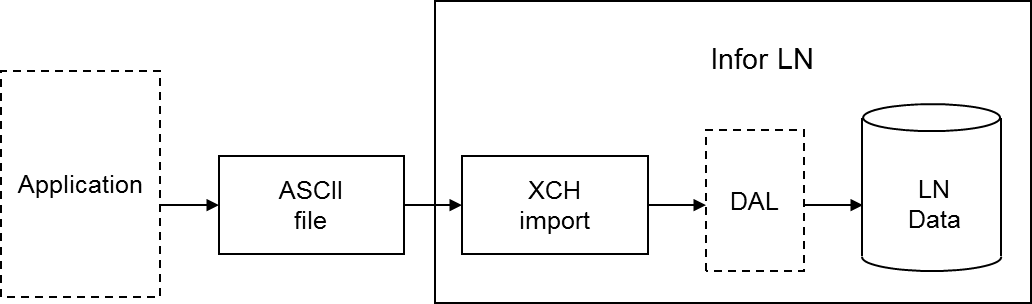
During an Exchange import, you can use all the functionality programmed into the Data Access Layer (DAL). If you use the DAL, Exchange carries out all the constraint checks, integrity checks, and side effects, for example, updates on other tables, that are programmed into the DAL. Database integrity is guaranteed automatically.

Using the DAL reduces the costs of interface development. You can use the DAL to import standard interfaces developed by Infor for partner products, as well as for specific interfaces built by customers, for example, to integrate LN with legacy systems. You can use the DAL in both single site and multisite environments.

The checks or additional actions specified in the DAL are carried out for each row that is imported. Database errors are logged in the same way for DAL and non-DAL import. DAL hook errors are also logged. You can specify whether the DAL property checks are or are not carried out.

If you specify the use of the DAL for a table relation for an import, the dal.new, dal.update, and dal.destroy functions are used instead of db.insert, db.update, and db.delete. You can choose to use DAL for particular tables and not for other tables, therefore, an import batch can contain both types of table relations simultaneously. The import through DAL works for both the import based on audit or indicators (inserts, updates, deletes), and the full import (inserts only).

DAL settings are run time aspects, which means you can change these aspects without having to regenerate the import program. DAL settings are also logged in the log table at batch line level, to enable you to find out what the DAL settings were when the import was run.

Important to realize is that an update through the DAL can result in a number of side effects. Actions performed by the DAL must not be carried out twice. For example, if the DAL updates the available to promise (ATP) quantity for an item when importing order data, the ATP quantity must not be updated in a condition script as well.

For this reason, you must not add any actions in condition scripts, or import additional data, that are already handled in the DAL.
FINANCE: Set Up and Calculate Currency Differences

To set up and calculate currency differences for foreign currencies:

  • Use the Company Parameters (tfgld0503m000) session to specify the profit and loss ledger accounts, 12 profit and loss dimensions, and transaction type for a posting exchange rate differences that is calculated using the FIFO method. To specify this data, use the Currency Diff. FIFO tab. The reports printed from the Print Company Parameters (tfgld0404m000) session, include the Currency Differences FIFO fields.
  • Use the Calculate Currency Differences (tfgld5201m000) session to calculate the currency differences resulting from transactions posted on accounts for which the field Currency Analysis in the session Chart of Accounts (tfgld0508m000) is set to Required.

OPERATIONS: Subcontracting Overview

Companies can decide to involve a subcontractor and subcontract part of their activities. The subcontractor carries out the work and returns the products to your company.

In Infor LN, subcontracting is considered as purchasing labor from a third party. Therefore, if a manufacturer wants to subcontract work, he must generate a purchase order to start the subcontracting process. These are the types of subcontracting:

  • Subcontracting with material flow
    • Operation subcontracting: For operation subcontracting, a part of the production process (one or more operations) is subcontracted.
    • Item subcontracting: For item subcontracting, an item's entire production process is subcontracted. Therefore, it is always used with material flow support.
  • Subcontracting without material flow: The simplest form of subcontracting is to generate a subcontracting purchase order to record the operations outsourced to a subcontractor. The subcontracting purchase order only represents the administrative handling of the subcontracting process. When the subcontracted item is received back from the subcontractor, you must close the subcontracting purchase order, which initiates the production process.
  • Unplanned subcontracting: Unplanned subcontracting is applicable when you subcontract after generating a production order. For unplanned subcontracting, a purchase order is generated from the production order and the material supply lines are populated by Shop Floor Control.
  • Service subcontracting: For service subcontracting, work on an item to be maintained or repaired is subcontracted. This work entails the entire repair process, or only a part of it. Service subcontracting can be used with or without material flow support.

To start the subcontracting process, a purchase order is required.

Previous Article Infor LN & Baan Tips & Tricks for FINANCE: Moving calendar periods
Next Article Infor LN & Baan Tips & Tricks for TECHNOLOGY: Using the Data Access Layer (DAL)
Print
2189 Rate this article:
5.0
Kathy Barthelt

Kathy BartheltKathy Barthelt

Other posts by Kathy Barthelt

Contact author

x

Categories