Please Wait a Moment
X

Infor LX Tips, Infor LN Tips, BPCS Tips, Baan Tips, Infor M3 Tips & Infor ERP News

Crossroads Connections

Infor ERP Tips & News from the Experts

Infor LX | Infor LN | BPCS | Baan | Infor M3

Infor LX & BPCS: Waste in Manufacturing

George Moroses 0 31881 Article rating: 5.0

In manufacturing, waste is anything that doesn’t add value to or benefit the end customer. Reducing waste enables manufacturers to save money and increase productivity. Where is the waste happening in your processes?

How often is your department spending time and resources on the following tasks?...

Infor LX & BPCS Tip: Overhead Costs - CST120D1

George Moroses 0 30297 Article rating: 4.0

Use this program to enter period overhead expenses to distribute to various work centers. You can set up this overhead cost allocation on either a per-hour or a per-piece basis, depending on the overhead allocation type specified for each work center on the Work Center Maintenance screen, CAP100D2-01. The system spreads the amounts entered across all shop orders posted by Shop Floor Posting, SFC600, or Production Reporting, JIT600, when you run Overhead Cost Allocation, CST510. The system stores allocated overhead in the Labor Ticket file, FLT, and updates actual item cost when you run Shop Order Close and Post, CST900.

Access: Menu CST

Infor LX & BPCS: BIG DATA - Keeping Track of Key Metrics

George Moroses 0 35601 Article rating: 5.0

In order to communicate effectively as a team, everyone needs to speak the same language and operate off the same playbook. If decisions are made based on the data or the view of data that individuals are maintaining through their own spreadsheets or other data silos, then communication is negatively impacted.

Manufacturers need to review large amounts of data every day, making it difficult to keep track of key metrics within your department.

That’s where Crossroads RMC’s Analytics Dashboard solution comes in. Our Analytics Dashboard was developed to make tasks easier by putting all of the key information in one convenient location so you can view all of your crucial data in real-time. 

With powerful dashboards, you can...

Infor LX & BPCS Tip: Transaction History – Did you know?

George Moroses 0 33410 Article rating: 3.5

Did you know that the system stores a record of every inventory transaction and makes them available for inquiries and reports? Transaction history is available for immediate inquiry by item, or by item and location in the Material Status Inquiry program. The inventory transaction record holds data such as the quantity, date, reference number, cost/value, transaction type, scheduled date, and master reference number, lot numbers, and warehouse/location information.

Infor LN & Baan Tip: How to deal with data growth of your ERP system…

Kathy Barthelt 0 169840 Article rating: 5.0

Spending time on managing ERP data can deliver huge benefits, not just in reducing storage costs, but also in improving the experience of business users. Proactively managing application data also helps accelerate key business processes which has a positive impact on customers, suppliers, and partners. Use these solutions to reduce the data growth and disk storage used on your system:

• Use database compression. See...

Check-Ups are important… Including Infor LN & Baan ERP Check-Ups!

Kathy Barthelt 0 191827 Article rating: 5.0

What would you say to someone if they never went to a doctor for a check-up, or never took their car in for regular maintenance, like an oil change?

You might say that they were asking for problems, right? The point of those check-ups is to catch a problem early, or better yet before it occurs. Going for check-ups gives you the peace of mind that things are running well and if an issue is identified early enough you can reduce overall risk. Regular check-ups can help reduce out-of-pocket expenses over time.

What about Finance, Manufacturing, Supply Chain, and Company-wide Check-Ups for your Infor ERP system? What will happen if you NEVER hit pause?

Here are some questions by department to consider.

Finance:...

Is your Baan or Infor LN system STILL not integrated with UPS and FedEx?

Kathy Barthelt 0 27162 Article rating: 2.5

It's hard to find a manufacturing article, or talk to a manufacturer for that matter without hearing about the importance of efficiency. In fact, 92% of manufacturers reported that their most significant business imperative is improving efficiency, according to a major new report published by The Manufacturer and IBM. Improving efficiency cuts costs, improves throughput, and ultimately improves competitiveness.

One way to improve efficiency is to eliminate the redundant process of manually keying data from Baan and Infor LN to your third-party logistics systems such as UPS or FedEx. Third-party systems need to know what you want shipped, how it is being shipped, the weight, quantity, etc. Once the shipment is ready, the tracking number, freight cost, and other information need to be entered into Baan and Infor LN in order to process your sales orders and ultimately invoice your customer. This process is time-consuming, error-prone, and causes delays in shipping and invoicing.

Why waste time and energy when the entire process can be automated on-premise or cloud with RMCship?

RMCship provides a complete one-way or two-way communication channel between Baan IV, Baan V, and Infor LN to UPS Worldship & FedEx Ship Manager.

TO UPS & FedEx -
RMCship....

Infor LN & Baan Tip: Rework of Serialized Items

Kathy Barthelt 0 154219 Article rating: 5.0

There are two options for rework of serialized items. One is to define the serial numbers upfront by defining the as-built serial header before releasing the rework order. The second option is to not define serials in the as-built header and instead, the serials are defined through issuing the material to the rework order. Manually entering the serial number after release of the rework order is not supported.

First4243444547495051Last

Tips:  LX | BPCS | M3

Tips: LN | Baan

Kathy Barthelt

Infor LN & Baan Tips & Tricks for EXECUTIVES

TECHNOLOGY: Using the Data Access Layer (DAL)

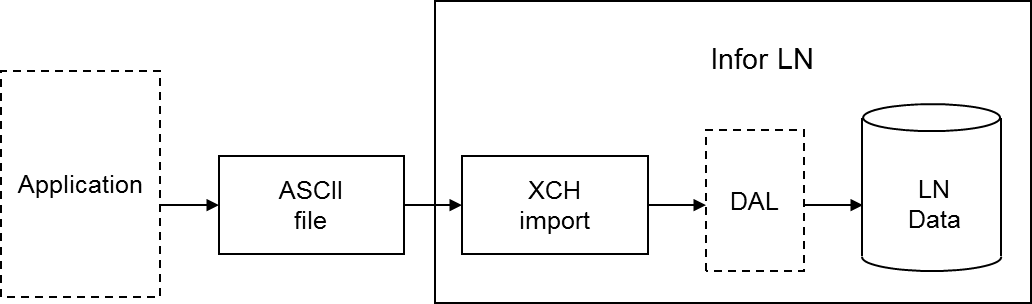
During an Exchange import, you can use all the functionality programmed into the Data Access Layer (DAL). If you use the DAL, Exchange carries out all the constraint checks, integrity checks, and side effects, for example, updates on other tables, that are programmed into the DAL. Database integrity is guaranteed automatically.

Using the DAL reduces the costs of interface development. You can use the DAL to import standard interfaces developed by Infor for partner products, as well as for specific interfaces built by customers, for example, to integrate LN with legacy systems. You can use the DAL in both single site and multisite environments.

The checks or additional actions specified in the DAL are carried out for each row that is imported. Database errors are logged in the same way for DAL and non-DAL import. DAL hook errors are also logged. You can specify whether the DAL property checks are or are not carried out.

If you specify the use of the DAL for a table relation for an import, the dal.new, dal.update, and dal.destroy functions are used instead of db.insert, db.update, and db.delete. You can choose to use DAL for particular tables and not for other tables, therefore, an import batch can contain both types of table relations simultaneously. The import through DAL works for both the import based on audit or indicators (inserts, updates, deletes), and the full import (inserts only).

DAL settings are run time aspects, which means you can change these aspects without having to regenerate the import program. DAL settings are also logged in the log table at batch line level, to enable you to find out what the DAL settings were when the import was run.

Important to realize is that an update through the DAL can result in a number of side effects. Actions performed by the DAL must not be carried out twice. For example, if the DAL updates the available to promise (ATP) quantity for an item when importing order data, the ATP quantity must not be updated in a condition script as well.

For this reason, you must not add any actions in condition scripts, or import additional data, that are already handled in the DAL.
FINANCE: Set Up and Calculate Currency Differences

To set up and calculate currency differences for foreign currencies:

  • Use the Company Parameters (tfgld0503m000) session to specify the profit and loss ledger accounts, 12 profit and loss dimensions, and transaction type for a posting exchange rate differences that is calculated using the FIFO method. To specify this data, use the Currency Diff. FIFO tab. The reports printed from the Print Company Parameters (tfgld0404m000) session, include the Currency Differences FIFO fields.
  • Use the Calculate Currency Differences (tfgld5201m000) session to calculate the currency differences resulting from transactions posted on accounts for which the field Currency Analysis in the session Chart of Accounts (tfgld0508m000) is set to Required.

OPERATIONS: Subcontracting Overview

Companies can decide to involve a subcontractor and subcontract part of their activities. The subcontractor carries out the work and returns the products to your company.

In Infor LN, subcontracting is considered as purchasing labor from a third party. Therefore, if a manufacturer wants to subcontract work, he must generate a purchase order to start the subcontracting process. These are the types of subcontracting:

  • Subcontracting with material flow
    • Operation subcontracting: For operation subcontracting, a part of the production process (one or more operations) is subcontracted.
    • Item subcontracting: For item subcontracting, an item's entire production process is subcontracted. Therefore, it is always used with material flow support.
  • Subcontracting without material flow: The simplest form of subcontracting is to generate a subcontracting purchase order to record the operations outsourced to a subcontractor. The subcontracting purchase order only represents the administrative handling of the subcontracting process. When the subcontracted item is received back from the subcontractor, you must close the subcontracting purchase order, which initiates the production process.
  • Unplanned subcontracting: Unplanned subcontracting is applicable when you subcontract after generating a production order. For unplanned subcontracting, a purchase order is generated from the production order and the material supply lines are populated by Shop Floor Control.
  • Service subcontracting: For service subcontracting, work on an item to be maintained or repaired is subcontracted. This work entails the entire repair process, or only a part of it. Service subcontracting can be used with or without material flow support.

To start the subcontracting process, a purchase order is required.

Previous Article Infor LN & Baan Tips & Tricks for FINANCE: Moving calendar periods
Next Article Infor LN & Baan Tips & Tricks for TECHNOLOGY: Using the Data Access Layer (DAL)
Print
2189 Rate this article:
5.0
Kathy Barthelt

Kathy BartheltKathy Barthelt

Other posts by Kathy Barthelt

Contact author

x

Categories