Infor ERP Tips and Infor ERP News for Infor LX, BPCS, Infor ERP LX, Infor LN, Infor ERP LN, Baan, Infor M3, and Movex

Please Wait a Moment
X

Infor LX Tips, Infor LN Tips, BPCS Tips, Baan Tips, Infor M3 Tips & Infor ERP News

Crossroads Connections

Infor ERP Tips & News from the Experts

Infor LX | Infor LN | BPCS | Baan | Infor M3

Infor ERP LX / BPCS Expert Help Desk Service

George Moroses 0 381 Article rating: 5.0

Crossroads RMC has fine-tuned our Technical Help Desk Service to meet specific job requirements. Our service delivers product-level support and development assistance with significant cost savings compared to traditional models. Our Help Desk is a tailored service that provides a dedicated ERP LX/BPCS technical resource, ensuring our support precisely aligns with your needs for a more efficient and effective solution. 

Key Features:

  • Flexible Hours: Tailored to fit your budget and requirements.
  • Duration Options: Choose from 3, 6, 9, or 12-month agreements.
  • Remote Accessibility: Primarily remote support with on-site options for comprehensive assistance.
  • Expertise Spectrum: Includes RPG proficiency, robust documentation, design skills, IBM i system knowledge, job scheduling, SQL expertise, CL development, and more.
  • Scope: Focuses on technical support and development, with application support available upon request.
     

What's NEXT together.
Schedule a brief consultation with Crossroads RMC to discuss your technical support and development needs. We’ll help define the right scope, duration, and expertise to align with your goals and budget.

Let’s design a Help Desk solution that fits your business.
Contact Crossroads RMC at 800.762.2077 to get started.

Infor LX/BPCS Tips & Tricks for TECHNOLOGY: Library BMRTOOLS contains the following commands

George Moroses 0 747 Article rating: 5.0

INSTALLBMR

  • Installs BMR Explosions from *SAVF or *LIB
  • Installs objects after backing up replaced objects
  • Installs source after backing up replaced source
  • Installs Webtop Metadata
  • Installs /InforBMR subdirectories
  • Writes all activity to log file and spooled file report
  • Optionally runs DBUPDATE command

DBUPDATE

  • Installs new or updates existing database tables, views, indexes, triggers, procedures, logical files.
  • Installs source for above objects
  • Sets authorities to replaced objects based on previous object settings
  • Sets journalling on replaced objects based on previous object settings
  • Installs Priming Data
  • Installs SSAOVR updates
  • Installs message file updates for core message files
  • Installs message file updates for NLV message files if included in explosion

This enhancement reduces the time required to install BMR Explosions. There still may be manual steps required after the processing completes, but the overall time required is dramatically reduced.

Infor LX/BPCS Tips & Tricks for OPERATIONS: Order Entry Action Code / Function Key Security

George Moroses 0 753 Article rating: 5.0

Access to Order Entry/Maintenance has traditionally been controlled by using LX Program Security to grant or remove authority to ORD700. LX Company Security and LX Warehouse Security further control which transactions a user is allowed to create or maintain. A separate 8.4.2 enhancement allows security managers to control which types of transactions a user is allowed to create or maintain, through LX Order Type Security and LX Order Class Security. Building on these LX transaction security features, the Order Entry Action Code/Function Key Security enhancement allows security managers to further control what actions a user can take regarding an authorized transaction.

Security managers can now control the actions each user is allowed to be restricted from in the Order Entry job stream. The benefit is easily illustrated by some examples:

  • Regular users can be allowed to create and revise customer orders but are restricted from deleting an order.
  • Salespersons can be authorized to full authority with quotes and can be allowed to create customer orders but not to revise or delete them.
  • Or, salespersons could be restricted from 1=Create in Order Directory, with the result that they could only create an order by copying a quote, if they are authorized to 3=Copy in Quote Directory.
  • Only selected customer service users can be allowed to create RMAs, by controlling 1=Create in RMA Directory. A different group of customer service users who handle the actual returns can be authorized to create the return orders or credit memos from those RMAs, by controlling 3=Copy in RMA Directory.

Infor LX/BPCS Tips & Tricks for FINANCE: Release Holds from IDF Order Inquiry Host Job

George Moroses 0 363 Article rating: 5.0

This enhancement provides the ability for IDF Order Inquiry to release order holds via a host job.

LX IDF Order Inquiry displays numerous details about an order, order lines, special lines and related files. An Order Inquiry user can copy, modify or delete an order through WebTop calls to ORD700 Order Maintenance, if authorized. Among the many details Order Inquiry also lists the Hold Codes for customer hold, credit hold, user hold, margin hold, and credit card hold. This enhancement provides the capability to release holds through a host job function that executes ORD680B, Order Hold Mass Release.   Batch Hold Release host job has been added to IDF Order Inquiry. The Order Inquiry user must be authorized to ORD680 in LX program security, SYS600.

ORD680 has been modified to accept parameters for multiple executions by host job. The user can release holds for a single order, a range of orders, or for multiple individually selected orders.

The following hold releases can be requested:

  • Credit hold – orders on credit hold by the system (01) or by a user (02) are released from credit hold.
  • Customer hold – orders on customer hold are released.
  • User hold – orders on user hold are released.
  • Margin hold – ORD680 re-evaluates orders or order lines that are on margin hold.
245678910Last

Tips:  LX | BPCS | M3

Tips: LN | Baan

Kathy Barthelt

Infor LN & Baan Tips & Tricks for EXECUTIVES

TECHNOLOGY: Using the Data Access Layer (DAL)

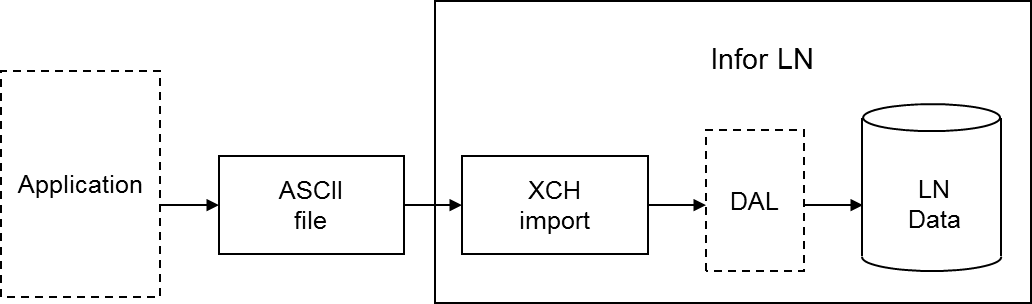
During an Exchange import, you can use all the functionality programmed into the Data Access Layer (DAL). If you use the DAL, Exchange carries out all the constraint checks, integrity checks, and side effects, for example, updates on other tables, that are programmed into the DAL. Database integrity is guaranteed automatically.

Using the DAL reduces the costs of interface development. You can use the DAL to import standard interfaces developed by Infor for partner products, as well as for specific interfaces built by customers, for example, to integrate LN with legacy systems. You can use the DAL in both single site and multisite environments.

The checks or additional actions specified in the DAL are carried out for each row that is imported. Database errors are logged in the same way for DAL and non-DAL import. DAL hook errors are also logged. You can specify whether the DAL property checks are or are not carried out.

If you specify the use of the DAL for a table relation for an import, the dal.new, dal.update, and dal.destroy functions are used instead of db.insert, db.update, and db.delete. You can choose to use DAL for particular tables and not for other tables, therefore, an import batch can contain both types of table relations simultaneously. The import through DAL works for both the import based on audit or indicators (inserts, updates, deletes), and the full import (inserts only).

DAL settings are run time aspects, which means you can change these aspects without having to regenerate the import program. DAL settings are also logged in the log table at batch line level, to enable you to find out what the DAL settings were when the import was run.

Important to realize is that an update through the DAL can result in a number of side effects. Actions performed by the DAL must not be carried out twice. For example, if the DAL updates the available to promise (ATP) quantity for an item when importing order data, the ATP quantity must not be updated in a condition script as well.

For this reason, you must not add any actions in condition scripts, or import additional data, that are already handled in the DAL.
FINANCE: Set Up and Calculate Currency Differences

To set up and calculate currency differences for foreign currencies:

  • Use the Company Parameters (tfgld0503m000) session to specify the profit and loss ledger accounts, 12 profit and loss dimensions, and transaction type for a posting exchange rate differences that is calculated using the FIFO method. To specify this data, use the Currency Diff. FIFO tab. The reports printed from the Print Company Parameters (tfgld0404m000) session, include the Currency Differences FIFO fields.
  • Use the Calculate Currency Differences (tfgld5201m000) session to calculate the currency differences resulting from transactions posted on accounts for which the field Currency Analysis in the session Chart of Accounts (tfgld0508m000) is set to Required.

OPERATIONS: Subcontracting Overview

Companies can decide to involve a subcontractor and subcontract part of their activities. The subcontractor carries out the work and returns the products to your company.

In Infor LN, subcontracting is considered as purchasing labor from a third party. Therefore, if a manufacturer wants to subcontract work, he must generate a purchase order to start the subcontracting process. These are the types of subcontracting:

  • Subcontracting with material flow
    • Operation subcontracting: For operation subcontracting, a part of the production process (one or more operations) is subcontracted.
    • Item subcontracting: For item subcontracting, an item's entire production process is subcontracted. Therefore, it is always used with material flow support.
  • Subcontracting without material flow: The simplest form of subcontracting is to generate a subcontracting purchase order to record the operations outsourced to a subcontractor. The subcontracting purchase order only represents the administrative handling of the subcontracting process. When the subcontracted item is received back from the subcontractor, you must close the subcontracting purchase order, which initiates the production process.
  • Unplanned subcontracting: Unplanned subcontracting is applicable when you subcontract after generating a production order. For unplanned subcontracting, a purchase order is generated from the production order and the material supply lines are populated by Shop Floor Control.
  • Service subcontracting: For service subcontracting, work on an item to be maintained or repaired is subcontracted. This work entails the entire repair process, or only a part of it. Service subcontracting can be used with or without material flow support.

To start the subcontracting process, a purchase order is required.

Previous Article Infor LN & Baan Tips & Tricks for FINANCE: Moving calendar periods
Next Article Infor LN & Baan Tips & Tricks for TECHNOLOGY: Using the Data Access Layer (DAL)
Print
3574 Rate this article:
5.0
Kathy Barthelt

Kathy BartheltKathy Barthelt

Other posts by Kathy Barthelt

Contact author

x

Categories