Please Wait a Moment
X

Infor LX Tips, Infor LN Tips, BPCS Tips, Baan Tips, Infor M3 Tips & Infor ERP News

Crossroads Connections

Infor ERP Tips & News from the Experts

Infor LX | Infor LN | BPCS | Baan | Infor M3

Baan/LN Tip of the Week: Why Would You Buy a BMW, But Use a Scooter?

Kathy Barthelt 0 75792 Article rating: No rating

Congratulations! You bought that shiny, new car! It has all the features you can possibly want and goes a million miles an hour. It can take you anywhere your heart desires…….but you rely on a manual scooter to get you around. You know, the kind you had when you were a kid…BEFORE you could drive…before you could afford the BMW. Make sense? Uh... no.

You’d never do this, right? So, why are you doing this with the ERP system that runs your business? Why are you relying on spreadsheets and separate little Access databases to record and store the information that is the most critical to your business when you have an ERP system that is meant for this? Why continue to plod along at a snail's pace when you have the tools to take your business to the next level?

Your ERP system is your BMW. Use it. See what it can do for you. Think you’ve used it to its potential? Unlikely. We’ve helped customers breathe new life into their EXISTING ERP version all by unlocking functionality for them that was already there and ready to use! We’ve also helped by offering add-ons to the ERP that can make your productivity skyrocket.

Ask us how. We’ve got an extra set of keys to the BMW in case you lost yours.

Optimize Your Manufacturing Today!

BPCS/LX TIP OF THE WEEK: 6 POWERFUL STEPS TO WIN WITH AUTOMATION:

Anthony Etzel 0 33953 Article rating: No rating
  1. Eliminate paper shop packet and distribution of the paperwork to the shop floor.     
  2. Eliminate manual (paper-based) recording activities and the need to key in the transactions.
  3. Easy electronic scheduling by sequence and changing job priorities.
  4. Evaluate differences using actual times compared to standards.
  5. Improve data accuracy and eliminate the need to chase and fix errors.
  6. Practice real-time data reporting to monitor efficiencies and identify problems as they occur.

Baan/LN Tip of the Week: 6 Powerful Steps to Win With Automation:

Kathy Barthelt 0 75014 Article rating: No rating
  1. Eliminate paper shop packet and distribution of the paperwork to the shop floor.  
  2. Eliminate manual (paper-based) recording activities and the need to key in the transactions.
  3. Easy electronic scheduling by sequence and changing job priorities.
  4. Evaluate differences using actual times compared to standards.
  5. Improve data accuracy and eliminate the need to chase and fix errors.
  6. Practice real-time data reporting to monitor efficiencies and identify problems as they occur.

Duncan – Out With the Old In With the New… MES

Anthony Etzel 0 19395 Article rating: No rating
Duncan Enterprises, Inc., a leading designer, manufacturer, and distributor of ceramics, arts and crafts, fabric dying and painting products, fashion arts, and home decor DIY products, has selected Crossroads MES to implement throughout all of their shop floor departments and work centers. Through this implementation, Duncan intends to replace their existing Code Soft label software and Shop 2000 Reports. In addition, they expect to eliminate manual tracking of performance measurements and labor. With Crossroads MES, all shop floor paperwork will be distributed in a paperless fashion and all shop floor activities and production receipts will be captured. In addition, real time shop floor status information will be available for reporting across the enterprise.

Baan/LN Tip of the Week: Transaction Accounts – Commissions

Kathy Barthelt 0 78782 Article rating: No rating

In Baan IV, if a link with Financials exists for commissions and rebates, invoices are created directly in the Commission Control System (CMS) module and posted to Financials. As a result, users must specify the ledger accounts that are used for posting commissions and rebates in the Maintain Commission/Rebate Transaction Accounts (tdcms2101m000) session.

In LN, the Maintain Commission/Rebate Transaction Accounts (tdcms2101m000) session is removed from the Commission Control System (CMS) module, because invoices are no longer created directly in the Commission Control System module.

BPCS/LX Tip of the Week: Vendor Maintenance Security Option for Company or Program

Anthony Etzel 0 40666 Article rating: No rating

The Vendor Maintenance Security option is in the Purchasing System Parameters program(PUR820D). The purpose of this program is to provide an additional security option for VendorMaster Maintenance. To access this program, the user selects the Parameters Generation option from the System Functions menu, SYS500. The user can modify the Vendor Maintenance Security parameter from PUR820D-04 in the Purchasing System Parameters program.This feature provides an additional security parameter for Vendor Master Maintenance.

Optimize Your Manufacturing Today!

BPCS/LX Tip of the Week: 6 Powerful Steps to Win With Automation

Anthony Etzel 0 37170 Article rating: No rating

1. Eliminate paper shop packet and distribution of the paperwork to the shop floor.  

2. Eliminate manual (paper-based) recording activities and the need to key in the transactions.

3. Easy electronic scheduling by sequence and changing job priorities.

4. Evaluate differences using actual times compared to standards.

5. Improve data accuracy and eliminate the need to chase and fix errors.

6. Practice Real-Time data reporting to monitor efficiencies and identify problems as they occur.

Optimize Your Manufacturing Today!

Baan/LN Tip of the Week: GRINYA Reconciliation – What Could Go Wrong?

Kathy Barthelt 0 80082 Article rating: No rating

One common GRINYA issue would be incorrectly entered Integration Setups.

Check the Baan or LN manual for recommended Integration setups. If such a mistake were to occur, it is important to know for what period of time the Integration was in error.

To ensure, it’s recommended that the Integrations Setup tables should be audited either through Baan/LN or Database Auditing. Corrections can be quickly calculated when an exact timeframe can be determined.

Optimize Your Manufacturing Today!

First9091929395979899Last

Tips:  LX | BPCS | M3

Tips: LN | Baan

Kathy Barthelt

Infor LN & Baan Tips & Tricks for EXECUTIVES

TECHNOLOGY: Using the Data Access Layer (DAL)

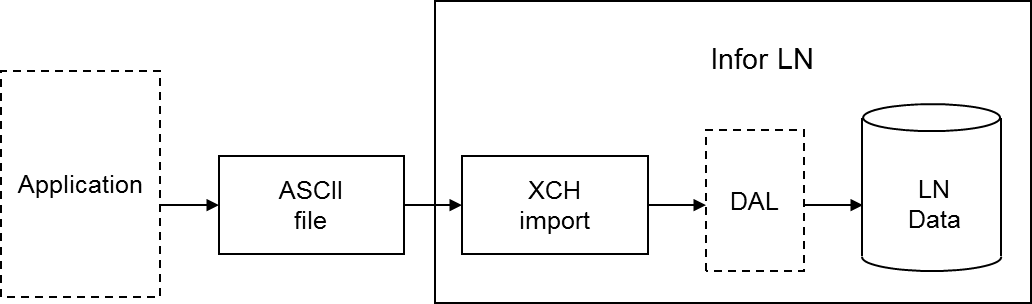
During an Exchange import, you can use all the functionality programmed into the Data Access Layer (DAL). If you use the DAL, Exchange carries out all the constraint checks, integrity checks, and side effects, for example, updates on other tables, that are programmed into the DAL. Database integrity is guaranteed automatically.

Using the DAL reduces the costs of interface development. You can use the DAL to import standard interfaces developed by Infor for partner products, as well as for specific interfaces built by customers, for example, to integrate LN with legacy systems. You can use the DAL in both single site and multisite environments.

The checks or additional actions specified in the DAL are carried out for each row that is imported. Database errors are logged in the same way for DAL and non-DAL import. DAL hook errors are also logged. You can specify whether the DAL property checks are or are not carried out.

If you specify the use of the DAL for a table relation for an import, the dal.new, dal.update, and dal.destroy functions are used instead of db.insert, db.update, and db.delete. You can choose to use DAL for particular tables and not for other tables, therefore, an import batch can contain both types of table relations simultaneously. The import through DAL works for both the import based on audit or indicators (inserts, updates, deletes), and the full import (inserts only).

DAL settings are run time aspects, which means you can change these aspects without having to regenerate the import program. DAL settings are also logged in the log table at batch line level, to enable you to find out what the DAL settings were when the import was run.

Important to realize is that an update through the DAL can result in a number of side effects. Actions performed by the DAL must not be carried out twice. For example, if the DAL updates the available to promise (ATP) quantity for an item when importing order data, the ATP quantity must not be updated in a condition script as well.

For this reason, you must not add any actions in condition scripts, or import additional data, that are already handled in the DAL.
FINANCE: Set Up and Calculate Currency Differences

To set up and calculate currency differences for foreign currencies:

  • Use the Company Parameters (tfgld0503m000) session to specify the profit and loss ledger accounts, 12 profit and loss dimensions, and transaction type for a posting exchange rate differences that is calculated using the FIFO method. To specify this data, use the Currency Diff. FIFO tab. The reports printed from the Print Company Parameters (tfgld0404m000) session, include the Currency Differences FIFO fields.
  • Use the Calculate Currency Differences (tfgld5201m000) session to calculate the currency differences resulting from transactions posted on accounts for which the field Currency Analysis in the session Chart of Accounts (tfgld0508m000) is set to Required.

OPERATIONS: Subcontracting Overview

Companies can decide to involve a subcontractor and subcontract part of their activities. The subcontractor carries out the work and returns the products to your company.

In Infor LN, subcontracting is considered as purchasing labor from a third party. Therefore, if a manufacturer wants to subcontract work, he must generate a purchase order to start the subcontracting process. These are the types of subcontracting:

  • Subcontracting with material flow
    • Operation subcontracting: For operation subcontracting, a part of the production process (one or more operations) is subcontracted.
    • Item subcontracting: For item subcontracting, an item's entire production process is subcontracted. Therefore, it is always used with material flow support.
  • Subcontracting without material flow: The simplest form of subcontracting is to generate a subcontracting purchase order to record the operations outsourced to a subcontractor. The subcontracting purchase order only represents the administrative handling of the subcontracting process. When the subcontracted item is received back from the subcontractor, you must close the subcontracting purchase order, which initiates the production process.
  • Unplanned subcontracting: Unplanned subcontracting is applicable when you subcontract after generating a production order. For unplanned subcontracting, a purchase order is generated from the production order and the material supply lines are populated by Shop Floor Control.
  • Service subcontracting: For service subcontracting, work on an item to be maintained or repaired is subcontracted. This work entails the entire repair process, or only a part of it. Service subcontracting can be used with or without material flow support.

To start the subcontracting process, a purchase order is required.

Previous Article Infor LN & Baan Tips & Tricks for FINANCE: Moving calendar periods
Next Article Infor LN & Baan Tips & Tricks for TECHNOLOGY: Using the Data Access Layer (DAL)
Print
2189 Rate this article:
5.0
Kathy Barthelt

Kathy BartheltKathy Barthelt

Other posts by Kathy Barthelt

Contact author

x

Categories