Please Wait a Moment
X

Infor LX Tips, Infor LN Tips, BPCS Tips, Baan Tips, Infor M3 Tips & Infor ERP News

Crossroads Connections

Infor ERP Tips & News from the Experts

Infor LX | Infor LN | BPCS | Baan | Infor M3

Crossroads RMC Forms Strategic Partnership with CTN Global

Crossroads RMC 0 40423 Article rating: 5.0

Crossroads RMC is proud to announce a new partnership with CTN Global. CTN Global is a leading provider of ERP implementation services in Latin America and Infor’s 2019 Cloud Partner of the Year.

This partnership extends Crossroads RMC customer service and support to our Infor LN and Infor LX customers in Latin America. CTN Global has over 20 years of experience in the ERP space, and over 100 clients globally. CTN Global is headquartered in Columbia with other locations in the Iberian Peninsula and Venezuela.

Why should you look at OTTO? Let’s see what an OTTO customer has to say:

Anthony Etzel 0 35557 Article rating: 5.0

"When first introduced to OTTO, for on-time ordering, you could not prove to me that there was a better system out there than what we already had. Boy what a big wakeup call! Being in a very option intensive business and the economy in a very flat or negative state, OTTO is the BEST tool to quickly respond to a customer’s needs TODAY. When Millions of dollars are at stake each month, we have to be better prepared to meet the task at hand with fewer people. OTTO is really doing this for us!  What normally took us hours or days to identify several indented bill of material shortages now only takes a few moments with the OTTO program. What this really means is that, we do not have to wait for MRP to run each week to plan and reschedule orders. This can be done today!  What I’m really saying is that, we can advise Purchasing and Scheduling TODAY without waiting for TOMORROW.  We are now able to ship DOLLARS this month and satisfy our CUSTOMERS. Without OTTO in some cases, the Customer would have to wait until next month and potential revenue dollars lost for the month."  Gary Hawk, Planning Manager - construction equipment

Infor LX / BPCS Tip of the Week: Control Date Lead Times in LX

George Moroses 0 59251 Article rating: 5.0
  • Control Date Lead Times – LX provides five separate Control Date Lead Time fields so you can specify additional lead time values for Shop Orders, Purchase Orders and Planned and Firm Planned orders. Each Control Lead Time Date represents additional time (days) required at each step in the process that needs more time (Quarantine, Stabilize), that is to say, when a component is due, and when it can be used. (working with an aerospace  precision bearing manufacturer, I had to account for the QA requirement that no measurements could be taken until the parts had been “soaked” (stored) in an atmospheric controlled environment (72 degrees, and controlled humidity) for 24 hours. This requirement added one full day of lead time between each machining operation) The MPS/MRP Generation program, as well as programs that Shop Order Material Allocation records use the five control date lead times to adjust component required dates to function in the same way as the BOM Offset Lead Time.
     
  • All programs that create MRP Planned Orders, MRP Firm Planned Orders, Shop Orders, and Purchase Orders call the Control Date Calculation program (MRP515B) to establish all five control dates. A Control Lead Time Date is used to adjust the component Required Dates data in the Material Requirements file (KMR), based on planned orders for a parent, and the FMA Required Dates data, based on shop order release dates for a parent.

Flexfab Goes Live with Crossroads Data Collection in China

Kathy Barthelt 0 36153 Article rating: 5.0

Flexfab Horizons International, Inc, a global leader in the manufacturing of high performance silicone and other advanced polymer products, goes live with Crossroads RMC’s Data Collection Solution, Web Collect, formerly RMC3, in their China facility. This represents the 3rd data collection go live for the Crossroads data collection solution within Flexfab with the US and UK going live in 2018. All installations focused on improvements in warehouse management in Infor LN 10.6. Applications implemented included Receiving, Inspections/Approvals, Putaway, Stock Transfers and Stock Inquiry.

Crossroads RMC is proud to partner with an American manufacturer of diagnostic healthcare

Integrated freight management solution for Infor LN 10.5.2 Cloud implementation

Kathy Barthelt 0 41654 Article rating: 5.0

An American manufacturer of diagnostic healthcare has selected the RMCship solution from Crossroads RMC to streamline their shipping process on Infor LN 10.5.2 in the cloud. They went live with one site running RMCship in June of 2019 and 3 more sites to follow by end of year. They will use RMCship to increase accuracy by eliminating manual steps and streamlining their operations.

Hunter Douglas Architectural Products Selects Crossroads RMC for LN 10.6 Upgrade Project

LN Upgrade 10.6

Kathy Barthelt 0 35712 Article rating: 5.0

Hunter Douglas, the world leader in window coverings and a major manufacturer of architectural products, has selected Crossroads RMC for their LN 10.2.1 to 10.6 upgrade project. Hunter Douglas has been an LN user for years, but due to a requirement from their parent organization to modernize their hardware/infrastructure, it was decided to update their ERP version as well. Phase 1 of the project will consist of a base technology upgrade with a Phase 2 planned for 2020. Phase 1 Go-Live is slated for January 1, 2020.

To learn more about our Infor LN & Baan Consulting, contact us at: 800.762.2077, email Kathy Barthelt, or visit our Services webpage.

Infor LN & Baan Tip of the Week: The Production Bill of Material – 10.7

Kathy Barthelt 0 178099 Article rating: 5.0

The production bill of material is globally specified at the company level. It can be used as a source for the definition of the local material lists, such as:

  • The production model in the repetitive module.
  • The production model in the job shop module.
  • The subcontracting model in the subcontracting module.

The production bill of material can be generated through the engineering bill of material. The new production bill of material differs from the old bill of material:

  • It has a header and a status.
  • It is always revision controlled.
  • The effective dates have been moved from the material lines to the header.
  • The BOM quantity has been moved from item production data to the header.
  • The use up has been moved from alternatives to the material line.
  • The material line excludes logistic data (no warehouse nor routing operation).

The production bill of material is not mandatory.

Production bill of material revisions:
The production bill of material is revision controlled. The objective of the revision is to control the changes to the bill of material over time.

The P-bom includes this revision-related data:

  • Revision number
  • Effective date and Expiry date
  • Status (New, Approved, Expired)
  • Creation date and Created by: user
  • Approval date and Approved by: user
  • Expiry date and Expired by: user
  • Source information
First6465666769717273Last

Tips:  LX | BPCS | M3

Tips: LN | Baan

Kathy Barthelt

Infor LN & Baan Tips & Tricks for EXECUTIVES

TECHNOLOGY: Using the Data Access Layer (DAL)

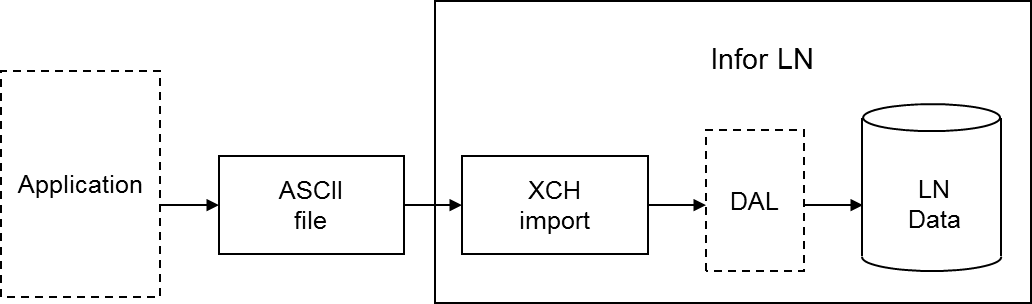
During an Exchange import, you can use all the functionality programmed into the Data Access Layer (DAL). If you use the DAL, Exchange carries out all the constraint checks, integrity checks, and side effects, for example, updates on other tables, that are programmed into the DAL. Database integrity is guaranteed automatically.

Using the DAL reduces the costs of interface development. You can use the DAL to import standard interfaces developed by Infor for partner products, as well as for specific interfaces built by customers, for example, to integrate LN with legacy systems. You can use the DAL in both single site and multisite environments.

The checks or additional actions specified in the DAL are carried out for each row that is imported. Database errors are logged in the same way for DAL and non-DAL import. DAL hook errors are also logged. You can specify whether the DAL property checks are or are not carried out.

If you specify the use of the DAL for a table relation for an import, the dal.new, dal.update, and dal.destroy functions are used instead of db.insert, db.update, and db.delete. You can choose to use DAL for particular tables and not for other tables, therefore, an import batch can contain both types of table relations simultaneously. The import through DAL works for both the import based on audit or indicators (inserts, updates, deletes), and the full import (inserts only).

DAL settings are run time aspects, which means you can change these aspects without having to regenerate the import program. DAL settings are also logged in the log table at batch line level, to enable you to find out what the DAL settings were when the import was run.

Important to realize is that an update through the DAL can result in a number of side effects. Actions performed by the DAL must not be carried out twice. For example, if the DAL updates the available to promise (ATP) quantity for an item when importing order data, the ATP quantity must not be updated in a condition script as well.

For this reason, you must not add any actions in condition scripts, or import additional data, that are already handled in the DAL.
FINANCE: Set Up and Calculate Currency Differences

To set up and calculate currency differences for foreign currencies:

  • Use the Company Parameters (tfgld0503m000) session to specify the profit and loss ledger accounts, 12 profit and loss dimensions, and transaction type for a posting exchange rate differences that is calculated using the FIFO method. To specify this data, use the Currency Diff. FIFO tab. The reports printed from the Print Company Parameters (tfgld0404m000) session, include the Currency Differences FIFO fields.
  • Use the Calculate Currency Differences (tfgld5201m000) session to calculate the currency differences resulting from transactions posted on accounts for which the field Currency Analysis in the session Chart of Accounts (tfgld0508m000) is set to Required.

OPERATIONS: Subcontracting Overview

Companies can decide to involve a subcontractor and subcontract part of their activities. The subcontractor carries out the work and returns the products to your company.

In Infor LN, subcontracting is considered as purchasing labor from a third party. Therefore, if a manufacturer wants to subcontract work, he must generate a purchase order to start the subcontracting process. These are the types of subcontracting:

  • Subcontracting with material flow
    • Operation subcontracting: For operation subcontracting, a part of the production process (one or more operations) is subcontracted.
    • Item subcontracting: For item subcontracting, an item's entire production process is subcontracted. Therefore, it is always used with material flow support.
  • Subcontracting without material flow: The simplest form of subcontracting is to generate a subcontracting purchase order to record the operations outsourced to a subcontractor. The subcontracting purchase order only represents the administrative handling of the subcontracting process. When the subcontracted item is received back from the subcontractor, you must close the subcontracting purchase order, which initiates the production process.
  • Unplanned subcontracting: Unplanned subcontracting is applicable when you subcontract after generating a production order. For unplanned subcontracting, a purchase order is generated from the production order and the material supply lines are populated by Shop Floor Control.
  • Service subcontracting: For service subcontracting, work on an item to be maintained or repaired is subcontracted. This work entails the entire repair process, or only a part of it. Service subcontracting can be used with or without material flow support.

To start the subcontracting process, a purchase order is required.

Previous Article Infor LN & Baan Tips & Tricks for FINANCE: Moving calendar periods
Next Article Infor LN & Baan Tips & Tricks for TECHNOLOGY: Using the Data Access Layer (DAL)
Print
2273 Rate this article:
5.0
Kathy Barthelt

Kathy BartheltKathy Barthelt

Other posts by Kathy Barthelt

Contact author

x

Categories