Please Wait a Moment
X

Infor LX Tips, Infor LN Tips, BPCS Tips, Baan Tips, Infor M3 Tips & Infor ERP News

Crossroads Connections

Infor ERP Tips & News from the Experts

Infor LX | Infor LN | BPCS | Baan | Infor M3

ION News: Crossroads RMC uses the ION process to deliver data to/from LX 8.3.5

George Moroses 0 34059 Article rating: 5.0

Crossroads RMC is currently working with a customer in the food and beverage industry to develop 18 inbound and outbound customized BOD messages using the ION process to deliver data to/from LX 8.3.5.

All of the messages will be using the standard OAGIS (Open Applications Group Integration Specification) BOD Message. The OAGIS is a widely accepted standard within the industry which specifies a standard way of passing data in and out of applications using an XML format. 

Some of the BOD Messages that we will be processing are:

  • Item Master
  • Purchase Order
  • Receipts
  • Accounts Payable Invoices
  • Vendor information
  • Notifications messages

This project kicks off in February 2020 with milestone deliveries throughout the year.

How Do I Determine If MES Is Right For My Business?

George Moroses 0 37533 Article rating: 5.0

There are certain key questions that must be answered to determine whether or not an MES system would benefit your organization: 

  • How do you analyze OEE?
  • Is there an opportunity to reduce WIP inventory, indirect labor, downtime, waste or scrap?
  • What is the cost and impact of producing and distributing shop paper including drawings and work instructions?
  • Would you like to go paperless on your shop floor?
  • How are your continuous improvement initiatives tied to your ERP?
  • Is Management requesting real time production status reporting via dashboards or drilldown reports?
  • What different “islands of automation” exist on your shop floor?

The answers to each of these questions could have a significant impact on the profitability of your business. Want to quantify your results? Contact George Moroses today to schedule your FREE MES ROI Analysis.

Consulting News: How comprehensive is the Crossroads RMC ERP business audit & how does it work?

George Moroses 0 44480 Article rating: 5.0

Our Infor LX Practice just finished a Supply Chain and Manufacturing audit for one of our customers. During that engagement, several areas of the business were identified that could benefit from additional training and consulting support. 

Areas of significance were:

  • Purchasing
  • Customer Service
  • Billing
  • Inventory
  • Costing
  • Bills of Materials and Routings
  • Material Requirements Planning
  • Shop Floor Control

Several manual procedures and “tribal knowledge” systems were discovered. The evaluation was done by two consultants who spent time with key users during two onsite visits. The next step in the process will involve working with the client to prioritize the list of items identified and develop a strategic plan focused on growth and efficiency.

Infor LX & BPCS Tip of the Week: Order processing enhancement – LX 8.4

George Moroses 0 64648 Article rating: 5.0

Restrict Over-shipments to Customers

  • System parameter option controls when over shipments are allowed

Options to:

  • Continue current process with warning message
  • Give error message
  • Automatically correct to quantity available for shipment
     
  • Option to revise the order quantity so that pricing, promotions, credit checking load planning and other processes reflect the actual quantity
  • Allows better control of exceptions for over shipments
  • Ensures that pricing, promotions are correctly based on actual order quantity

About 65% of the world’s population are visual learners. This extends into the ERP software realm, too.

Infor LN & Baan

Kathy Barthelt 0 82874 Article rating: 5.0

Graphical representation makes complex concepts—like the intricacies of an ERP system—more universal, relatable and easy to understand.

ERP dashboards gather and visualize critical metrics from across the organization, offering insight into the performance, outlook and interconnectivity of business processes.

By setting up ERP dashboards that illustrate key metrics and compellingly communicate operational performance, key stakeholders will have a clear picture of the health of the business—and make better, more informed business decisions as a result.

The Crossroads Analytics Dashboard has preconfigured views for all of the following:

 Infor LN & Baan
  • Accounts Payable
  • Accounts Receivable
  • Journal
  • Booked Sales
  • Invoiced Sales
  • Production
  • Receipts
  • Purchase Orders
  • Inventory

To learn more visit our Analytic Dashboard webpage.

Data Collection: Are you able to perform a full cycle count of your inventory in one day?

Kathy Barthelt 0 42676 Article rating: 5.0

Cycle Counting Benefits:

  • Overall increased inventory accuracy
  • Increased accuracy of count
  • Ability to review and approve count before direct update of Baan / Infor LN tables
  • Elimination of unnecessary re-orders of items with current inventory
  • Greater ability to satisfy customer orders due to greater visibility to accurate inventory levels
  • Direct labor cost savings – less staff required for count
  • Increased productivity during count

Some of our customers counts used to take weeks. They can now complete a count of their entire inventory in one day. One of our LN customers just told us that they recently wrapped up a cycle count using our software and said it was the first time ever that they completed a count without one complaint or mistake!

Contact us today to learn more - 800.762.2077

Integration News: Crossroads RMC has developed an integration from Baan IV to Modula OnePick for Grindmaster Corporation

Kathy Barthelt 0 37380 Article rating: 5.0

One Pick is a Modula Lift automatic vertical warehouse with a special picking bay equipped to provide expedited picking and a high level of pick accuracy. With this system, Grindmaster is able to save floor space, store items safely, automate inventory management, track items, save picking time and prevent picking errors. Go live for this solution is expected in Q1 2020.

First6061626365676869Last

Tips:  LX | BPCS | M3

Tips: LN | Baan

Kathy Barthelt

Infor LN & Baan Tips & Tricks for EXECUTIVES

TECHNOLOGY: Using the Data Access Layer (DAL)

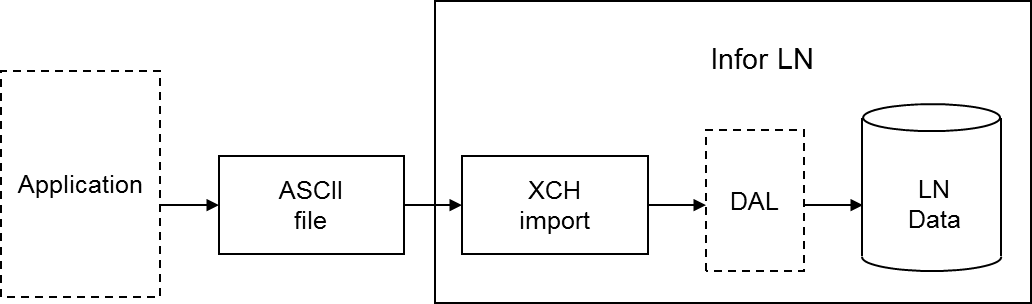
During an Exchange import, you can use all the functionality programmed into the Data Access Layer (DAL). If you use the DAL, Exchange carries out all the constraint checks, integrity checks, and side effects, for example, updates on other tables, that are programmed into the DAL. Database integrity is guaranteed automatically.

Using the DAL reduces the costs of interface development. You can use the DAL to import standard interfaces developed by Infor for partner products, as well as for specific interfaces built by customers, for example, to integrate LN with legacy systems. You can use the DAL in both single site and multisite environments.

The checks or additional actions specified in the DAL are carried out for each row that is imported. Database errors are logged in the same way for DAL and non-DAL import. DAL hook errors are also logged. You can specify whether the DAL property checks are or are not carried out.

If you specify the use of the DAL for a table relation for an import, the dal.new, dal.update, and dal.destroy functions are used instead of db.insert, db.update, and db.delete. You can choose to use DAL for particular tables and not for other tables, therefore, an import batch can contain both types of table relations simultaneously. The import through DAL works for both the import based on audit or indicators (inserts, updates, deletes), and the full import (inserts only).

DAL settings are run time aspects, which means you can change these aspects without having to regenerate the import program. DAL settings are also logged in the log table at batch line level, to enable you to find out what the DAL settings were when the import was run.

Important to realize is that an update through the DAL can result in a number of side effects. Actions performed by the DAL must not be carried out twice. For example, if the DAL updates the available to promise (ATP) quantity for an item when importing order data, the ATP quantity must not be updated in a condition script as well.

For this reason, you must not add any actions in condition scripts, or import additional data, that are already handled in the DAL.
FINANCE: Set Up and Calculate Currency Differences

To set up and calculate currency differences for foreign currencies:

  • Use the Company Parameters (tfgld0503m000) session to specify the profit and loss ledger accounts, 12 profit and loss dimensions, and transaction type for a posting exchange rate differences that is calculated using the FIFO method. To specify this data, use the Currency Diff. FIFO tab. The reports printed from the Print Company Parameters (tfgld0404m000) session, include the Currency Differences FIFO fields.
  • Use the Calculate Currency Differences (tfgld5201m000) session to calculate the currency differences resulting from transactions posted on accounts for which the field Currency Analysis in the session Chart of Accounts (tfgld0508m000) is set to Required.

OPERATIONS: Subcontracting Overview

Companies can decide to involve a subcontractor and subcontract part of their activities. The subcontractor carries out the work and returns the products to your company.

In Infor LN, subcontracting is considered as purchasing labor from a third party. Therefore, if a manufacturer wants to subcontract work, he must generate a purchase order to start the subcontracting process. These are the types of subcontracting:

  • Subcontracting with material flow
    • Operation subcontracting: For operation subcontracting, a part of the production process (one or more operations) is subcontracted.
    • Item subcontracting: For item subcontracting, an item's entire production process is subcontracted. Therefore, it is always used with material flow support.
  • Subcontracting without material flow: The simplest form of subcontracting is to generate a subcontracting purchase order to record the operations outsourced to a subcontractor. The subcontracting purchase order only represents the administrative handling of the subcontracting process. When the subcontracted item is received back from the subcontractor, you must close the subcontracting purchase order, which initiates the production process.
  • Unplanned subcontracting: Unplanned subcontracting is applicable when you subcontract after generating a production order. For unplanned subcontracting, a purchase order is generated from the production order and the material supply lines are populated by Shop Floor Control.
  • Service subcontracting: For service subcontracting, work on an item to be maintained or repaired is subcontracted. This work entails the entire repair process, or only a part of it. Service subcontracting can be used with or without material flow support.

To start the subcontracting process, a purchase order is required.

Previous Article Infor LN & Baan Tips & Tricks for FINANCE: Moving calendar periods
Next Article Infor LN & Baan Tips & Tricks for TECHNOLOGY: Using the Data Access Layer (DAL)
Print
2273 Rate this article:
5.0
Kathy Barthelt

Kathy BartheltKathy Barthelt

Other posts by Kathy Barthelt

Contact author

x

Categories