Please Wait a Moment
X

Infor LX Tips, Infor LN Tips, BPCS Tips, Baan Tips, Infor M3 Tips & Infor ERP News

Crossroads Connections

Infor ERP Tips & News from the Experts

Infor LX | Infor LN | BPCS | Baan | Infor M3

BPCS/LX Tip of the Week: Actual Versus Standard

Anthony Etzel 0 53311 Article rating: No rating

Job costing based on standards is great, but what if reality doesn’t match up to that?

What if jobs are really taking twice as long, and you don’t know that? What if jobs are taking ½ as long as you think, but you’re scheduling based on how much time they “should” take? Either way, you’re losing money and productivity. Getting a handle on start/stop times for jobs, and therefore the total amount of time actually spent allows you to take proper action and be more productive.


Optimize Your Manufacturing Today!

Baan/LN Tip of the Week: Project Templates

Kathy Barthelt 0 196269 Article rating: No rating

Project templates are useful because you can specify all of the information that you would normally want to include when creating a new project such as project structure, budget and so on.

In Baan IV/V, project templates do not exist, but you can set up a project template by creating a regular project, and setting the status to simulated or free. This is done so that the project does not create plans. Under this scenario, you can easily copy one project to another.

In LN, when you create a new project, a template can be used as the starting point. This is similar to copying a normal project, but unlike normal projects, no costs or revenues can be posted on a template.

Optimize Your Manufacturing Today!


Infor LX and Crossroads MES Selected by Blonder Tongue

Crossroads RMC 0 34092 Article rating: No rating

Blonder Tongue, a global communication equipment supplier for TV broadcasters, cable system operator, lodging video, Internet system, and institutional systems, has selected Crossroads RMC to assist them with a BPCS 6.0.04 upgrade to Infor LX. Crossroads RMC will be providing all applications and technical consulting for this project. Also included as part of the project will be the implementation of the Crossroads MES solution. Go live for both solutions is expected in January of 2018.

BPCS/LX Tip of the Week: LX 8.3.5 Facility Period Close

Anthony Etzel 0 47728 Article rating: 5.0

The Facility Period Close process was introduced in Infor LX 8.3.4 and has been enhanced in 8.3.5. This feature allows continuous or 24-hour worldwide operations in multiple facilities to submit Period End Close jobs for each facility as daily operations cease, or shifts end.

This enhancement provides a batch mode for the Facility Period Close (INV930) process and allows the Update IIM Inventory from IWI (INV931) process to be submitted from the INV930B program. The enhancement also provides a batch mode for the INV931 process.

Optimize Your Manufacturing Today!

Baan/LN Tip of the Week: Order Series Full – Switching to a Different Series

Kathy Barthelt 0 215663 Article rating: 5.0

In general, you can enter a different series in the order field if you have an available series.

To add a new series, find the appropriate group in the First Free Number session, and add a new series and first free number (usually 1).

In Baan IV, go to the Maintain First Free Numbers Session (under Common, Tables, Maintain Logistics Tables, Maintenance 1).
Groups are easily identified (e.g., Purchase Order, Sales Order, etc.).

In Baan V, go to the First Free Number Session (under Common Data, Tables, Logistics). There are number groups (e.g., 570 may be for Purchase Orders, 650 may be for Sales Orders, etc.).

In LN, go to the First Free Number Session (tcmcs0150m000 – it is in different places in the menu under different Feature Packs). There are number groups (e.g., 210 may be for Purchase Orders, 310 may be for Sales Orders, etc.).

BPCS/LX Tip of the Week: Revisit The Last Brilliant Idea

Anthony Etzel 0 50019 Article rating: No rating

Sometimes the best ideas have to be tabled due to competing priorities. That doesn’t mean that the idea was bad. Revisit previously suggested cost savings ideas, or ideas to make a manual process more efficient. Now could be the right time to do something great!

Optimize Your Manufacturing Today!

Baan/LN Tip of the Week: Difference Between a Serialized Item and Unit Effective Item

Kathy Barthelt 0 142740 Article rating: No rating

A serialized item is not the same as a unit effective item. A serialized item has a serial number that is used to identify and track individual items, whereas a unit effectivity item has an effectivity unit that provides some information about the item's configuration. However, an item can be both serialized and unit effective.

Optimize Your Manufacturing Today!
 

Baan/LN Tip of the Week: Alternative Materials in BOMs:

Kathy Barthelt 0 442913 Article rating: No rating

Often, multiple items are interchangeable even when these are purchased from various vendors. You can use any of these items as material in a bill of material (BOM). If a shortage of a standard material is expected to delay a production order, LN can automatically select one of the alternative materials. You can define up to nine alternative materials for any material in a BOM.

The use of alternative materials has the following advantages:

  • LN can handle material shortages for some items without user intervention.
  • The use of alternative items can reduce the average inventory level.
First95969798100102103104Last

Tips:  LX | BPCS | M3

Tips: LN | Baan

Kathy Barthelt

Infor LN & Baan Tips & Tricks for EXECUTIVES

TECHNOLOGY: Using the Data Access Layer (DAL)

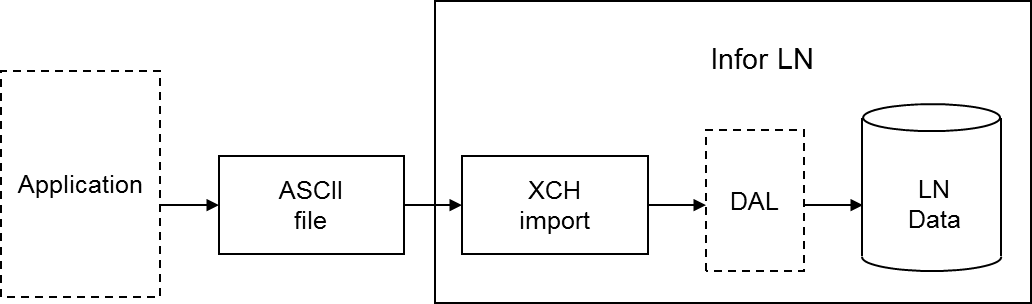
During an Exchange import, you can use all the functionality programmed into the Data Access Layer (DAL). If you use the DAL, Exchange carries out all the constraint checks, integrity checks, and side effects, for example, updates on other tables, that are programmed into the DAL. Database integrity is guaranteed automatically.

Using the DAL reduces the costs of interface development. You can use the DAL to import standard interfaces developed by Infor for partner products, as well as for specific interfaces built by customers, for example, to integrate LN with legacy systems. You can use the DAL in both single site and multisite environments.

The checks or additional actions specified in the DAL are carried out for each row that is imported. Database errors are logged in the same way for DAL and non-DAL import. DAL hook errors are also logged. You can specify whether the DAL property checks are or are not carried out.

If you specify the use of the DAL for a table relation for an import, the dal.new, dal.update, and dal.destroy functions are used instead of db.insert, db.update, and db.delete. You can choose to use DAL for particular tables and not for other tables, therefore, an import batch can contain both types of table relations simultaneously. The import through DAL works for both the import based on audit or indicators (inserts, updates, deletes), and the full import (inserts only).

DAL settings are run time aspects, which means you can change these aspects without having to regenerate the import program. DAL settings are also logged in the log table at batch line level, to enable you to find out what the DAL settings were when the import was run.

Important to realize is that an update through the DAL can result in a number of side effects. Actions performed by the DAL must not be carried out twice. For example, if the DAL updates the available to promise (ATP) quantity for an item when importing order data, the ATP quantity must not be updated in a condition script as well.

For this reason, you must not add any actions in condition scripts, or import additional data, that are already handled in the DAL.
FINANCE: Set Up and Calculate Currency Differences

To set up and calculate currency differences for foreign currencies:

  • Use the Company Parameters (tfgld0503m000) session to specify the profit and loss ledger accounts, 12 profit and loss dimensions, and transaction type for a posting exchange rate differences that is calculated using the FIFO method. To specify this data, use the Currency Diff. FIFO tab. The reports printed from the Print Company Parameters (tfgld0404m000) session, include the Currency Differences FIFO fields.
  • Use the Calculate Currency Differences (tfgld5201m000) session to calculate the currency differences resulting from transactions posted on accounts for which the field Currency Analysis in the session Chart of Accounts (tfgld0508m000) is set to Required.

OPERATIONS: Subcontracting Overview

Companies can decide to involve a subcontractor and subcontract part of their activities. The subcontractor carries out the work and returns the products to your company.

In Infor LN, subcontracting is considered as purchasing labor from a third party. Therefore, if a manufacturer wants to subcontract work, he must generate a purchase order to start the subcontracting process. These are the types of subcontracting:

  • Subcontracting with material flow
    • Operation subcontracting: For operation subcontracting, a part of the production process (one or more operations) is subcontracted.
    • Item subcontracting: For item subcontracting, an item's entire production process is subcontracted. Therefore, it is always used with material flow support.
  • Subcontracting without material flow: The simplest form of subcontracting is to generate a subcontracting purchase order to record the operations outsourced to a subcontractor. The subcontracting purchase order only represents the administrative handling of the subcontracting process. When the subcontracted item is received back from the subcontractor, you must close the subcontracting purchase order, which initiates the production process.
  • Unplanned subcontracting: Unplanned subcontracting is applicable when you subcontract after generating a production order. For unplanned subcontracting, a purchase order is generated from the production order and the material supply lines are populated by Shop Floor Control.
  • Service subcontracting: For service subcontracting, work on an item to be maintained or repaired is subcontracted. This work entails the entire repair process, or only a part of it. Service subcontracting can be used with or without material flow support.

To start the subcontracting process, a purchase order is required.

Previous Article Infor LN & Baan Tips & Tricks for FINANCE: Moving calendar periods
Next Article Infor LN & Baan Tips & Tricks for TECHNOLOGY: Using the Data Access Layer (DAL)
Print
2189 Rate this article:
5.0
Kathy Barthelt

Kathy BartheltKathy Barthelt

Other posts by Kathy Barthelt

Contact author

x

Categories