Please Wait a Moment
X

Infor LX Tips, Infor LN Tips, BPCS Tips, Baan Tips, Infor M3 Tips & Infor ERP News

Crossroads Connections

Infor ERP Tips & News from the Experts

Infor LX | Infor LN | BPCS | Baan | Infor M3

Infor LX & BPCS Tip of the Week: ION Tip – Pausing Receiving and Sending of Messages

Anthony Etzel 0 77662 Article rating: 5.0

If it is necessary to pause sending and receiving of BOD messages on your IBM i during your month end process, it is best practice for the document flows that point to the IBM i to guarantee delivery of BOD messages. Once the month end process has been completed, you will need to Resume the ‘Receiving’ and ‘Sending’ Active Connection Points so your documents will continue to process.

Pausing Sending messages

To pause sending messages to ION:

  1. Select Connect > Active Connection Points.
  2. Select the connection point that must be paused for sending messages.
  3. In the Sending Paused column, click Pause. The page is automatically refreshed and the Sending Paused checkbox is selected. A Resume button becomes available. 

Sending of messages by this connection point is stopped....

Tax Law Changes by the Numbers - Infor LX & BPCS Integration to Avalara

A look at what's changed in 2018-2019

Anthony Etzel 0 46968 Article rating: 4.0

Are you up to speed on all of the sale tax changes that could affect your business?

Tax Law Changes by the Numbers
A look at what's changed in 2018-2019

  • 21 states adopted economic nexus as of December 31, 2018, requiring out-of-state businesses with a certain amount of economic activity in the state to collect and remit sales tax
  • 33 states have enforced economic nexus as of June 30, 2019
  • 43 states will enforce economic nexus as of December 31, 2019
  • 7 states had marketplace facilitator sales tax laws as of December 31, 2018, requiring marketplaces to collect sales tax on behalf of their sellers
  • 15 states have marketplace facilitator sales tax laws as of June 30, 2019
  • 28 states will have marketplace facilitator sales tax laws as of January 1, 2020

The trend to tax remote sales is certain to continue, and there will be the normal slew of rate, regulation, and product taxability changes. 

Sales Tax is complicated! Crossroads RMC provides the integration from Infor LX & BPCS to Avalara to make it easy. Click Here to Learn More

Steps to undo an IDF modification and restore to the default

Anthony Etzel 0 40915 Article rating: 5.0

Changes are great, but if you want to undo an IDF modification and restore to the default, you need to follow these steps:

Reset to an Infor shipped view (“un-modify” it)

  1. Open the public node of an object you would like to reset to the shipped status. Notice that all of the standard views (i.e., those owned by Infor) are unmodified.
  2. Select the row with the Modified column = yes
  3. Select the Reset to default button on the toolbar
  4. Say Yes to the prompt
  5. The object is now back to the way it was shipped by Infor. Note that it now shows that it has not been modified. If you display the editor, you will see that the attribute you deleted has been restored. Note that only objects owned by Infor can be reset. If you change a standard definition, and later regret it, you can use this feature to restore it with a couple of clicks.

How to Improve Customer Shipments With OTTO - A Case Study

Anthony Etzel 0 33563 Article rating: 5.0

Setting Industry Service Standards

Shenandoah Manufacturing, a $20 million producer of poultry-raising equipment (heaters and brooders), had been having difficulty for some time shipping orders to customers in a timely manner. They had successfully implemented a popular ERP system and had been using it for more than 3 years, yet the situation didn't improve.

Customer Service Representatives were complaining about the frequent backorders and late orders. Employees were giving it their best effort, but were frustrated, and customers were threatening to take their business elsewhere.

The company considered installing an APS system as a possible solution, but found implementation would be difficult, expensive, and running the system might be a challenging task as a number of key business practices would have to be changed. A consultant familiar with OTTO suggested they look at that product as an alternative to APS. Several OTTO aspects cited by the consultant convinced them to consider a cursorily review. Specifically:

  • The non-intrusive nature of the product.
  • It's relative inexpensive initial investment.
  • The low overall total cost of ownership.
  • The integration with their ERP system.

The initial demonstration was impressive. OTTO was installed on Shenandoah's server within 45 minutes of arrival and, most impressively, it was fully functional with their real "live" data immediately. Needless to say, the demo was well received. Even more importantly Shenandoah was able to "test drive" the software to prove its applicability before making any dollar commitments.

According to Mark Shank, Information Systems Manager, some baseline measurements were made last year, and it was determined that approximately 50% of their customer orders had shipped on time. As they began using OTTO, on-time order performance rose to 90% for the month. And Shenandoah caught up on its entire backlog and started working ahead on February's orders. In February on-time shipment performance jumped to 92% and subsequently on-time performance has ranged somewhere between 98.3% and 99.5% — well above the 96% goal set by Management.

OTTO provides the means for keeping the whole production organization focused on the few things that have to happen as the ship date approaches to get each order shipped on time. Components that have the potential for delaying an order are identified so they can be managed. Shenandoah's staff, a precious and limited resource, now concentrates on analyzing information and managing the right things at the right time rather than digging out date. To quote one production control individual: "what use to take hours now takes seconds."

According to Roy Hackett, Plant Manager: "Knowing the right things to pay attention to at the right time"

Crossroads RMC's Analytics Dashboard serves as the perfect complement to extend your MES solution

George Moroses 0 36869 Article rating: 5.0

Did you know our Analytics Dashboard serves as the perfect complement to extend your MES solution?

Need real-time information regarding what shop orders are active, which lines are down, and overall OEE? Want to display all of this data in easy to understand graphs and charts with drill-down capability?

Contact us today to find out how our Analytics Dashboard can provide all of the information you need in real-time.

  • MES Work Center Job Step Status
  • MES Work Center Machine Status
  • MES Shop Order Status
  • MES Order / Operation Status
  • MES Order / Parts Status
  • MES Badge Status

Contact George Moroses to learn more.

Infor and Crossroads RMC Partner to Drive Success at Ridewell

Anthony Etzel 0 37589 Article rating: 5.0

Earlier this year, Ridewell Corporation inked a deal with Infor to move their BPCS 4.05 CD system to Infor LX. As part of that deal, Crossroads RMC’s MES software was selected to provide shop floor automation. 

For the ERP upgrade, Infor reached out to Crossroads RMC to provide support for both Finance and Data Conversion due to our positive track record with 4.05 CD to LX migrations. Crossroads RMC has extensive migration experience and developed a methodology for converting legacy 4.05 CD GL into CEA. 

The process Crossroads RMC developed makes it cleaner, more manageable, and easy to embrace from the client perspective. Infor also engaged Crossroads RMC to provide technical support to manage the data conversion, utilizing the Infor utilities and converting Ridewell’s 4.05 CD data to standard LX.

IDF: Defining the Attributes for a New Object

Anthony Etzel 0 31666 Article rating: 5.0

Attributes are the fields you define in your System i file.

You can begin by building your attribute list in Integrator by synchronizing the object with the host. This process reads the file definition from the System i and builds your list of attributes. The synchronize process will automatically run and read the definitions for the first occurrence of this file name within the library list. You can repeat this process manually multiple times if you change the file definition on the host by using the ‘Synchronize with Host’ option. However, the synchronization process will not recognize changed field names.

Non on key field attributes: The integrator requires a unique key for each object. If the host file already has a key, the synchronization process will automatically identify fields as part of the key as well as add a sequence number to multiple key parts. If the file does not have a unique key, you must either create a keyed logical file or identify the key manually. Key fields are the default sort order for all list views for an object.

Why do you need OTTO? Let’s let our customers tell you…

George Moroses 0 27285 Article rating: 5.0

“Our priorities change daily. It’s important to manage the priorities instead of having someone here in the office constantly expediting. We don’t want to run MRP every day, that would just introduce nervousness, all plans and priorities are likely to change and the flood of recommendations would be unmanageable. We run MRP once a week and rely on OTTO to track the constantly shifting priorities day-to-day.”  
Production & Inventory Control Manager, Top U.S. Crane Manufacturer

Learn More About OTTO

First7374757678808182Last

Tips:  LX | BPCS | M3

Tips: LN | Baan

Kathy Barthelt

Infor LN & Baan Tips & Tricks for EXECUTIVES

TECHNOLOGY: Using the Data Access Layer (DAL)

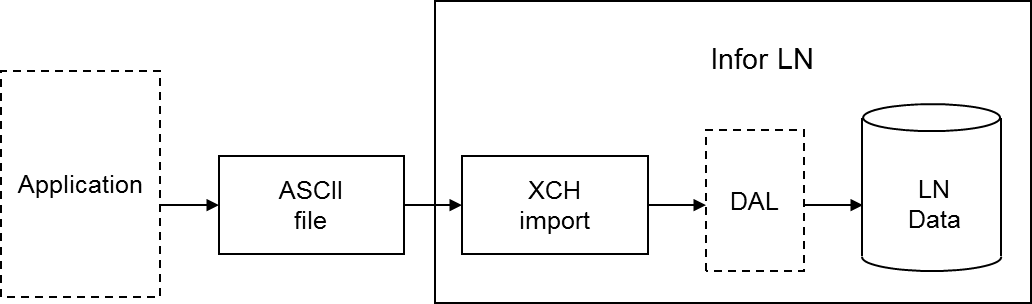
During an Exchange import, you can use all the functionality programmed into the Data Access Layer (DAL). If you use the DAL, Exchange carries out all the constraint checks, integrity checks, and side effects, for example, updates on other tables, that are programmed into the DAL. Database integrity is guaranteed automatically.

Using the DAL reduces the costs of interface development. You can use the DAL to import standard interfaces developed by Infor for partner products, as well as for specific interfaces built by customers, for example, to integrate LN with legacy systems. You can use the DAL in both single site and multisite environments.

The checks or additional actions specified in the DAL are carried out for each row that is imported. Database errors are logged in the same way for DAL and non-DAL import. DAL hook errors are also logged. You can specify whether the DAL property checks are or are not carried out.

If you specify the use of the DAL for a table relation for an import, the dal.new, dal.update, and dal.destroy functions are used instead of db.insert, db.update, and db.delete. You can choose to use DAL for particular tables and not for other tables, therefore, an import batch can contain both types of table relations simultaneously. The import through DAL works for both the import based on audit or indicators (inserts, updates, deletes), and the full import (inserts only).

DAL settings are run time aspects, which means you can change these aspects without having to regenerate the import program. DAL settings are also logged in the log table at batch line level, to enable you to find out what the DAL settings were when the import was run.

Important to realize is that an update through the DAL can result in a number of side effects. Actions performed by the DAL must not be carried out twice. For example, if the DAL updates the available to promise (ATP) quantity for an item when importing order data, the ATP quantity must not be updated in a condition script as well.

For this reason, you must not add any actions in condition scripts, or import additional data, that are already handled in the DAL.
FINANCE: Set Up and Calculate Currency Differences

To set up and calculate currency differences for foreign currencies:

  • Use the Company Parameters (tfgld0503m000) session to specify the profit and loss ledger accounts, 12 profit and loss dimensions, and transaction type for a posting exchange rate differences that is calculated using the FIFO method. To specify this data, use the Currency Diff. FIFO tab. The reports printed from the Print Company Parameters (tfgld0404m000) session, include the Currency Differences FIFO fields.
  • Use the Calculate Currency Differences (tfgld5201m000) session to calculate the currency differences resulting from transactions posted on accounts for which the field Currency Analysis in the session Chart of Accounts (tfgld0508m000) is set to Required.

OPERATIONS: Subcontracting Overview

Companies can decide to involve a subcontractor and subcontract part of their activities. The subcontractor carries out the work and returns the products to your company.

In Infor LN, subcontracting is considered as purchasing labor from a third party. Therefore, if a manufacturer wants to subcontract work, he must generate a purchase order to start the subcontracting process. These are the types of subcontracting:

  • Subcontracting with material flow
    • Operation subcontracting: For operation subcontracting, a part of the production process (one or more operations) is subcontracted.
    • Item subcontracting: For item subcontracting, an item's entire production process is subcontracted. Therefore, it is always used with material flow support.
  • Subcontracting without material flow: The simplest form of subcontracting is to generate a subcontracting purchase order to record the operations outsourced to a subcontractor. The subcontracting purchase order only represents the administrative handling of the subcontracting process. When the subcontracted item is received back from the subcontractor, you must close the subcontracting purchase order, which initiates the production process.
  • Unplanned subcontracting: Unplanned subcontracting is applicable when you subcontract after generating a production order. For unplanned subcontracting, a purchase order is generated from the production order and the material supply lines are populated by Shop Floor Control.
  • Service subcontracting: For service subcontracting, work on an item to be maintained or repaired is subcontracted. This work entails the entire repair process, or only a part of it. Service subcontracting can be used with or without material flow support.

To start the subcontracting process, a purchase order is required.

Previous Article Infor LN & Baan Tips & Tricks for FINANCE: Moving calendar periods
Next Article Infor LN & Baan Tips & Tricks for TECHNOLOGY: Using the Data Access Layer (DAL)
Print
2273 Rate this article:
5.0
Kathy Barthelt

Kathy BartheltKathy Barthelt

Other posts by Kathy Barthelt

Contact author

x

Categories