Please Wait a Moment
X

Infor LX Tips, Infor LN Tips, BPCS Tips, Baan Tips, Infor M3 Tips & Infor ERP News

Crossroads Connections

Infor ERP Tips & News from the Experts

Infor LX | Infor LN | BPCS | Baan | Infor M3

Get Tax Compliance Right in 2021!

Webinar: February 9, 2021 1:00 PM CST / 2:00 PM EST

Crossroads RMC 0 29943 Article rating: 5.0

We brought in our partners at Avalara to make sure you are up-to-speed on recent sales and use tax changes and ready for those to come in 2021. We’ll cover:

  • The impact of COVID-19 in 2020 and its influence on 2021
  • Why understanding economic nexus and its triggers is more important now than ever
  • New tax obligations resulting from increased marketplace sales
  • The international market and changes to cross-border e-commerce compliance
  • Answers to your questions – live!

Date/Time: February 9, 2021 at 11 AM PST / 1 PM CST / 2 PM EST
Duration: 45 minutes
Cost: Free!

Don’t miss this in-depth review of the 2020 sales tax changes you need to know about in order to have a successful 2021.

Register Today>

What is manual tax compliance costing your business?

Crossroads RMC 0 26651 Article rating: 5.0

Why automate tax compliance?
The better question is: Why burden your business with something so complex and tedious when it can be solved with software in the cloud?

Decrease the high cost and drain on your business
Employee time and expertise are expensive

Without automation, your tax professionals are probably buried in endless tasks that could be offloaded. Every hour spent on tax management is an hour lost on other (more important) parts of your business.

Manual Vs. Automated Tax Management Calculator>

Contact Crossroads RMC to learn how the Avalara - AvaTax integration can benefit your company. 800.762.2077​

What are the biggest struggles manufacturers face with regard to tax compliance?

George Moroses 0 31579 Article rating: 5.0
  • Tracking thousands of SKU numbers that cross taxability rules or vary in taxability based on state
  • Getting the rates right and filing the reports correctly
  • Surviving an audit (which in this business is inevitable)
  • Keeping track of all the smaller jurisdictions and their special districts
  • Ensuring a seamless process that is audit-able
  • Figuring out what is taxable and what isn’t
  • Tracking use tax

As with other manufacturing processes, having a repeatable, consistent process with sales and use tax compliance means automation. Automating sales and use tax compliance with a solution that ensures that consistent, accurate process means a solution that delivers:...

Infor LX & BPCS: What are your production orders telling you?

George Moroses 0 31261 Article rating: 5.0

Measure what you want to improve.

Six simple words, but put together they convey a powerful concept that can transform manufacturing companies. It’s a basic concept that’s hard to argue with: Collect data, see where the data leads you, and make changes that have a positive impact on the data. Repeat often.

If your company is manufacturing a product, you’re more than likely creating manufacturing variances. These variances tell managers...

Is Your Infor ERP System the Elephant in the Room?

Crossroads RMC 0 34836 Article rating: 5.0

The Infor ERP Elephant in the Room That Must Be Addressed

In a recent survey of Infor ERP customers, we discovered that 50% of respondents said that they did not know whether or not their ERP system had the features and functionality required for their business.  50%....1 out of every 2……not good.

Why is this the case? Well, the causes can be traced back to one of the following reasons:

  • A key-person has retired or left the company and their knowledge left with them.
  • Systems were implemented based on how the previous system worked.
  • Upgrades and implementations were viewed as a “technical upgrade”, meaning that the upgrade was done to get off an old or outdated platform. The new version wasn't researched, its functionality was unknown and no one was trained on it.

You may say “So what? Who cares if our team doesn’t know what else is available, or how the rest of the ERP system functions? Does it really matter?”

Yes - It matters more than you think.... 

First4950515254565758Last

Tips:  LX | BPCS | M3

Tips: LN | Baan

Kathy Barthelt

Infor LN & Baan Tips & Tricks for TECHNOLOGY: Using the Data Access Layer (DAL)

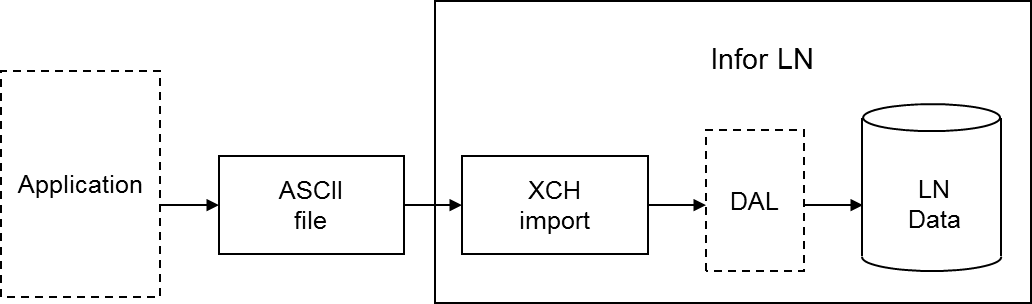
During an Exchange import, you can use all the functionality programmed into the Data Access Layer (DAL). If you use the DAL, Exchange carries out all the constraint checks, integrity checks, and side effects, for example, updates on other tables, that are programmed into the DAL. Database integrity is guaranteed automatically.

Using the DAL reduces the costs of interface development. You can use the DAL to import standard interfaces developed by Infor for partner products, as well as for specific interfaces built by customers, for example, to integrate LN with legacy systems. You can use the DAL in both single site and multisite environments.

The checks or additional actions specified in the DAL are carried out for each row that is imported. Database errors are logged in the same way for DAL and non-DAL import. DAL hook errors are also logged. You can specify whether the DAL property checks are or are not carried out.

If you specify the use of the DAL for a table relation for an import, the dal.new, dal.update, and dal.destroy functions are used instead of db.insert, db.update, and db.delete. You can choose to use DAL for particular tables and not for other tables, therefore, an import batch can contain both types of table relations simultaneously. The import through DAL works for both the import based on audit or indicators (inserts, updates, deletes), and the full import (inserts only).

DAL settings are run time aspects, which means you can change these aspects without having to regenerate the import program. DAL settings are also logged in the log table at batch line level, to enable you to find out what the DAL settings were when the import was run.

Important to realize is that an update through the DAL can result in a number of side effects. Actions performed by the DAL must not be carried out twice. For example, if the DAL updates the available to promise (ATP) quantity for an item when importing order data, the ATP quantity must not be updated in a condition script as well.

For this reason, you must not add any actions in condition scripts, or import additional data, that are already handled in the DAL.
Previous Article Infor LN & Baan Tips & Tricks for EXECUTIVES
Next Article Infor LN & Baan Tips & Tricks for FINANCE: Set Up and Calculate Currency Differences
Print
5427 Rate this article:
5.0
Kathy Barthelt

Kathy BartheltKathy Barthelt

Other posts by Kathy Barthelt

Contact author

x

Categories