Please Wait a Moment
X

Infor LX Tips, Infor LN Tips, BPCS Tips, Baan Tips, Infor M3 Tips & Infor ERP News

Crossroads Connections

Infor ERP Tips & News from the Experts

Infor LX | Infor LN | BPCS | Baan | Infor M3

Infor LN & Baan Tip: Broadcast message to users

Kathy Barthelt 0 74555 Article rating: 5.0

Did you know that you can send a broadcast message to users on the system? This is especially useful if you need users to exit their sessions, or in the event of system maintenance.   

  • For Baan IV users, see KB 22869250
  • For LN users, see KB 1830758

Infor LX & BPCS Tip: Product interface list, SYS635D

George Moroses 0 30078 Article rating: 5.0

Did you know?  Product interface list, SYS635D

This program creates a report that contains all interface program call records that were created for the Infor LX programs specified in the range on this screen. The report contains a line for each record found. The line displays the following information:

  • The name of an Infor LX program that contains a user exit to an add-on program
  • The interface point in the Infor LX program, that is, an identifier of the point in the program code where the user exit is requested
  • The execution sequence number of the record, because more than one add-on program can exist that can run from the same interface point
  • The add-on program to call at the interface point. The Add-on Product Interface file, ZXI, stores the records.

Access: Menu SYS

Infor LX & BPCS Finance Tip of the Week: Invoice Level Inquiries – ACR300D7

George Moroses 0 33074 Article rating: 5.0

Use the Invoice Level Inquiries program, ACR300D7, to perform online customer account receivable inquiries and to perform write-off transactions on open invoices. The inquiries display customer master file and credit information, open and closed invoices, debits, credits, payments, and dunning statuses. Additional detail information is available, such as original prefix and document number, customer order number, customer purchase order number, reason codes, and currency.

You can view closed items for a period specified in Transaction History System Parameters, SYS824D-01.

Open items are aged in one of five user-defined aging periods as defined in Accounts Receivable Parameters, ACR820D-01.

Infor LN & Baan Manufacturing Tip: Performance Problems in Generate Order Planning (cprrp1210m000)

Kathy Barthelt 0 70845 Article rating: 5.0

When the Generate Order Planning (cprrp1210m000) session is run it can take minutes to days to finish the process.

The performance of this session depends on many settings, like the number of plan items, the number of orders, but it also depends on hardware and database setup.

Here are some guidelines on how performance can be improved...

Infor LX & BPCS Manufacturing Tip: Shop Calendar Maintenance – SFC140D1

George Moroses 0 28638 Article rating: 5.0

This program features multiple-level shop calendar maintenance. You can maintain a shop calendar at the global, facility, or work center level. Global level entries override default values found in Work Center Maintenance, CAP100D1, for any program that uses the shop calendar.

Facility overrides affect all work centers in a Facility and are exceptions to the global level. Exceptions defined at the Facility level apply to all work centers for the facility. Work Center calendar entries are the most specific. These entries apply....

Infor LX & BPCS Materials Tip: Over-Receipts

George Moroses 0 30528 Article rating: 5.0

If Infor LX is set up to prevent over-receipts, you cannot post a receipt quantity that is more than the remaining PO line quantity with the over-tolerance % added to it.

As an alternative, you can:

  • Receive the maximum, remaining line quantity plus over-tolerance percentage quantity, and reject the balance to quarantine or
  • Receive the full quantity into quarantine.


Note: Over-receipt checking applies only to receipts to stock.

Infor LN & Baan Tip of the Week: Limitations of Customer Defined Fields (CDFs)

Kathy Barthelt 0 75108 Article rating: 5.0

Customer Defined fields are fields that can be added to tables, screens, reports, and BODs. Validation and calculation logic can be defined around those fields. This gives you great added capability and flexibility… however, are you aware of the limitations of using CDFs?

  • You cannot define customer-defined fields for tables within Tools (the tl and tt packages).
  • External integrations.....
First4546474850525354Last

Tips:  LX | BPCS | M3

Tips: LN | Baan

Kathy Barthelt

Infor LN & Baan Tips & Tricks for TECHNOLOGY: Using the Data Access Layer (DAL)

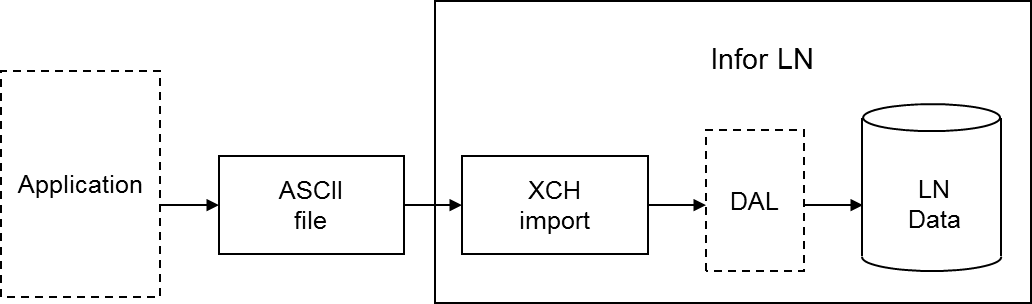
During an Exchange import, you can use all the functionality programmed into the Data Access Layer (DAL). If you use the DAL, Exchange carries out all the constraint checks, integrity checks, and side effects, for example, updates on other tables, that are programmed into the DAL. Database integrity is guaranteed automatically.

Using the DAL reduces the costs of interface development. You can use the DAL to import standard interfaces developed by Infor for partner products, as well as for specific interfaces built by customers, for example, to integrate LN with legacy systems. You can use the DAL in both single site and multisite environments.

The checks or additional actions specified in the DAL are carried out for each row that is imported. Database errors are logged in the same way for DAL and non-DAL import. DAL hook errors are also logged. You can specify whether the DAL property checks are or are not carried out.

If you specify the use of the DAL for a table relation for an import, the dal.new, dal.update, and dal.destroy functions are used instead of db.insert, db.update, and db.delete. You can choose to use DAL for particular tables and not for other tables, therefore, an import batch can contain both types of table relations simultaneously. The import through DAL works for both the import based on audit or indicators (inserts, updates, deletes), and the full import (inserts only).

DAL settings are run time aspects, which means you can change these aspects without having to regenerate the import program. DAL settings are also logged in the log table at batch line level, to enable you to find out what the DAL settings were when the import was run.

Important to realize is that an update through the DAL can result in a number of side effects. Actions performed by the DAL must not be carried out twice. For example, if the DAL updates the available to promise (ATP) quantity for an item when importing order data, the ATP quantity must not be updated in a condition script as well.

For this reason, you must not add any actions in condition scripts, or import additional data, that are already handled in the DAL.
Previous Article Infor LN & Baan Tips & Tricks for EXECUTIVES
Next Article Infor LN & Baan Tips & Tricks for FINANCE: Set Up and Calculate Currency Differences
Print
5427 Rate this article:
5.0
Kathy Barthelt

Kathy BartheltKathy Barthelt

Other posts by Kathy Barthelt

Contact author

x

Categories