Please Wait a Moment
X

Infor LX Tips, Infor LN Tips, BPCS Tips, Baan Tips, Infor M3 Tips & Infor ERP News

Crossroads Connections

Infor ERP Tips & News from the Experts

Infor LX | Infor LN | BPCS | Baan | Infor M3

Infor LN & Baan Tip: Can You Backflush An Item If Estimated Quantity is Zero?

Kathy Barthelt 0 69702 Article rating: 5.0

Yes, you can backflush an item with an estimated quantity = 0.00 if you haven't already backflushed the order. For example, you had an order with one component, you reported the quantity at the operation or order level and ran the backflush. Now you realize you need another component added. In this example, the order has already been backflushed, so if you were to add a second component, run backflushing, nothing would happen.

Backflushing is based on the 'quantity to backflush' in report operations or report orders complete. When the quantity is backflushed....

Increase Production by 10-20% - It's Simple!

Developed for Infor LX, BPCS, Infor LN, Baan & Infor M3

Crossroads RMC 0 29430 Article rating: 5.0

Studies show that merely displaying current production data to your workers via a dashboard increases production.

Improve the performance of your shop floor with Analytics Dashboard for Infor LX, BPCS, Infor LN, Baan, and Infor M3. It's simple to use and configure without programming knowledge. Display performance metrics in a grid, graph, chart, or any way that makes sense. learn more>

Infor LX & BPCS Manufacturing Tip: Production Register Listing

George Moroses 0 30187 Article rating: 5.0

Use the Production Register Listing screen, JIT610D1-01, to print an edit list of the labor tickets that you added or updated. Use this report to see the data to post before you actually perform the update. After you print the edit list, you can go back to Production Reporting (JIT600) and change the data before you post the batch. The program assigns a number to each production report that you posted in JIT600. You can use JIT600 to reference the production report that you want to update. Access: Specify Post on Production Reporting, JIT600D1-01.

Infor LN & Baan Tip: Remove Posted Payment/Direct Debit Batches

Kathy Barthelt 0 67219 Article rating: 5.0

The functionality of session Remove Posted payment batches tfcmg1259m000 and Remove posted Direct Debit batches tfcmg4259m000 is explained below:

1.These 2 sessions can be used to removed already posted payment/direct debit batches that have been processed through CMG Module. After the batches are changed to removed status they can be deleted also.

2. Only a superuser, defined in the Payment Authorizations (tfcmg1100m000) can delete the payment/direct debit batch.

3....

Understanding Taxability Rules Is Key To Sales Tax Compliance

Avalara for Infor LN | Baan | Infor LX | BPCS

Crossroads RMC 0 32414 Article rating: 5.0

Product taxability may seem straightforward because there are generally only two options: taxable or exempt. Yet that seemingly simple contrast fails to truly capture the inherent complexity of sales tax compliance. In fact, it’s a multistep process that starts with determining where a business has sales tax nexus. Knowing whether the products or services one sells are taxable or exempt is critical to the compliance process, from start to finish.

The good news is that you don’t have to be a tax expert, nor do you need to stay up on the latest tax rules and regulations in each state or country where you do business. Avalara handles all of this for you and Crossroads RMC provides the integration to Infor LN, Infor LX, Baan, and BPCS to make staying compliant a no-brainer.

Want to learn more?...

Infor LX & BPCS Finance Tip: Items without costs, CST101D

George Moroses 0 29089 Article rating: 5.0

This program generates an uncosted items listing for the specified facility and cost set. You can use this report as an exception listing to identify those items that are currently maintained at zero cost or new items that require entry prior to cost rollup in Cost Set Rollup, CST500.

If a facility-specific component cost does not exist for a parent being rolled up, zero cost is rolled up for the component. When a new parent item is being rolled up for the first time, the audit report for Cost Rollup, CST500, displays a warning wherever a component cost is zero. Rolling up the parent cost again does not display a message for zero component costs.

Access: Menu CST01

Infor LN & Baan: What are your production orders telling you?

Kathy Barthelt 0 30944 Article rating: 5.0

Measure what you want to improve.

Six simple words, but put together they convey a powerful concept that can transform manufacturing companies. It’s a basic concept that’s hard to argue with: Collect data, see where the data leads you, and make changes that have a positive impact on the data. Repeat often.

If your company is manufacturing a product, you’re more than likely creating manufacturing variances. These variances tell managers where the company is not performing to the standards that were created and agreed to by those responsible in the Engineering, Finance, or Production Departments. There is almost a 100% chance you are creating either favorable or unfavorable manufacturing variances and, quite frankly, none of the variances will ever be favorable because the company is either over-costing or under-costing the production parts.

The data is all there within your ERP system… or at least it should be… provided that you are not tracking production information outside of your ERP system in a spreadsheet.

Analyzing your production orders can help you track down:

Infor LN & Baan Tip: MPS planned vs. MRP planned

Kathy Barthelt 0 67907 Article rating: 3.8

What items should be MPS planned, and what items should be MRP planned…

Master Scheduled Items are those items that are finished goods, or service items, that receive their requirements either specifically from Independent demand, or both Dependent and Independent demand.

  • Independent Demand is...
First4849505153555657Last

Tips:  LX | BPCS | M3

Tips: LN | Baan

Kathy Barthelt

Infor LN & Baan Tips & Tricks for EXECUTIVES

TECHNOLOGY: Using the Data Access Layer (DAL)

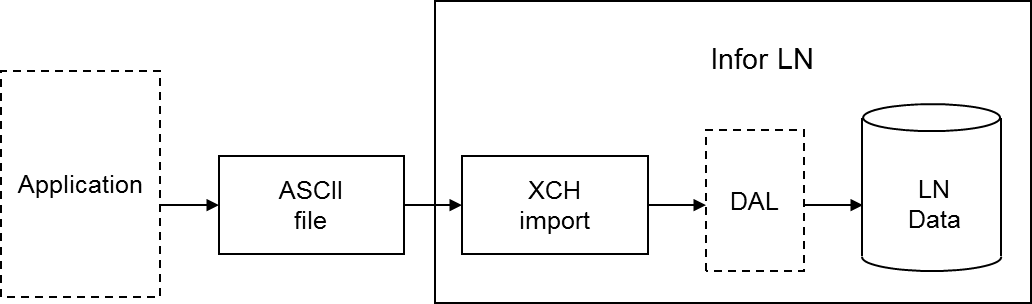
During an Exchange import, you can use all the functionality programmed into the Data Access Layer (DAL). If you use the DAL, Exchange carries out all the constraint checks, integrity checks, and side effects, for example, updates on other tables, that are programmed into the DAL. Database integrity is guaranteed automatically.

Using the DAL reduces the costs of interface development. You can use the DAL to import standard interfaces developed by Infor for partner products, as well as for specific interfaces built by customers, for example, to integrate LN with legacy systems. You can use the DAL in both single site and multisite environments.

The checks or additional actions specified in the DAL are carried out for each row that is imported. Database errors are logged in the same way for DAL and non-DAL import. DAL hook errors are also logged. You can specify whether the DAL property checks are or are not carried out.

If you specify the use of the DAL for a table relation for an import, the dal.new, dal.update, and dal.destroy functions are used instead of db.insert, db.update, and db.delete. You can choose to use DAL for particular tables and not for other tables, therefore, an import batch can contain both types of table relations simultaneously. The import through DAL works for both the import based on audit or indicators (inserts, updates, deletes), and the full import (inserts only).

DAL settings are run time aspects, which means you can change these aspects without having to regenerate the import program. DAL settings are also logged in the log table at batch line level, to enable you to find out what the DAL settings were when the import was run.

Important to realize is that an update through the DAL can result in a number of side effects. Actions performed by the DAL must not be carried out twice. For example, if the DAL updates the available to promise (ATP) quantity for an item when importing order data, the ATP quantity must not be updated in a condition script as well.

For this reason, you must not add any actions in condition scripts, or import additional data, that are already handled in the DAL.
FINANCE: Set Up and Calculate Currency Differences

To set up and calculate currency differences for foreign currencies:

  • Use the Company Parameters (tfgld0503m000) session to specify the profit and loss ledger accounts, 12 profit and loss dimensions, and transaction type for a posting exchange rate differences that is calculated using the FIFO method. To specify this data, use the Currency Diff. FIFO tab. The reports printed from the Print Company Parameters (tfgld0404m000) session, include the Currency Differences FIFO fields.
  • Use the Calculate Currency Differences (tfgld5201m000) session to calculate the currency differences resulting from transactions posted on accounts for which the field Currency Analysis in the session Chart of Accounts (tfgld0508m000) is set to Required.

OPERATIONS: Subcontracting Overview

Companies can decide to involve a subcontractor and subcontract part of their activities. The subcontractor carries out the work and returns the products to your company.

In Infor LN, subcontracting is considered as purchasing labor from a third party. Therefore, if a manufacturer wants to subcontract work, he must generate a purchase order to start the subcontracting process. These are the types of subcontracting:

  • Subcontracting with material flow
    • Operation subcontracting: For operation subcontracting, a part of the production process (one or more operations) is subcontracted.
    • Item subcontracting: For item subcontracting, an item's entire production process is subcontracted. Therefore, it is always used with material flow support.
  • Subcontracting without material flow: The simplest form of subcontracting is to generate a subcontracting purchase order to record the operations outsourced to a subcontractor. The subcontracting purchase order only represents the administrative handling of the subcontracting process. When the subcontracted item is received back from the subcontractor, you must close the subcontracting purchase order, which initiates the production process.
  • Unplanned subcontracting: Unplanned subcontracting is applicable when you subcontract after generating a production order. For unplanned subcontracting, a purchase order is generated from the production order and the material supply lines are populated by Shop Floor Control.
  • Service subcontracting: For service subcontracting, work on an item to be maintained or repaired is subcontracted. This work entails the entire repair process, or only a part of it. Service subcontracting can be used with or without material flow support.

To start the subcontracting process, a purchase order is required.

Previous Article Infor LN & Baan Tips & Tricks for FINANCE: Moving calendar periods
Next Article Infor LN & Baan Tips & Tricks for TECHNOLOGY: Using the Data Access Layer (DAL)
Print
2189 Rate this article:
5.0
Kathy Barthelt

Kathy BartheltKathy Barthelt

Other posts by Kathy Barthelt

Contact author

x

Categories