Please Wait a Moment
X

Infor LX Tips, Infor LN Tips, BPCS Tips, Baan Tips, Infor M3 Tips & Infor ERP News

Crossroads Connections

Infor ERP Tips & News from the Experts

Infor LX | Infor LN | BPCS | Baan | Infor M3

Infor LX & BPCS Tip: Customer Tax Exempt Declarations, SYS160D1

George Moroses 0 27951 Article rating: 5.0

The Customer Tax Exemption Maintenance program, SYS160, allows you to specify customer declarations used by the Customer Order Entry (ORD) and Billing (BIL) applications to apply a tax rate code to specific order lines of an invoice.

With this program, Infor LX can invoice customers without value-added tax (VAT) if one of the following conditions occurs:

  • The cumulated...

Infor LN & Baan Tip: Important Porting Set Announcement (all versions of LN & Baan)

Kathy Barthelt 0 76038 Article rating: 5.0

There has been a recent porting set change due to Infor’s Product Life Cycle Policy.  

How to determine the maintenance stage of an Infor LN product version and release

Before a customer starts deploying Porting Set 9.4a or a later release, they must determine the actual maintenance stage of their Baan / Infor LN product. The definition of the maintenance stages for the product versions and releases of all versions of Baan and Infor LN are outlined in the Product Support schedule as published in the PLC policy. The maintenance stage of the ERP version is either “Mainstream Maintenance”, “Extended Maintenance” or “Sustaining Maintenance”.

How to manage Porting Set updates

The following conditions apply to customers who intend to upgrade to Porting Set 9.4a or later Porting Set releases:

Are You Running Your IT Department, or is IT Running You?

Crossroads RMC 0 27809 Article rating: 5.0

It's hard to efficiently manage your ERP system and support the users who rely on it every day when you are spending all your time running your manufacturing business. We get it and want you to know you are not alone. 

Are you able to answer any of these questions?

  1. How much available disk space is there on my ERP system box?
  2. What happens when users encounter an error in the ERP system?
  3. How are new employees being brought up to speed on ERP functionality?
  4. What needs to be done to ensure optimal performance of our ERP system?

If you don’t know all the answers that's because it's not easy to be the ERP guru of a company AND successfully stay on top of everything that is necessary to keep your business systems running efficiently and effectively. So, this begs the question…why do it? ....

Don't laugh - the average lifespan of an ERP system is 7-10 years

Crossroads RMC 0 37705 Article rating: 5.0

Don’t laugh! I know, I know…many of our customers say that after 7-10 years they are finally settling in after the implementation! We have seen many a customer stretch out the lifespan of their ERP system to 20+ years. That sounds great for the company’s bank account, but is it good for the business?

An outdated ERP system hurts your business in many ways, not just with slow performance. The best-of-breed functionality is now 2 decades old, and obsolete technology can't leverage newer technology. Lack of integration leads to siloed data that hurts communication and your internal teams feel the pain, and your customers are noticing. Poor visibility into your operations makes it nearly impossible to achieve industry-based regulatory compliance and meet financial auditing requirements. Not to mention the sheer size of Big Data that is being collected today vs. 2 decades ago or the fact that your vendor is no longer supporting your ERP version.

Let’s scrap it all and start over!...

Infor LN & Baan Tip: Purchase Order Text

Kathy Barthelt 0 72485 Article rating: 5.0

Is the text linked to the purchase order just an information field? Could it be used for another purpose?

The text editor is just an information field when linked to the purchase order line and there is no other logic behind this functionality. The line text or the header text could be a part of the printed document. When you add text to a purchase order line you are creating a unique code that links the purchase order line (Baan - tdpur041/ LN - tdpur401) to the text (tttxt010).

Infor LX & BPCS Tip: Vendor Terms Maintenance, ACP160D1

George Moroses 0 36830 Article rating: 5.0

This program allows maintenance of vendor terms, which you individually assign to each vendor. Vendor terms designate the due date and the discount date as a number of days after the invoice date. You establish the discount percentage here. Vendor terms are stored in the AVT file. Rather than use the method specified above, you can override due dates and discount dates so those calendar days are used to age invoices.

Access: Menu ACP02

Infor LN & Baan: BIG DATA - Keeping Track of Key Metrics

Kathy Barthelt 0 101489 Article rating: 5.0

In order to communicate effectively as a team, everyone needs to speak the same language and operate off the same playbook. If decisions are made based on the data or the view of data that individuals are maintaining through their own spreadsheets or other data silos, then communication is negatively impacted.

Manufacturers need to review large amounts of data every day, making it difficult to keep track of key metrics within your department.

That’s where Crossroads RMC’s Analytics Dashboard solution comes in. Our Analytics Dashboard was developed to make tasks easier by putting all of the key information in one convenient location so you can view all of your crucial data in real-time. 

With powerful dashboards, you can...

First4142434446484950Last

Tips:  LX | BPCS | M3

Tips: LN | Baan

Kathy Barthelt

Infor LN & Baan Tips & Tricks for TECHNOLOGY: Using the Data Access Layer (DAL)

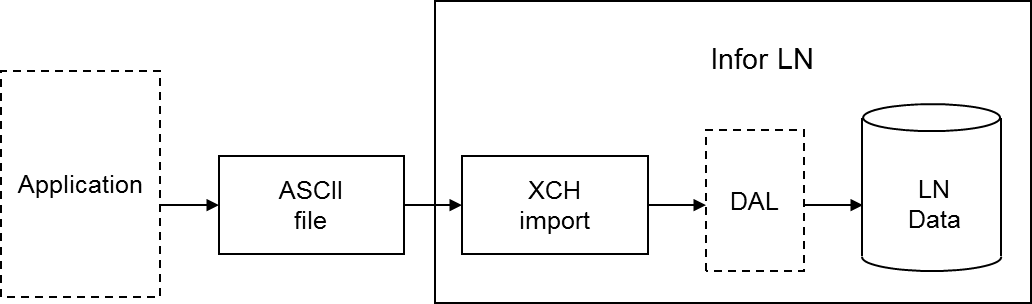
During an Exchange import, you can use all the functionality programmed into the Data Access Layer (DAL). If you use the DAL, Exchange carries out all the constraint checks, integrity checks, and side effects, for example, updates on other tables, that are programmed into the DAL. Database integrity is guaranteed automatically.

Using the DAL reduces the costs of interface development. You can use the DAL to import standard interfaces developed by Infor for partner products, as well as for specific interfaces built by customers, for example, to integrate LN with legacy systems. You can use the DAL in both single site and multisite environments.

The checks or additional actions specified in the DAL are carried out for each row that is imported. Database errors are logged in the same way for DAL and non-DAL import. DAL hook errors are also logged. You can specify whether the DAL property checks are or are not carried out.

If you specify the use of the DAL for a table relation for an import, the dal.new, dal.update, and dal.destroy functions are used instead of db.insert, db.update, and db.delete. You can choose to use DAL for particular tables and not for other tables, therefore, an import batch can contain both types of table relations simultaneously. The import through DAL works for both the import based on audit or indicators (inserts, updates, deletes), and the full import (inserts only).

DAL settings are run time aspects, which means you can change these aspects without having to regenerate the import program. DAL settings are also logged in the log table at batch line level, to enable you to find out what the DAL settings were when the import was run.

Important to realize is that an update through the DAL can result in a number of side effects. Actions performed by the DAL must not be carried out twice. For example, if the DAL updates the available to promise (ATP) quantity for an item when importing order data, the ATP quantity must not be updated in a condition script as well.

For this reason, you must not add any actions in condition scripts, or import additional data, that are already handled in the DAL.
Previous Article Infor LN & Baan Tips & Tricks for EXECUTIVES
Next Article Infor LN & Baan Tips & Tricks for FINANCE: Set Up and Calculate Currency Differences
Print
5427 Rate this article:
5.0
Kathy Barthelt

Kathy BartheltKathy Barthelt

Other posts by Kathy Barthelt

Contact author

x

Categories