Infor ERP Tips and Infor ERP News for Infor LX, BPCS, Infor ERP LX, Infor LN, Infor ERP LN, Baan, Infor M3, and Movex

Please Wait a Moment
X

Infor LX Tips, Infor LN Tips, BPCS Tips, Baan Tips, Infor M3 Tips & Infor ERP News

Crossroads Connections

Infor ERP Tips & News from the Experts

Infor LX | Infor LN | BPCS | Baan | Infor M3

Digital Transformation & Your ERP

70% of global executives said the pandemic will accelerate their digital transformation pace

Crossroads RMC 0 24165 Article rating: 5.0

Transformation: (definition)  A thorough and dramatic change.

We all dream about it….how can we transform ourselves into something better…something more desirable? Maybe it is our appearance that we want to improve, maybe it is our physical strength and stamina, or maybe it is our mental toughness.

Have we thought about transformation when it comes to our businesses? More specifically, our ERP systems that are the lifeblood of our businesses?

When it comes to this type of transformation, we’re talking about a digital transformation. This means taking...

What are your production orders telling you?

Infor LX | BPCS | Infor LN | Baan

Crossroads RMC 0 19973 Article rating: 5.0

MEASURE WHAT YOU WANT TO IMPROVE!

Six simple words, but put together they convey a powerful concept that can transform manufacturing companies. It’s a basic concept that’s hard to argue with: Collect data, see where the data leads you, and make changes that have a positive impact on the data. Repeat often.

If your company is manufacturing a product, you’re...

Infor LX & BPCS Tip: MPS Planned vs. MRP Planned

George Moroses 0 24179 Article rating: 5.0

What items should be MPS planned, and what items should be MRP planned?
Master Scheduled Items are those items that are finished goods, or service items, that receive their requirements either specifically from Independent demand, or both Dependent and Independent demand.

  • Independent Demand is demand that cannot be calculated from higher-level demand in the product structure, and therefore must be either a forecast or an actual customer order (Finished Goods or Service parts sold to customers).
  • Dependent demand is derived from higher-level demand in the product structure. Dependent demand includes components, raw materials, and sub-assemblies. (these are not normally Master Scheduled Items).
  • Service Parts may have both independent demand from forecast and/or customer orders, as well as dependent demand from higher-level demand if that item is also used in other sub-assemblies or products.
  • Cumulative Lead Time is a concept used in Master Production Scheduling (MPS) that combines the “fixed” lead time, and the “variable” lead time needed to produce the product. It is the longest path through a given Bill-of-material. Based on the MPS setup options, Infor LX (ERP LX) will calculate the cumulative lead time (also called “the Critical Path”) for you (use the “indented BOM” display in BOM300 and find the item with the longest lead time “L/T”). Note: You may have to use Action 21, Line Detail, to see the “L/T” lead time for each item.

Infor LN & Baan Finance Tip: MPS Planned vs. MRP Planned

Kathy Barthelt 0 64845 Article rating: 5.0

What items should be MPS planned, and what items should be MRP planned…

Master Scheduled Items are those items that are finished goods, or service items, that receive their requirements either specifically from Independent demand, or both Dependent and Independent demand.

  • Independent Demand is...

Crossroads RMC Welcomes Robert Brown!

Crossroads RMC 0 20408 Article rating: 5.0

Crossroads RMC Welcomes Robert Brown, as a Sr. Business Consultant!
Bob brings 30+ years of shop floor and project management skills to Crossroad RMC. He is a self-starter that has progressively mastered the Manufacturing, Supply Chain, and Finance modules within Infor LX. Bob will get started with EDI/ECM set up for new trading partners and within the Supply Chain ranks. Bob is a great addition to the Crossroads RMC team, and we look forward to his leadership expertise on implementations and upgrades in the near future.

You can benefit from a business process review only if...

Infor LX | BPCS | Infor LN | Baan

Crossroads RMC 0 24064 Article rating: 5.0

Did you implement your ERP system 5 years ago… or maybe 20 years ago? At the time, it was like a brand new car… sleek, fast, top-of-the-line, and fuel-efficient. And although it may have needed a few minor “adjustments”, overall you were very pleased. Fast forward to today. Does it still have that new car smell? Does it run as efficiently as it used to? Do you know how to fix a problem when it occurs?

While ERP systems are certainly designed to last, over time, your business changes, your customers’ needs change, employees change and you are left with a system that may run “fine”, but you certainly don’t feel the same way about it as you did when it was brand new.

So the good news is that you CAN restore that “new car smell” with a utilization review, or business process review.

What is a Utilization or Business Process Review and Why Do I Need One?
Simply put, a business process review is an...

Dashboards vs. Reports – What do they offer and which do I need?

Crossroads RMC 0 31089 Article rating: 5.0

Companies are collecting oceans of data, and struggle with transforming it into usable information. Most businesses focus on two methods of sharing data - the report and the dashboard. While these two terms mean many things to many people, it is important to understand what these terms mean and how the report and dashboard have similar features but they are not the same thing.  

What is a Report?

A report is meant to be used to gather detailed intelligence on the operations within an organization, thus a report can be either very broadly covering a wide scope of related information, or narrowly focusing on details of a single item, purpose, or event. All of this information, while presented in a report, is meant to be a snapshot in time.

Quite often, a report is built within the ERP system itself and often is constrained by the graphical and user limitations within the ERP. More often than not, large amounts of data are exported to Excel where added features allow for better manipulation of the data to a format that is digestible by users. Regardless, the data is only valid for that moment and time.

What is a Dashboard?

A dashboard is a graphical interface that provides at-a-glance views revolving around answering a central question. For example, an executive may ask you for up-to-the-minute details on "how the business is doing?". The answer to that question is as complex as the organizational structure of the company, but it is probably very simply measured with approximately 10 metrics. Those 10 metrics can likely be analyzed in chart form, and can and should be combined into one chart when the numbers are relatable or are on a similar scale. All these things should be considered when building a dashboard.

Dashboards, similar to the one in your vehicle, display critical data. Imagine driving down the road and having to push a bunch of buttons to find out how much fuel you have left, or having to pull over and pop the hood to check the oil pressure. It would be dangerous and a waste of your precious time. Your car's control panel or dashboard displays the most crucial information in an easy-to-use, graphical way.

How do Dashboards and Reports differ?

First3738394042444546Last

Tips:  LX | BPCS | M3

Tips: LN | Baan

Kathy Barthelt

Infor LN & Baan Tips & Tricks for TECHNOLOGY: Using the Data Access Layer (DAL)

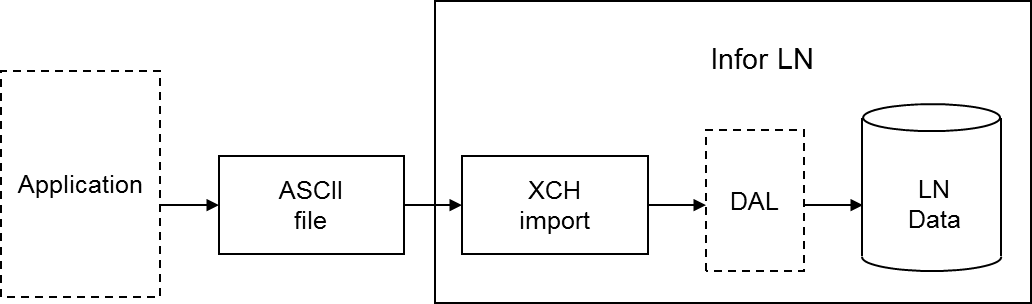
During an Exchange import, you can use all the functionality programmed into the Data Access Layer (DAL). If you use the DAL, Exchange carries out all the constraint checks, integrity checks, and side effects, for example, updates on other tables, that are programmed into the DAL. Database integrity is guaranteed automatically.

Using the DAL reduces the costs of interface development. You can use the DAL to import standard interfaces developed by Infor for partner products, as well as for specific interfaces built by customers, for example, to integrate LN with legacy systems. You can use the DAL in both single site and multisite environments.

The checks or additional actions specified in the DAL are carried out for each row that is imported. Database errors are logged in the same way for DAL and non-DAL import. DAL hook errors are also logged. You can specify whether the DAL property checks are or are not carried out.

If you specify the use of the DAL for a table relation for an import, the dal.new, dal.update, and dal.destroy functions are used instead of db.insert, db.update, and db.delete. You can choose to use DAL for particular tables and not for other tables, therefore, an import batch can contain both types of table relations simultaneously. The import through DAL works for both the import based on audit or indicators (inserts, updates, deletes), and the full import (inserts only).

DAL settings are run time aspects, which means you can change these aspects without having to regenerate the import program. DAL settings are also logged in the log table at batch line level, to enable you to find out what the DAL settings were when the import was run.

Important to realize is that an update through the DAL can result in a number of side effects. Actions performed by the DAL must not be carried out twice. For example, if the DAL updates the available to promise (ATP) quantity for an item when importing order data, the ATP quantity must not be updated in a condition script as well.

For this reason, you must not add any actions in condition scripts, or import additional data, that are already handled in the DAL.
Previous Article Infor LN & Baan Tips & Tricks for EXECUTIVES
Next Article Infor LN & Baan Tips & Tricks for FINANCE: Set Up and Calculate Currency Differences
Print
10363 Rate this article:
5.0
Kathy Barthelt

Kathy BartheltKathy Barthelt

Other posts by Kathy Barthelt

Contact author

x

Categories