Please Wait a Moment
X

Infor LX Tips, Infor LN Tips, BPCS Tips, Baan Tips, Infor M3 Tips & Infor ERP News

Crossroads Connections

Infor ERP Tips & News from the Experts

Infor LX | Infor LN | BPCS | Baan | Infor M3

Infor LX & BPCS Tip: What is System i Workspace AnyWhere?

George Moroses 0 28328 Article rating: 5.0

Infor System i Workspace AnyWhere is a user interface for launching Infor ERP and IBM i application tasks through a web browser. It provides an intuitive way for users to navigate through the System Manager Menu structure and to launch tasks that can display screens either using a graphical or an emulator look and feel.

Learn more> System i Workspace AnyWhere Product Guide

Manufacturing vs. Operations vs. Finance: Who WINS?

Infor LX | BPCS | Infor LN | Baan

Crossroads RMC 0 22021 Article rating: 5.0

Manufacturing Goals: develop high-quality products and services in response to the demands of the market, improve efficiency and maximize capacity utilization.

Operations Goals: utilize resources, labor, material, and equipment effectively in order to match supply and demand.

Finance Goals: analyze revenue growth opportunities, control costs, and maximize profitability.

So, who WINS?

3+ Reasons to Invest in Automated Tax Compliance with Crossroads RMC & Avalara

Crossroads RMC 0 24056 Article rating: 5.0

Without automation, your tax professionals are buried in endless tasks that should be offloaded. Every hour spent on tax management is an hour lost on other, more important, parts of your business. Then, of course, there is the audit risk, UGH!

Crossroads RMC and Avalara provide seamless integrations to Infor LN (ERP LN), Baan, Infor LX (ERP LX), and BPCS.

Want to learn how automating tax compliance can benefit your company? Click on each success story below to find out how a partnership between your organization, Avalara, and Crossroads RMC can be a HUGE WIN for your business!...

Infor ERP Tip of the Week: 5 Steps to Managing Sales Tax

Infor LX | BPCS | Infor LN | Baan

Crossroads RMC 0 38631 Article rating: 5.0

The world of sales tax is constantly changing and can be extremely confusing, but getting it right is crucial to your company’s success. As your business evolves, your sales tax obligations may also change. Through it all, there are typically five steps involved in maintaining sales tax compliance. Review the steps below to understand your complete sales tax picture.

Step 1: Know where your business must collect...

Infor LN & Baan Tip: Defining “Unavailability” in Infor LN

Kathy Barthelt 0 31016 Article rating: 5.0

This topic describes the definition of temporary unavailability for resources in a calendar.

Use one of the following sessions:

  • Recurring unavailability
    For recurring unavailability, such as national holidays, define the recurrence in the Recurrences (tcccp0143m000) session. Add that recurrence to the applicable calendar and...

“Sorry, boss. We can’t help you move the business forward.”

Infor LX | BPCS | Infor LN | Baan

Crossroads RMC 0 18613 Article rating: 5.0

Imagine saying that to your boss, or the president of your company. What would their response be? Do you think they would say, “It’s ok, we can wait to save a ton of money and move us ahead of the competition... No problem... let me know when you have time to work on it.”  Pretty unlikely. Instead, they will want you to...

What you missed: Infor’s vision for the IBM i teams’ future alignment and focus – Register today!

Inforum

George Moroses 0 23218 Article rating: 5.0

What you missed at Inforum

Infor’s vision for the IBM i teams’ future alignment and focus – Register today!

February 8 | 11am CT / 12pm ET

Join this webinar to hear Jay Allison, Director of Sales, share some insight into Infor’s vision for the IBM i teams’ future alignment and focus. Also hear from David Rapacz, Product Manager for Infor LX, on what you may have missed at Inforum as well as some product updates.

Register today via the LX Community calendar.

Infor LN & Baan Tip: Porting Set Issues

Kathy Barthelt 0 62515 Article rating: 5.0

Are you on the latest porting set for your version of Baan or Infor LN?

Here are some issues you might run into if you stay on an old porting set too long:

  • Incompatibility because of operating system patches
  • Printing issues because of out-of-date libraries
  • Potential performance issues if binaries are not updated
  • Updating...
First3738394042444546Last

Tips:  LX | BPCS | M3

Tips: LN | Baan

Kathy Barthelt

Infor LN & Baan Tips & Tricks for EXECUTIVES

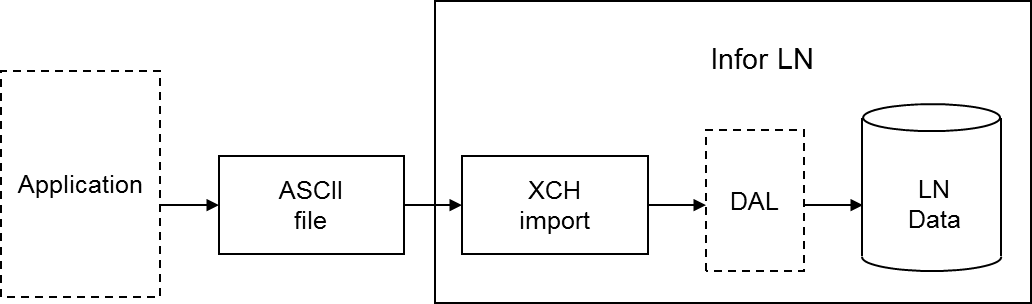
TECHNOLOGY: Using the Data Access Layer (DAL)

During an Exchange import, you can use all the functionality programmed into the Data Access Layer (DAL). If you use the DAL, Exchange carries out all the constraint checks, integrity checks, and side effects, for example, updates on other tables, that are programmed into the DAL. Database integrity is guaranteed automatically.

Using the DAL reduces the costs of interface development. You can use the DAL to import standard interfaces developed by Infor for partner products, as well as for specific interfaces built by customers, for example, to integrate LN with legacy systems. You can use the DAL in both single site and multisite environments.

The checks or additional actions specified in the DAL are carried out for each row that is imported. Database errors are logged in the same way for DAL and non-DAL import. DAL hook errors are also logged. You can specify whether the DAL property checks are or are not carried out.

If you specify the use of the DAL for a table relation for an import, the dal.new, dal.update, and dal.destroy functions are used instead of db.insert, db.update, and db.delete. You can choose to use DAL for particular tables and not for other tables, therefore, an import batch can contain both types of table relations simultaneously. The import through DAL works for both the import based on audit or indicators (inserts, updates, deletes), and the full import (inserts only).

DAL settings are run time aspects, which means you can change these aspects without having to regenerate the import program. DAL settings are also logged in the log table at batch line level, to enable you to find out what the DAL settings were when the import was run.

Important to realize is that an update through the DAL can result in a number of side effects. Actions performed by the DAL must not be carried out twice. For example, if the DAL updates the available to promise (ATP) quantity for an item when importing order data, the ATP quantity must not be updated in a condition script as well.

For this reason, you must not add any actions in condition scripts, or import additional data, that are already handled in the DAL.
FINANCE: Set Up and Calculate Currency Differences

To set up and calculate currency differences for foreign currencies:

  • Use the Company Parameters (tfgld0503m000) session to specify the profit and loss ledger accounts, 12 profit and loss dimensions, and transaction type for a posting exchange rate differences that is calculated using the FIFO method. To specify this data, use the Currency Diff. FIFO tab. The reports printed from the Print Company Parameters (tfgld0404m000) session, include the Currency Differences FIFO fields.
  • Use the Calculate Currency Differences (tfgld5201m000) session to calculate the currency differences resulting from transactions posted on accounts for which the field Currency Analysis in the session Chart of Accounts (tfgld0508m000) is set to Required.

OPERATIONS: Subcontracting Overview

Companies can decide to involve a subcontractor and subcontract part of their activities. The subcontractor carries out the work and returns the products to your company.

In Infor LN, subcontracting is considered as purchasing labor from a third party. Therefore, if a manufacturer wants to subcontract work, he must generate a purchase order to start the subcontracting process. These are the types of subcontracting:

  • Subcontracting with material flow
    • Operation subcontracting: For operation subcontracting, a part of the production process (one or more operations) is subcontracted.
    • Item subcontracting: For item subcontracting, an item's entire production process is subcontracted. Therefore, it is always used with material flow support.
  • Subcontracting without material flow: The simplest form of subcontracting is to generate a subcontracting purchase order to record the operations outsourced to a subcontractor. The subcontracting purchase order only represents the administrative handling of the subcontracting process. When the subcontracted item is received back from the subcontractor, you must close the subcontracting purchase order, which initiates the production process.
  • Unplanned subcontracting: Unplanned subcontracting is applicable when you subcontract after generating a production order. For unplanned subcontracting, a purchase order is generated from the production order and the material supply lines are populated by Shop Floor Control.
  • Service subcontracting: For service subcontracting, work on an item to be maintained or repaired is subcontracted. This work entails the entire repair process, or only a part of it. Service subcontracting can be used with or without material flow support.

To start the subcontracting process, a purchase order is required.

Previous Article Infor LN & Baan Tips & Tricks for FINANCE: Moving calendar periods
Next Article Infor LN & Baan Tips & Tricks for TECHNOLOGY: Using the Data Access Layer (DAL)
Print
2189 Rate this article:
5.0
Kathy Barthelt

Kathy BartheltKathy Barthelt

Other posts by Kathy Barthelt

Contact author

x

Categories