Please Wait a Moment
X

Infor LX Tips, Infor LN Tips, BPCS Tips, Baan Tips, Infor M3 Tips & Infor ERP News

Crossroads Connections

Infor ERP Tips & News from the Experts

Infor LX | Infor LN | BPCS | Baan | Infor M3

Baan/LN Tip of the Day: Vendor Rating

Kathy Barthelt 0 1416 Article rating: No rating

In LN, a supplier's reliability is no longer based only on correct deliveries. The vendor rating functionality of LN is based on various objective criteria and subjective criteria that can be used to calculate the vendor’s rating.


The set up procedure for analyzing suppliers has changed completely compared to Baan IV.  To execute the vendor rating process, users must update the vendor ratings in the Update Vendor Rating (tdpur8850m000) session.

If users update the vendor ratings, the following stages exist in the update vendor rating procedure:


1. Calculate actual weightings

2. Calculate ratings for objective criteria

3. Calculate ratings for subjective criteria

4. Update overall vendor rating

Baan/LN Tip of the Day: Release Commissions/Rebates to Invoicing

Kathy Barthelt 0 3103 Article rating: No rating

In Baan IV, this session is called Release Commissions/Rebates to Invoicing (tdcms2201m000) and is used to set the status of the commissions/rebates to Reserved, or Closed. In Infor LN, this session is only used to set the status to  Closed. Users can reserve commissions/rebates in the Reservation and Approval of Reserved Commissions/Rebates (tdcms2202m000) session. In addition, the following fields are added to the Release Commissions/Rebates to Invoicing (tdcms2201m000) session:

▪ Commissions to Accounts Payable

▪ Rebates to Central Invoicing

BPCS/LX Tip of the Day: How Does LX Fit in With Just-In-Time?

Anthony Etzel 0 364 Article rating: No rating

For years, repetitive manufacturing industries have been applying many of the principles in Just-in-Time philosophy. They have established balanced production lines that depend on a steady flow of material to each work station. They schedule production in daily or weekly rates rather than in discrete shop order lots. They track finished inventory by work center rather than by job. They typically backflush stock balances (decrement stock balances upon completion of specific manufacturing steps rather than issued at the beginning of each production run).


Costing is typically based upon a daily rate or hourly rate rather than being associated with specific shop orders. 


Repetitive manufacturers use MRP II software adaptable to their environments

in the following key areas:


 Product definition

 Inventory tracking

 MRP/Master Scheduling

 Shop Floor Control

 Purchasing

 Costing

BPCS/LX Tip of the Day: What is Just-In-Time?

Anthony Etzel 0 313 Article rating: No rating

Just-in-Time (JIT) is a management philosophy that focuses on minimizing the resources necessary to add value to your products and to operate your factory in ways that eliminate waste. Resources are labor, materials, equipment, space, and time. Waste is anything that does not add value to your products. Moving work-in-process from place to place, stacking and sorting, investing capital in large work-in-process and raw material inventories, inspecting materials at your vendors' sites, and tying up warehouse space with finished goods are all activities that add cost, not value, to your products. 

JIT is a process that reduces lead time. JIT does not replace an MRP, an inventory program, a scheduling technique to bypass your Master Schedule, or a materials management project. JIT is the never-ending commitment of everyone, from top management to your workers on the floor, to maximize your effectiveness through continuous, incremental improvements.

Baan/LN Tip of the Day: Configuring Items

Kathy Barthelt 0 2237 Article rating: No rating

In LN, the configuration of a generic item not always results into a customized item. Configured items can now be customized items as well as standard items. If users configure items without PCS projects, standard items are generated instead of customized items.


The sessions for generating product variant structures for sales quotations and sales orders are moved from the Product Configuration module in Manufacturing to the Sales Control module in LN. The following new sessions are available in Sales Control:

▪ Generate (Budget) Structure for Sales Quotations (tdsls1201m100).

▪ Generate (Project) Structure for Sales Orders (tdsls4244m000)

BPCS/LX Tip of the Day: Shop Order Control

Anthony Etzel 0 443 Article rating: No rating

To create and maintain shop orders use SFC500 Shop Order Entry Maintenance. These orders use the standard bill of material (BOM) as the base list of components. You can also set up standard routings, which list the operations,

or work steps, involved in manufacturing.


To release shop orders, use the Shop Order Release program, SFC505. Infor ERP LX groups shop orders by user ID for batch processing. Use Shop Packet Print, SFC520, to print the shop orders that you select. SFC530 allows you to create multi-level shop orders to link shop orders together with a common end item parent. Linking multiple shop orders together for a final assembly product provides support for make-to-order and engineer-to-order manufacturing environments which need to schedule these multiple orders together or as a vertical slice in the production schedule.


You can make changes to shop orders after you print them. Use Shop Order Entry/Maintenance, SFC500, to update the shop orders. Changes are immediately visible on the inquiry screens for SFC300 and SFC350. To reprint the shop packet, use Reprint Shop Packet, SFC560.

Baan/LN Tip of the Day: Multi-Company Service

Kathy Barthelt 0 240 Article rating: No rating

Service departments and warehouses that contain spare parts and components used for service and maintenance belong to enterprise units. To perform separate financial accounting for the service departments and their warehouses, you can assign service departments and warehouses to enterprise units that are linked to different financial companies.


If material, labor, or other costs are transferred between service departments and warehouses, or from one service department to another (in the case of internal subcontracting for depot repair), LN can perform the invoicing between these departments and warehouses. In the Enterprise Modeling Management module, you can define internal trade relationships with invoicing between various entities.


You can also record and process service operations in a multi-logistic company environment.

BPCS/LX Tip of the Day: Material Requirement Dates and Lead Time Offsets in MRP

Anthony Etzel 0 322 Article rating: No rating

The system automatically performs offsets for requirements dates for components in the MPS/MRP calculations. It also performs offsets for calculation of material need dates at the time that shop orders are released.


To calculate the offset, the system takes the parent lead time from the Item 
Master and adjusts it by the bill of materials offset (plus or minus) for the component. This gives the lead time days for that specific component. The system starts with the due date of the parent and backs up and skips all non-work days in the shop calendar.


Note that the offset calculation uses only calendar records that have a blank 
work center (the calendar record applies to all work centers). See the information for the Shop Calendar Maintenance program SFC140, in your Shop Floor Control documentation for shop calendar details.

First120121122123125127128129Last

Tips:  LX | BPCS | M3

Tips: LN | Baan

Kathy Barthelt

Infor LN & Baan Tips & Tricks for EXECUTIVES

TECHNOLOGY: Using the Data Access Layer (DAL)

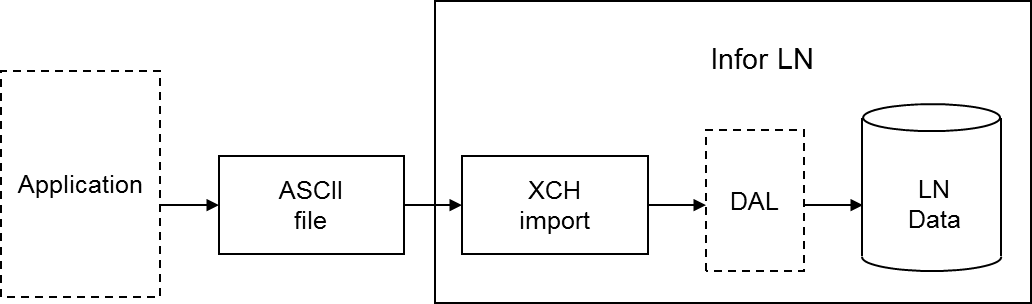
During an Exchange import, you can use all the functionality programmed into the Data Access Layer (DAL). If you use the DAL, Exchange carries out all the constraint checks, integrity checks, and side effects, for example, updates on other tables, that are programmed into the DAL. Database integrity is guaranteed automatically.

Using the DAL reduces the costs of interface development. You can use the DAL to import standard interfaces developed by Infor for partner products, as well as for specific interfaces built by customers, for example, to integrate LN with legacy systems. You can use the DAL in both single site and multisite environments.

The checks or additional actions specified in the DAL are carried out for each row that is imported. Database errors are logged in the same way for DAL and non-DAL import. DAL hook errors are also logged. You can specify whether the DAL property checks are or are not carried out.

If you specify the use of the DAL for a table relation for an import, the dal.new, dal.update, and dal.destroy functions are used instead of db.insert, db.update, and db.delete. You can choose to use DAL for particular tables and not for other tables, therefore, an import batch can contain both types of table relations simultaneously. The import through DAL works for both the import based on audit or indicators (inserts, updates, deletes), and the full import (inserts only).

DAL settings are run time aspects, which means you can change these aspects without having to regenerate the import program. DAL settings are also logged in the log table at batch line level, to enable you to find out what the DAL settings were when the import was run.

Important to realize is that an update through the DAL can result in a number of side effects. Actions performed by the DAL must not be carried out twice. For example, if the DAL updates the available to promise (ATP) quantity for an item when importing order data, the ATP quantity must not be updated in a condition script as well.

For this reason, you must not add any actions in condition scripts, or import additional data, that are already handled in the DAL.
FINANCE: Set Up and Calculate Currency Differences

To set up and calculate currency differences for foreign currencies:

  • Use the Company Parameters (tfgld0503m000) session to specify the profit and loss ledger accounts, 12 profit and loss dimensions, and transaction type for a posting exchange rate differences that is calculated using the FIFO method. To specify this data, use the Currency Diff. FIFO tab. The reports printed from the Print Company Parameters (tfgld0404m000) session, include the Currency Differences FIFO fields.
  • Use the Calculate Currency Differences (tfgld5201m000) session to calculate the currency differences resulting from transactions posted on accounts for which the field Currency Analysis in the session Chart of Accounts (tfgld0508m000) is set to Required.

OPERATIONS: Subcontracting Overview

Companies can decide to involve a subcontractor and subcontract part of their activities. The subcontractor carries out the work and returns the products to your company.

In Infor LN, subcontracting is considered as purchasing labor from a third party. Therefore, if a manufacturer wants to subcontract work, he must generate a purchase order to start the subcontracting process. These are the types of subcontracting:

  • Subcontracting with material flow
    • Operation subcontracting: For operation subcontracting, a part of the production process (one or more operations) is subcontracted.
    • Item subcontracting: For item subcontracting, an item's entire production process is subcontracted. Therefore, it is always used with material flow support.
  • Subcontracting without material flow: The simplest form of subcontracting is to generate a subcontracting purchase order to record the operations outsourced to a subcontractor. The subcontracting purchase order only represents the administrative handling of the subcontracting process. When the subcontracted item is received back from the subcontractor, you must close the subcontracting purchase order, which initiates the production process.
  • Unplanned subcontracting: Unplanned subcontracting is applicable when you subcontract after generating a production order. For unplanned subcontracting, a purchase order is generated from the production order and the material supply lines are populated by Shop Floor Control.
  • Service subcontracting: For service subcontracting, work on an item to be maintained or repaired is subcontracted. This work entails the entire repair process, or only a part of it. Service subcontracting can be used with or without material flow support.

To start the subcontracting process, a purchase order is required.

Previous Article Infor LN & Baan Tips & Tricks for FINANCE: Moving calendar periods
Next Article Infor LN & Baan Tips & Tricks for TECHNOLOGY: Using the Data Access Layer (DAL)
Print
2129 Rate this article:
5.0
Kathy Barthelt

Kathy BartheltKathy Barthelt

Other posts by Kathy Barthelt

Contact author

x

Categories