Please Wait a Moment
X

Infor LX Tips, Infor LN Tips, BPCS Tips, Baan Tips, Infor M3 Tips & Infor ERP News

Crossroads Connections

Infor ERP Tips & News from the Experts

Infor LX | Infor LN | BPCS | Baan | Infor M3

BPCS/LX Tip of the Week: Ways to Prevent Scrap & Rework From Costing You

Anthony Etzel 0 53110 Article rating: No rating

Scrap and rework costs are a manufacturing reality impacting organizations across all industries and product lines.

Scrap and rework costs are caused by many things—when the wrong parts are ordered, when engineering changes aren’t effectively communicated or when designs aren’t properly executed on the manufacturing line.

No matter why scrap and rework occurs, its impact on an organization is always the same—wasted time and money. And while no one, especially an operations manager, wants to admit it, these expenses add up quickly and negatively impact the bottom line...

Read Full Article

Baan/LN Tip of the Week: Ways to Prevent Scrap & Rework From Costing You

Kathy Barthelt 0 81761 Article rating: No rating

Scrap and rework costs are a manufacturing reality impacting organizations across all industries and product lines.

Scrap and rework costs are caused by many things—when the wrong parts are ordered, when engineering changes aren’t effectively communicated or when designs aren’t properly executed on the manufacturing line.

No matter why scrap and rework occurs, its impact on an organization is always the same—wasted time and money. And while no one, especially an operations manager, wants to admit it, these expenses add up quickly and negatively impact the bottom line...

Read Full Article

Tip of the Week: 8 Common-Sense Rules for Inventory Management

Anthony Etzel 0 55904 Article rating: No rating

Common sense rules. We may not like them, but generally, they stand the test of time and should be followed. Here are 8 common sense rules related to inventory management published by Inbound Logistics back in 2007. They still hold true today. 

1. If you don' t know where you are going, no road will take you there. Enterprise resource management systems are designed to tell you about today' s inventory. With some work, you can also access information about past inventory. To manage inventory proactively, however, you must know projected inventory levels for the future.

2. Make what you can sell. An integrated Sales and Operations Plan will naturally take into account expected demand in its production plan. Inventory is not an independent variable - it is the direct result of demand and supply.

3. Sell what you can make. Too often, a disconnect exists between sales and marketing desires and the reality of production capabilities.

4. If you can' t sell it, stop making it. If demand for your product does not materialize, you need to identify that gap quickly to avoid a buildup of non-moving inventory. Numerous mechanisms can be put in place to identify such trends.

For tips 5 through 8 and more details into the other tips, click the button below to read the full article.

Read Full Article

Tip of the Week: 8 Common-Sense Rules for Inventory Management

Kathy Barthelt 0 80965 Article rating: No rating

Common sense rules. We may not like them, but generally, they stand the test of time and should be followed. Here are 8 common sense rules related to inventory management published by Inbound Logistics back in 2007. They still hold true today. 

1. If you don' t know where you are going, no road will take you there. Enterprise resource management systems are designed to tell you about today' s inventory. With some work, you can also access information about past inventory. To manage inventory proactively, however, you must know projected inventory levels for the future.

2. Make what you can sell. An integrated Sales and Operations Plan will naturally take into account expected demand in its production plan. Inventory is not an independent variable - it is the direct result of demand and supply.

3. Sell what you can make. Too often, a disconnect exists between sales and marketing desires and the reality of production capabilities.

4. If you can' t sell it, stop making it. If demand for your product does not materialize, you need to identify that gap quickly to avoid a buildup of non-moving inventory. Numerous mechanisms can be put in place to identify such trends.

For tips 5 through 8 and more details into the other tips, click the button below to read the full article.

Read Full Article

Crossroads RMC to Exhibit at Inforum 2016

Crossroads RMC 0 29151 Article rating: No rating

Inforum 2016  returns as a three and a half-day event of educational seminars and workshops focused on the future of enterprise software and your business. This event is Infor’s premier event for 2016, and Crossroads RMC is excited to sponsor the event! Come see us in Booth 173 to learn about Crossroads MES and Analytics Dashboard solutions for the shop floor, our Services for Baan/LN and BPCS/LX, and see a demo of our latest solution, Analytics Dashboard, which can be connected to any ERP to provide up to the minute sales analysis data.


If ERP is plumbing for the Enterprise - How do we unplug it and keep it from making a huge mess?

David Dickson 0 38922 Article rating: 5.0

I have been working with ERP in various roles for over 30 years, directly involved in over a hundred implementations, while my company has been involved with over 400 more. Of course, in many ways the systems we use today are completely different from what we used in the ‘80s – back then it was green screens, simple transaction entry forms, and cumbersome updates (at best) to link what one department did with all the other areas that needed access to that information. Then there were those planning programs that took all the information along with various parameters the users needed to set and told us what to do.

The More Things Change, the More They Stay the Same

First107108109110112114115116Last

Tips:  LX | BPCS | M3

Tips: LN | Baan

Kathy Barthelt

Infor LN & Baan Tips & Tricks for EXECUTIVES

TECHNOLOGY: Using the Data Access Layer (DAL)

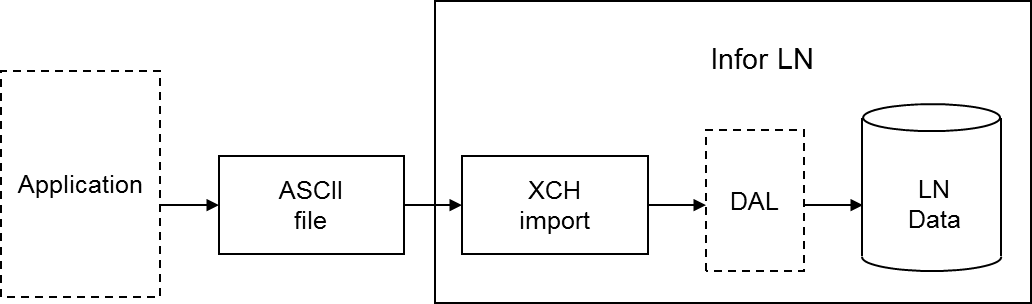
During an Exchange import, you can use all the functionality programmed into the Data Access Layer (DAL). If you use the DAL, Exchange carries out all the constraint checks, integrity checks, and side effects, for example, updates on other tables, that are programmed into the DAL. Database integrity is guaranteed automatically.

Using the DAL reduces the costs of interface development. You can use the DAL to import standard interfaces developed by Infor for partner products, as well as for specific interfaces built by customers, for example, to integrate LN with legacy systems. You can use the DAL in both single site and multisite environments.

The checks or additional actions specified in the DAL are carried out for each row that is imported. Database errors are logged in the same way for DAL and non-DAL import. DAL hook errors are also logged. You can specify whether the DAL property checks are or are not carried out.

If you specify the use of the DAL for a table relation for an import, the dal.new, dal.update, and dal.destroy functions are used instead of db.insert, db.update, and db.delete. You can choose to use DAL for particular tables and not for other tables, therefore, an import batch can contain both types of table relations simultaneously. The import through DAL works for both the import based on audit or indicators (inserts, updates, deletes), and the full import (inserts only).

DAL settings are run time aspects, which means you can change these aspects without having to regenerate the import program. DAL settings are also logged in the log table at batch line level, to enable you to find out what the DAL settings were when the import was run.

Important to realize is that an update through the DAL can result in a number of side effects. Actions performed by the DAL must not be carried out twice. For example, if the DAL updates the available to promise (ATP) quantity for an item when importing order data, the ATP quantity must not be updated in a condition script as well.

For this reason, you must not add any actions in condition scripts, or import additional data, that are already handled in the DAL.
FINANCE: Set Up and Calculate Currency Differences

To set up and calculate currency differences for foreign currencies:

  • Use the Company Parameters (tfgld0503m000) session to specify the profit and loss ledger accounts, 12 profit and loss dimensions, and transaction type for a posting exchange rate differences that is calculated using the FIFO method. To specify this data, use the Currency Diff. FIFO tab. The reports printed from the Print Company Parameters (tfgld0404m000) session, include the Currency Differences FIFO fields.
  • Use the Calculate Currency Differences (tfgld5201m000) session to calculate the currency differences resulting from transactions posted on accounts for which the field Currency Analysis in the session Chart of Accounts (tfgld0508m000) is set to Required.

OPERATIONS: Subcontracting Overview

Companies can decide to involve a subcontractor and subcontract part of their activities. The subcontractor carries out the work and returns the products to your company.

In Infor LN, subcontracting is considered as purchasing labor from a third party. Therefore, if a manufacturer wants to subcontract work, he must generate a purchase order to start the subcontracting process. These are the types of subcontracting:

  • Subcontracting with material flow
    • Operation subcontracting: For operation subcontracting, a part of the production process (one or more operations) is subcontracted.
    • Item subcontracting: For item subcontracting, an item's entire production process is subcontracted. Therefore, it is always used with material flow support.
  • Subcontracting without material flow: The simplest form of subcontracting is to generate a subcontracting purchase order to record the operations outsourced to a subcontractor. The subcontracting purchase order only represents the administrative handling of the subcontracting process. When the subcontracted item is received back from the subcontractor, you must close the subcontracting purchase order, which initiates the production process.
  • Unplanned subcontracting: Unplanned subcontracting is applicable when you subcontract after generating a production order. For unplanned subcontracting, a purchase order is generated from the production order and the material supply lines are populated by Shop Floor Control.
  • Service subcontracting: For service subcontracting, work on an item to be maintained or repaired is subcontracted. This work entails the entire repair process, or only a part of it. Service subcontracting can be used with or without material flow support.

To start the subcontracting process, a purchase order is required.

Previous Article Infor LN & Baan Tips & Tricks for FINANCE: Moving calendar periods
Next Article Infor LN & Baan Tips & Tricks for TECHNOLOGY: Using the Data Access Layer (DAL)
Print
2165 Rate this article:
5.0
Kathy Barthelt

Kathy BartheltKathy Barthelt

Other posts by Kathy Barthelt

Contact author

x

Categories