Please Wait a Moment
X

Infor LX Tips, Infor LN Tips, BPCS Tips, Baan Tips, Infor M3 Tips & Infor ERP News

Crossroads Connections

Infor ERP Tips & News from the Experts

Infor LX | Infor LN | BPCS | Baan | Infor M3

Tip of the Week: The 3 Secrets to Improving Your MO (Manufacturing Optimization)

Kathy Barthelt 0 101194 Article rating: No rating
  1. Identify the key metrics. You need benchmark data so you know what realistic goals are, then track them and publish your performance along with a brief comment from time to time on how things are trending and how you compare with others, particularly your primary competitors. The best thing about this is that it is a system that develops a life of its own.
     
  2. Measure it. Automatically, people start to think about improving things. Then the fun part, stuff begins to improve by itself. Once in place, the system just hums along and the benefits appear, because it has motivated people to think about it, and figure out what they can do to make it better.
     
  3. Communicate it. Publish your numbers, and explain to people how what they do affects the company as a whole and its success/failure. Once they see the numbers, employees quite often start to modify their behavior for the better.

Optimize Your Manufacturing Today!

BPCS/LX Tip of the Week: CEA

Anthony Etzel 0 74399 Article rating: No rating

CEA Upload provides the capability to prepare both Budgets and Journal Entries in Excel. Once the spreadsheet is complete, it can be uploaded to CEA for posting as an entry to the GL Book of choice. Ease of use is achieved and a full audit trail is created. LX users can capitalize on their investment in both CEA and Excel to achieve a better accounting process. 

Optimize Your Manufacturing Today!

3rd Hoffmaster Site Goes Lives with Crossroads MES

Anthony Etzel 0 27131 Article rating: No rating

Hoffmaster, a leading manufacturer of disposable tabletop paper products, has gone live with Crossroads MES at their Oshkosh, WI plant. This is the 3rd Hoffmaster plant that has gone live with the Crossroads MES solution, and implementation of 80 more machines is planned at this facility for later this year. Engineering drawings and other production-related documents are now immediately available at each workstation running MES, thereby increasing efficiency and accuracy in their operations.

BPCS/LX Tip of the Week: Efficiency– The What & How

Anthony Etzel 0 54589 Article rating: No rating

Efficiency is something we all strive for in our personal lives and at work. How can manufacturers increase their efficiency? Take a hard look at the 4 key areas:

  1. Planning
  2. Bill of Material and Job Accuracy
  3. Inventory Planning
  4. Real Time Reporting / Processing 

Need help figuring out how to become more efficient in each of these areas? Contact us, we’d be happy to help.

Optimize Your Manufacturing Today!

Baan/LN Tip of the Week: Efficiency– The What & How

Kathy Barthelt 0 158652 Article rating: No rating

Efficiency is something we all strive for in our personal lives and at work. How can manufacturers increase their efficiency? Take a hard look at the 4 key areas:

  1. Planning
  2. Bill of Material and Job Accuracy
  3. Inventory Planning
  4. Real Time Reporting / Processing 

Need help figuring out how to become more efficient in each of these areas? Contact us, we’d be happy to help.

Optimize Your Manufacturing Today!

BPCS/LX Tip of the Week: Learn More About Infor’s LX Exit Points Functionality

Anthony Etzel 0 59562 Article rating: No rating

Exit Points is a new feature in Infor LX Version 8 that allows users to customize, without changing the original LX source code. Exit points provide a way for you to call an external program and pass a set of parameters to implement any needed custom logic. By using Exit Points, LX customers are able to modify the software, and still take advantage of new releases from Infor. Exit points are available in many LX programs. A complete list is available on the Infor support website.

Optimize Your Manufacturing Today!

First102103104105107109110111Last

Tips:  LX | BPCS | M3

Tips: LN | Baan

Kathy Barthelt

Infor LN & Baan Tips & Tricks for TECHNOLOGY: Using the Data Access Layer (DAL)

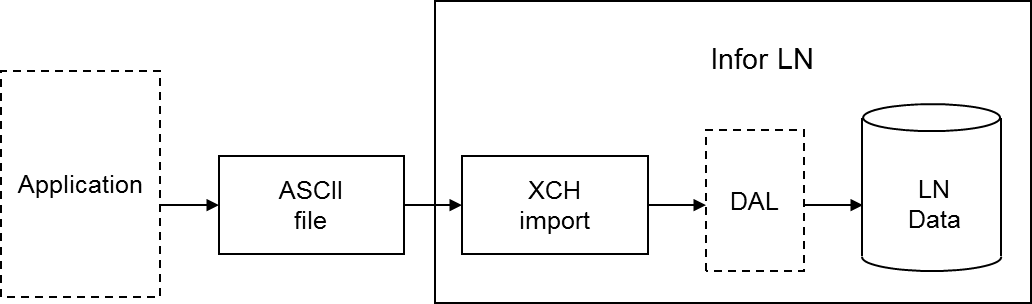
During an Exchange import, you can use all the functionality programmed into the Data Access Layer (DAL). If you use the DAL, Exchange carries out all the constraint checks, integrity checks, and side effects, for example, updates on other tables, that are programmed into the DAL. Database integrity is guaranteed automatically.

Using the DAL reduces the costs of interface development. You can use the DAL to import standard interfaces developed by Infor for partner products, as well as for specific interfaces built by customers, for example, to integrate LN with legacy systems. You can use the DAL in both single site and multisite environments.

The checks or additional actions specified in the DAL are carried out for each row that is imported. Database errors are logged in the same way for DAL and non-DAL import. DAL hook errors are also logged. You can specify whether the DAL property checks are or are not carried out.

If you specify the use of the DAL for a table relation for an import, the dal.new, dal.update, and dal.destroy functions are used instead of db.insert, db.update, and db.delete. You can choose to use DAL for particular tables and not for other tables, therefore, an import batch can contain both types of table relations simultaneously. The import through DAL works for both the import based on audit or indicators (inserts, updates, deletes), and the full import (inserts only).

DAL settings are run time aspects, which means you can change these aspects without having to regenerate the import program. DAL settings are also logged in the log table at batch line level, to enable you to find out what the DAL settings were when the import was run.

Important to realize is that an update through the DAL can result in a number of side effects. Actions performed by the DAL must not be carried out twice. For example, if the DAL updates the available to promise (ATP) quantity for an item when importing order data, the ATP quantity must not be updated in a condition script as well.

For this reason, you must not add any actions in condition scripts, or import additional data, that are already handled in the DAL.
Previous Article Infor LN & Baan Tips & Tricks for EXECUTIVES
Next Article Infor LN & Baan Tips & Tricks for FINANCE: Set Up and Calculate Currency Differences
Print
11216 Rate this article:
5.0
Kathy Barthelt

Kathy BartheltKathy Barthelt

Other posts by Kathy Barthelt

Contact author

x

Categories