Please Wait a Moment
X

Infor LX Tips, Infor LN Tips, BPCS Tips, Baan Tips, Infor M3 Tips & Infor ERP News

Crossroads Connections

Infor ERP Tips & News from the Experts

Infor LX | Infor LN | BPCS | Baan | Infor M3

Baan/LN Tip of the Week: Creating Product Variants

Kathy Barthelt 0 75672 Article rating: No rating

If you specify a configurable item on the sales order line, you can configure or link a product variant.

An item is configurable if the Configurable check box is selected in the Item - General (tcibd0101s000) session.

Manufactured items with theDefault Supply Sourceset to Assembly in the Item - General (tcibd0101s000) session and Generic items, are always configurable.

Purchased items with the Purchase Schedule in Use check box selected in the Item - General (tcibd0101s000) session, can be configurable.

Crossroads RMC, in partnership with Infor, takes Yupo to LX 8.3.4

Crossroads RMC 0 28772 Article rating: 5.0

Yupo Corporation, a leader in synthetic paper, with products that are 100% recyclable, waterproof and tree-free, went live on Infor LX 8.3.4 on April 3, 2017. Yupo partnered with Crossroads RMC for this important technology upgrade. Included in the implementation were the Finance, Supply Chain, Manufacturing and Plant Maintenance (EAM) modules.

Crossroads RMC Takes Polar to LX 8.3.4

Crossroads RMC 0 32009 Article rating: No rating

Polar Beverages, the largest independent soft drink bottler in the United States, went live on Infor LX 8.3.4 on January 16, 2017. Polar partnered with Crossroads RMC for this important technology initiative. Included in the implementation were the Finance Supply Chain and Manufacturing modules. Phase 2 will include Adirondack Beverages, a subsidiary of Polar. This project will begin in Q3 2017.

BPCS/LX Tip of the Week: Handwritten Inventory Tickets

Anthony Etzel 0 48157 Article rating: No rating

Are you still using handwritten tickets for your inventory?  This method of inventory tracking is slow and prone to human error.

Putting a simple barcode system in place speeds up the process of tracking inventory movements, reduces the likelihood of mistakes, and creates a recorded history of the who/what/where that can provide valuable insight to those who make critical business decisions for your business.

Not sure where to start? Contact us and we’d be happy to help you take the first step.

Baan/LN Tip of the Week: Ledger Default Account

Kathy Barthelt 0 72300 Article rating: No rating

If you do not wish to define a detailed mapping to various ledger accounts for specific integration transactions, you can map the corresponding integration document type to a default account. All the transactions of the integration document type for which an account cannot be determined based on the mapping scheme details, are posted to the default account.


The mapping of an integration document type to a default account is direct, without the need for element groups and mapping elements. No distinction is made on any of the transaction details.


Default accounts can be used in two ways:

  • Instead of a detailed mapping to various ledger accounts. All the transactions are posted to the same account. For example, all warehouse receipts are posted to the Inventory ledger account, without any distinction.
  • In addition to a detailed mapping. If a transaction cannot be mapped based on the detailed mapping scheme, it is posted to the default account.

BPCS/LX Tip of the Week: Email Distribution Lists

Anthony Etzel 0 49077 Article rating: No rating

Email Distribution Lists are new in Infor LX Version 8.

With this feature, users can create groups to which they may add internal or external email addresses, and in turn, use the name of the group when sending out the email.

The email distribution list eliminates the need for a program change if recipients need to be added to or deleted from the group. 

Optimize Your Manufacturing Today!

Baan/LN Tip of the Week: Clusters in LN

Kathy Barthelt 0 72570 Article rating: No rating

A cluster is a group of one or more warehouses in a particular geographical area. You can plan an item by cluster (geographical area).

To enable this, you can set up multiple plan items for one item. You always define one plan item without a cluster indication and multiple plan items with a cluster indication. A plan item with a cluster is called a clustered plan item, and a plan item without cluster is called the non-clustered plan item.

The plan items in the clusters can be supplied not only by distribution, but also through purchase and production. In this way, you can, for example, plan local purchasing in a cluster (geographical area). You can also plan supply from multiple sources.


Optimize Your Manufacturing Today!

BPCS/LX Tip of the Week: When More = Less

Anthony Etzel 0 48320 Article rating: No rating

Do you have bottlenecks in your process due to product changeovers or breakdowns?
Maybe the answer is adding redundancy in the department where you are experiencing the problem. A duplicate machine setup can allow for double the capacity during high production periods. It can also eliminate the need to swap out tools or other materials due to different production runs. When breakdowns occur, equipment can be swapped out to keep production moving while repairs are being made.

Planning for this keeps production levels high.


Optimize Your Manufacturing Today!

First979899100102104105106Last

Tips:  LX | BPCS | M3

Tips: LN | Baan

Kathy Barthelt

Infor LN & Baan Tips & Tricks for TECHNOLOGY: Using the Data Access Layer (DAL)

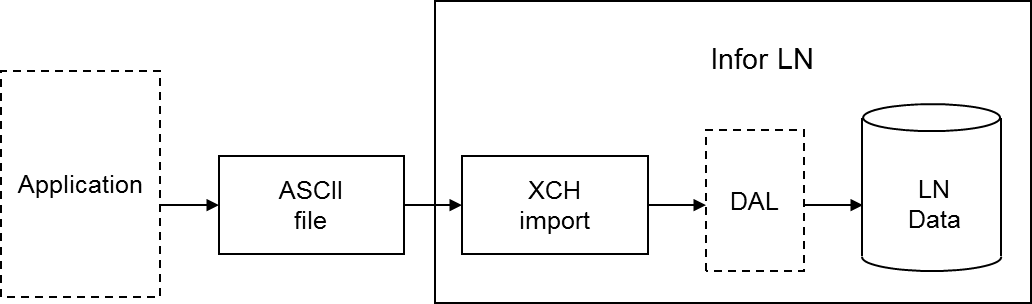
During an Exchange import, you can use all the functionality programmed into the Data Access Layer (DAL). If you use the DAL, Exchange carries out all the constraint checks, integrity checks, and side effects, for example, updates on other tables, that are programmed into the DAL. Database integrity is guaranteed automatically.

Using the DAL reduces the costs of interface development. You can use the DAL to import standard interfaces developed by Infor for partner products, as well as for specific interfaces built by customers, for example, to integrate LN with legacy systems. You can use the DAL in both single site and multisite environments.

The checks or additional actions specified in the DAL are carried out for each row that is imported. Database errors are logged in the same way for DAL and non-DAL import. DAL hook errors are also logged. You can specify whether the DAL property checks are or are not carried out.

If you specify the use of the DAL for a table relation for an import, the dal.new, dal.update, and dal.destroy functions are used instead of db.insert, db.update, and db.delete. You can choose to use DAL for particular tables and not for other tables, therefore, an import batch can contain both types of table relations simultaneously. The import through DAL works for both the import based on audit or indicators (inserts, updates, deletes), and the full import (inserts only).

DAL settings are run time aspects, which means you can change these aspects without having to regenerate the import program. DAL settings are also logged in the log table at batch line level, to enable you to find out what the DAL settings were when the import was run.

Important to realize is that an update through the DAL can result in a number of side effects. Actions performed by the DAL must not be carried out twice. For example, if the DAL updates the available to promise (ATP) quantity for an item when importing order data, the ATP quantity must not be updated in a condition script as well.

For this reason, you must not add any actions in condition scripts, or import additional data, that are already handled in the DAL.
Previous Article Infor LN & Baan Tips & Tricks for EXECUTIVES
Next Article Infor LN & Baan Tips & Tricks for FINANCE: Set Up and Calculate Currency Differences
Print
5427 Rate this article:
5.0
Kathy Barthelt

Kathy BartheltKathy Barthelt

Other posts by Kathy Barthelt

Contact author

x

Categories