Infor ERP Tips and Infor ERP News for Infor LX, BPCS, Infor ERP LX, Infor LN, Infor ERP LN, Baan, Infor M3, and Movex

Please Wait a Moment
X

Infor LX Tips, Infor LN Tips, BPCS Tips, Baan Tips, Infor M3 Tips & Infor ERP News

Crossroads Connections

Infor ERP Tips & News from the Experts

Infor LX | Infor LN | BPCS | Baan | Infor M3

The Far-Reaching Impact of Disconnected Data

Kathy Barthelt 0 7086 Article rating: 5.0

Disconnected data doesn’t just slow you down—it creates bottlenecks across your entire business. When your ERP isn’t connected to the systems you rely on, every department feels it.

How Disconnected Data Hurts Your Organization

  • Operations: Spreadsheets and manual order entry waste valuable time.

  • Finance: Budgets, POs, and invoices stuck in silos cause delays and errors.

  • Technology: Teams burn hours exporting data to stay “up to date.”

  • Executives: No single source of truth makes it hard to see the big picture.

A recent study found that 61% of companies face project delays from slow data integration, while employees waste the equivalent of 19 workdays per year moving data between systems. That’s lost productivity you can’t afford.

Why ERP Integration Matters
Your ERP is the heart of your operations. Connecting it to the rest of your business tools unlocks:

  • Real-time data access → no more outdated spreadsheets.

  • Improved communication → one source of truth for every team.

  • Higher productivity → eliminate duplicate entry and manual reporting.

  • Smarter supply chains → better visibility, fewer delays.

  • Sales enablement → reps get live pricing, inventory, and customer data.


Simplify Integration with Infor ION...

Infor LN & Baan Tips & Tricks for OPERATIONS: Subcontracting Overview

Kathy Barthelt 0 15653 Article rating: 5.0

Companies can decide to involve a subcontractor and subcontract part of their activities. The subcontractor carries out the work and returns the products to your company.

In Infor LN, subcontracting is considered as purchasing labor from a third party. Therefore, if a manufacturer wants to subcontract work, he must generate a purchase order to start the subcontracting process. These are the types of subcontracting:

  • Subcontracting with material flow
    • Operation subcontracting: For operation subcontracting, a part of the production process (one or more operations) is subcontracted.
    • Item subcontracting: For item subcontracting, an item's entire production process is subcontracted. Therefore, it is always used with material flow support.
  • Subcontracting without material flow: The simplest form of subcontracting is to generate a subcontracting purchase order to record the operations outsourced to a subcontractor. The subcontracting purchase order only represents the administrative handling of the subcontracting process. When the subcontracted item is received back from the subcontractor, you must close the subcontracting purchase order, which initiates the production process.
  • Unplanned subcontracting: Unplanned subcontracting is applicable when you subcontract after generating a production order. For unplanned subcontracting, a purchase order is generated from the production order and the material supply lines are populated by Shop Floor Control.
  • Service subcontracting: For service subcontracting, work on an item to be maintained or repaired is subcontracted. This work entails the entire repair process, or only a part of it. Service subcontracting can be used with or without material flow support.

To start the subcontracting process, a purchase order is required.

Infor LN & Baan Tips & Tricks for FINANCE: Set Up and Calculate Currency Differences

Kathy Barthelt 0 7847 Article rating: 5.0

To set up and calculate currency differences for foreign currencies:

  • Use the Company Parameters (tfgld0503m000) session to specify the profit and loss ledger accounts, 12 profit and loss dimensions, and transaction type for a posting exchange rate differences that is calculated using the FIFO method. To specify this data, use the Currency Diff. FIFO tab. The reports printed from the Print Company Parameters (tfgld0404m000) session, include the Currency Differences FIFO fields.
  • Use the Calculate Currency Differences (tfgld5201m000) session to calculate the currency differences resulting from transactions posted on accounts for which the field Currency Analysis in the session Chart of Accounts (tfgld0508m000) is set to Required.

Infor LN & Baan Tips & Tricks for TECHNOLOGY: Using the Data Access Layer (DAL)

Kathy Barthelt 0 9063 Article rating: 5.0

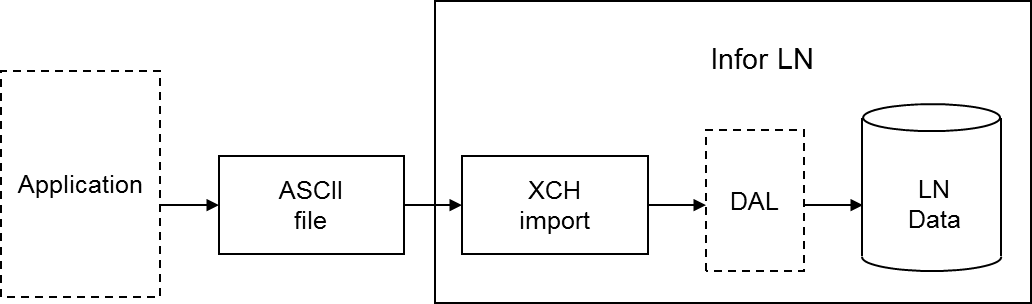
During an Exchange import, you can use all the functionality programmed into the Data Access Layer (DAL). If you use the DAL, Exchange carries out all the constraint checks, integrity checks, and side effects, for example, updates on other tables, that are programmed into the DAL. Database integrity is guaranteed automatically.

Using the DAL reduces the costs of interface development. You can use the DAL to import standard interfaces developed by Infor for partner products, as well as for specific interfaces built by customers, for example, to integrate LN with legacy systems. You can use the DAL in both single site and multisite environments.

The checks or additional actions specified in the DAL are carried out for each row that is imported. Database errors are logged in the same way for DAL and non-DAL import. DAL hook errors are also logged. You can specify whether the DAL property checks are or are not carried out.

If you specify the use of the DAL for a table relation for an import, the dal.new, dal.update, and dal.destroy functions are used instead of db.insert, db.update, and db.delete. You can choose to use DAL for particular tables and not for other tables, therefore, an import batch can contain both types of table relations simultaneously. The import through DAL works for both the import based on audit or indicators (inserts, updates, deletes), and the full import (inserts only).

DAL settings are run time aspects, which means you can change these aspects without having to regenerate the import program. DAL settings are also logged in the log table at batch line level, to enable you to find out what the DAL settings were when the import was run.

Important to realize is that an update through the DAL can result in a number of side effects. Actions performed by the DAL must not be carried out twice. For example, if the DAL updates the available to promise (ATP) quantity for an item when importing order data, the ATP quantity must not be updated in a condition script as well.

For this reason, you must not add any actions in condition scripts, or import additional data, that are already handled in the DAL.
Infor LX/BPCS Tips & Tricks for TECHNOLOGY: Add Last Maintained Audit Fields to SYS600

George Moroses 0 15394 Article rating: 5.0

LX has enhanced the SYS600 User Security Maintenance application by adding the ZXUP audit fields:

  • Last Maintained Date

  • Last Maintained Time

  • Last Maintained User

These fields are updated whenever a user or role is revised, deleted, or reactivated.

This enhancement provides standard audit tracking to identify who modified a User Security record and when. The audit fields can be used for ad hoc tracking, reporting, and analysis.

First567810121314Last

Tips:  LX | BPCS | M3

Tips: LN | Baan

Crossroads RMC

End of Year E R P Checklist: Streamline Your Transition to the New Year

The end of the year is a busy time for everyone, but a little preparation can make the start of the next year smoother and more productive. Here's a checklist broken out by the department to help optimize your ERP system as you wrap up this year.

All Departments End of Year Checklist

_____1. Strategic ERP Review

  • Review and Update Reports and Dashboards
    • Evaluate standard reports and dashboards to ensure they align with current business requirements.
    • Adapt them to reflect changing priorities so the information remains relevant and actionable.

_____2. ERP Support and Maintenance

  • Address Outstanding Support Issues
    • Reach out to Crossroads RMC for unresolved support concerns or system issues.
    • Collaborate to resolve lingering problems and clear your to-do list before the year ends.

_____3. Training and Consulting Services

  • Assess Team Training Needs
    • Conduct a skills gap analysis to identify areas where your team may require additional ERP training.
    • Allocate resources for consulting services to help your team remain efficient and effective with the ERP system.

_____4. Future Investments

  • Evaluate New ERP Features or Modules
    • Review potential ERP investments to support business growth.
    • Align new features or modules with the organization’s current and future needs to maximize ROI and operational efficiency.


IT/Technology Checklist

_____1. Data Cleanup

  • Perform data deduplication to eliminate redundant entries.
  • Validate existing data to ensure accuracy and reliability. This reduces errors and boosts confidence in reporting.

_____2. Archive/Remove Obsolete Data

  • Archive or delete outdated data to improve system performance and reduce database clutter.
  • Streamlined data management enhances system usability and reduces search inefficiencies.

_____3. Monitor System Performance

  • Review system logs and performance metrics to identify bottlenecks.
  • Address any recurring lags or slowdowns to improve overall system efficiency.

_____4. Review User Access Controls

  • Audit user roles, permissions, and access rights for accuracy.
  • Remove or update access for users with altered responsibilities or those no longer with the organization.
  • This step mitigates cybersecurity risks and ensures compliance with data governance policies.

_____5. Test Emergency Recovery Procedures

  • Perform a test run of backup and recovery protocols to verify their effectiveness.
  • Ensure all critical data can be restored in the event of a disaster.

_____6. Prepare for Date-Dependent Processes

  • Audit scheduled jobs, scripts, and automation with hard-coded dates.
  • Update these dates to reflect the upcoming year to avoid disruptions in processes.

_____7. Bonus IT Tasks

  • Communicate planned system downtimes with all stakeholders in advance.
  • Document any changes made to the system during this period for future reference.
  • Encourage feedback from end-users on potential system improvements.

Operations Checklist

_____1. Critical Data Accuracy

  • Ensure critical data, such as inventory levels and customer information, is up-to-date and accurate to support efficient facility operations.
  • Remove discontinued items.
  • Delete sold purchase receipts.
  • Clear lot attributes for sold lots.
  • Non-Manufacturing Environments: Update the standard cost field based on current cost.

_____2. Inventory Management

  • Conduct a full physical inventory and update quantities before year-end or establish a cycle-counting program to maintain accuracy.
  • Prepare users for year-end completion of all inventory adjustments, receipts, and invoicing.
  • Determine processes for handling new-year transactions without immediate posting.

_____3. Purchase Orders & Contracts

  • Close out all purchase contracts and purchase orders (POs) to prevent further receipts against any contract line items.

_____4. Costing & Manufacturing Tasks

  • Decide on new standard costs for the upcoming year (for Manufacturing environments).
  • Establish cutoff dates for removing archived BOMs and closed/canceled manufacturing orders.

_____5. LX-Specific Tasks

  • Run PRF900 to update performance measurements and purge closed shop orders.

_____6. Fixed Assets & Depreciation

  • Review and update the depreciation schedule for fixed assets.
  • Verify depreciation expenses for the year have been accurately recorded.
  • For any new assets added during the year, ensure they are included in the depreciation schedule.

Finance Checklist

_____1. Period Closing & Reconciliation

  • Close financial periods and reconcile accounts to ensure financial data consistency and readiness for audits, tax filings, and other financial processes.
  • Set up financial periods for 2025 before the year begins.
  • Open the January 2025 period.
  • Finalize all outstanding transactions from 2024.

_____2. LN-Specific Tasks:

  • Perform a soft-close for any open periods in 2024.

_____3. LX-Specific Tasks:

  • Copy the CEA Book for the new year, ensuring all Journal Sources are set up. This ensures all required records are in place.
  • Run ACP920 (1099 Report) before ACP910 (Year End Close), as the Close Program clears 1099 Payments History.

_____4. Financial Cleanup

  • Address any old sales invoices and ensure they are properly closed.
  • Rectify any outstanding financial integration errors.
  • Set up and test new integration mappings for 2025 in a test environment.
  • Review and update jobs to ensure they are configured correctly for 2025 processing.
  • Identify purchase invoices for cash-flow management that won’t be paid until 2025.

_____5. Payroll Review

  • Verify employee payroll records and reconcile them with financial statements.
  • Ensure all employee information is up-to-date, including unpaid sick leave and vacation time, and carry over or adjust as necessary.

_____6. Accounts Receivable & Payable

  • Resolve any outstanding issues or unpaid invoices in customer or vendor accounts.
  • Record all payments and receipts to maintain accurate financial data.
  • Review outstanding receivables for potential bad debts.
    • Decide whether to carry them over into the new year.
    • Adjust the allowance for bad debts as necessary.

_____7. Bonus Financial Tasks

  • Verify that ERP calendars are set up for the new year with holidays correctly indicated.
  • Ensure proper mapping and testing of financial processes to avoid disruptions in the new year.

Taking these proactive steps will set your ERP system up for success in the coming year.

Print
9234 Rate this article:
5.0
Crossroads RMC

Crossroads RMCCrossroads RMC

Other posts by Crossroads RMC

Contact author

x

Categories