Please Wait a Moment
X

Infor LX Tips, Infor LN Tips, BPCS Tips, Baan Tips, Infor M3 Tips & Infor ERP News

Crossroads Connections

Infor ERP Tips & News from the Experts

Infor LX | Infor LN | BPCS | Baan | Infor M3

Infor LX/BPCS Tips & Tricks for EXECUTIVES

George Moroses 0 15740 Article rating: 5.0

OPERATIONS:
Shelf Life Days and Retest Days
This feature provides the ability to enter information in the shelf life days and retest days fields for non-QMS lot controlled items, even when the QMS product is installed. The purpose of this enhancement is to allow the user to enter information for non-QMS lot controlled items even when QMS is activated in Parameters Generation, SYS800D.

In previous versions, when QMS was activated, the Shelf Life Days and Retest Days fields in Facility Planning Maintenance (MRP140) and Item Master Maintenance (INV100) were not maintainable for non-QMS lot controlled items.

FINANCE
Inventory Transaction Post to G/L by Cost Type
This enhancement provides a method to post material, labor, and overhead values on inventory postings to the general ledger to meet financial reporting requirements. The solution provides an optional further breakdown of cost by cost bucket using the new G/L Cost Type.

TECHNOLOGY:
Role-Based Security
Role-Based Security introduces Role type profiles and allows combining the use of Role profiles with the traditional LX User type security profile functionality. The new Role type profile can be defined to allow or deny access to All Products, Attention Key, Products, Programs, and Transaction Effects. Facility, Warehouse, and Company securities are still defined solely by the User profile settings and are not affected by the assignment of a Role. Where applicable, the Role authority is displayed alongside the User authority on the security profile maintenance screens making it easy to see where there are differences in authority between the User and the assigned Roles. 

When Users are assigned to Roles, security access in LX becomes a combination of authorities granted or denied by the Role, plus any User Exceptions. User Exceptions override authorities set by the Roles. A User can also be assigned to more than one Role.

Infor LX/BPCS Tips & Tricks for OPERATIONS: Shelf Life Days and Retest Days

George Moroses 0 14494 Article rating: 5.0

This feature provides the ability to enter information in the shelf life days and retest days fields for non-QMS lot controlled items, even when the QMS product is installed. The purpose of this enhancement is to allow the user to enter information for non-QMS lot controlled items even when QMS is activated in Parameters Generation, SYS800D.

In previous versions, when QMS was activated, the Shelf Life Days and Retest Days fields in Facility Planning Maintenance (MRP140) and Item Master Maintenance (INV100) were not maintainable for non-QMS lot controlled items.

Infor LN & Baan Tips & Tricks for EXECUTIVES:

Kathy Barthelt 0 27234 Article rating: 5.0

OPERATIONS: Order Quantity Dependent Routings vs Default Routings
Order quantity-dependent routings
An automatically selected routing tailored to a specific production order quantity is useful. An example would be if the production order quantity is large, a routing with high production rates is used; If the order quantity is small, another routing is selected.

You can set up these quantity-dependent routings:...


FINANCE: Integration Transactions - Compression
Integration transactions can be compressed before they are posted. For each integration document type, you can indicate whether the debit transactions and/or the credit transactions must be compressed.

Transactions can be compressed if the following transaction details have the same value...


TECHNOLOGY: Infor LN Rest API
Frequently Asked Questions (KB2316174)

Infor News You Can Use: Discover the Power of Advanced Planning & Scheduling with industry expert Greg Keating

Kathy Barthelt 0 12238 Article rating: 5.0

CloudSuite® Industrial APS - Effective Planning & Scheduling

Learn what it is, how it works, and how it can transform your manufacturing operations.

Logo

Presented by

Greg Keating, Senior Solution Consultant, Infor

About this talk

Bring the future into closer focus If you are like most manufacturers today, managing your planning and scheduling resources has become a major challenge. The disrupted supply chain, workforce availability, equipment capacity, sporadic market demand, and changing customer expectations all contribute to the complexities of planning. Having the right resources available is essential for keeping production flowing and ensuring customers receive orders on time. In this session we will focus on Advanced Planning and Scheduling (APS) capabilities within CloudSuite Industrial. Our Infor expert will share: - What APS is, how it varies from traditional Manufacturing Resource Planning and the difference between Planning and Scheduling within CSI. - The basic configuration requirements needed to effectively utilize APS and available-to-promise/capable-to-promise (ATP/CTP) functionality. We'll also look at the key differences between these solutions - Examples of advanced applications that help identify accurate and reliable commitment dates.

Watch now On-Demand >

Infor On-Demand: 67min talk

Bring New Life to Your Infor LN & Baan ERP System

Kathy Barthelt 0 11779 Article rating: 5.0

Bring New Life to Your ERP System

Did you implement your ERP system 5 or 20 years ago? Back then, it was like a brand-new car—sleek, fast, and efficient. It may have needed minor adjustments, but you were very pleased. Fast forward to today, does it still have that new car smell? Does it run as efficiently as it used to?

While ERP systems are designed to last, your business evolves. Customer needs change, employees come and go, and you are left with a system that may run “fine” but lacks its original spark.

GOOD NEWS: You can restore that “new car smell” with a utilization, or business process review.

What is a Utilization or Business Process Review?

Our consultants review your Infor ERP system's current usage and related business processes to make recommendations that reinvigorate your system and its users.

Does My Organization Need One?

While every company could benefit, it's especially worthwhile if you have a specific problem to solve or a goal to achieve.

Financial Benefits Include:
Technology Benefits Include:

Join Us at inPOWER 2024!

George Moroses 0 10802 Article rating: 5.0

We are excited to invite you to the Infor user group inPower event this September 23-26, 2024.

As a Gold Sponsor, Crossroads RMC is proud to support this premier event. Here are some reasons you should attend:

  • Networking: Connect with peers and industry experts.
  • Product Updates: Discover the latest features and future roadmaps.
  • Training: Participate in hands-on workshops and expert-led sessions.
  • Problem Solving: Learn from other users’ success stories.
  • Influence: Provide feedback to Infor’s product development teams.
  • ROI: Gain insights on maximizing your Infor investments.
  • Community: Engage with special interest groups and regional user communities.

This event is a great opportunity to enhance your knowledge, solve challenges, and optimize your use of Infor solutions. Don't miss out!

What's in it for me?

inPower has something for everyone!

Technology:
Operations:
Finance:
Executives:

First1819202123252627Last

Tips:  LX | BPCS | M3

Tips: LN | Baan

Kathy Barthelt

Infor LN & Baan Tips & Tricks for TECHNOLOGY: Using the Data Access Layer (DAL)

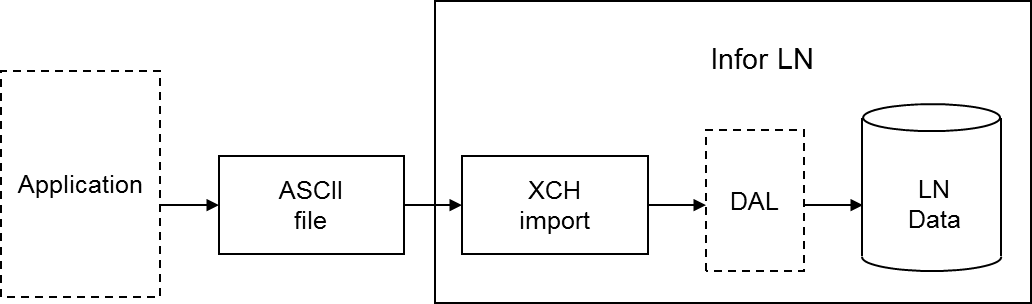
During an Exchange import, you can use all the functionality programmed into the Data Access Layer (DAL). If you use the DAL, Exchange carries out all the constraint checks, integrity checks, and side effects, for example, updates on other tables, that are programmed into the DAL. Database integrity is guaranteed automatically.

Using the DAL reduces the costs of interface development. You can use the DAL to import standard interfaces developed by Infor for partner products, as well as for specific interfaces built by customers, for example, to integrate LN with legacy systems. You can use the DAL in both single site and multisite environments.

The checks or additional actions specified in the DAL are carried out for each row that is imported. Database errors are logged in the same way for DAL and non-DAL import. DAL hook errors are also logged. You can specify whether the DAL property checks are or are not carried out.

If you specify the use of the DAL for a table relation for an import, the dal.new, dal.update, and dal.destroy functions are used instead of db.insert, db.update, and db.delete. You can choose to use DAL for particular tables and not for other tables, therefore, an import batch can contain both types of table relations simultaneously. The import through DAL works for both the import based on audit or indicators (inserts, updates, deletes), and the full import (inserts only).

DAL settings are run time aspects, which means you can change these aspects without having to regenerate the import program. DAL settings are also logged in the log table at batch line level, to enable you to find out what the DAL settings were when the import was run.

Important to realize is that an update through the DAL can result in a number of side effects. Actions performed by the DAL must not be carried out twice. For example, if the DAL updates the available to promise (ATP) quantity for an item when importing order data, the ATP quantity must not be updated in a condition script as well.

For this reason, you must not add any actions in condition scripts, or import additional data, that are already handled in the DAL.
Previous Article Infor LN & Baan Tips & Tricks for EXECUTIVES
Next Article Infor LN & Baan Tips & Tricks for FINANCE: Set Up and Calculate Currency Differences
Print
5386 Rate this article:
5.0
Kathy Barthelt

Kathy BartheltKathy Barthelt

Other posts by Kathy Barthelt

Contact author

x

Categories