Please Wait a Moment
X

Infor LX Tips, Infor LN Tips, BPCS Tips, Baan Tips, Infor M3 Tips & Infor ERP News

Crossroads Connections

Infor ERP Tips & News from the Experts

Infor LX | Infor LN | BPCS | Baan | Infor M3

Infor LX / BPCS Tips & Tricks for Finance: Inventory Period Balance Freeze

George Moroses 0 20381 Article rating: 5.0

Users can now freeze period-end balances at the end of a fiscal period. You can now store the opening/ending on hand balance for each Inventory period at the Item (IIM), Warehouse/Item (IWI) and Lot/Location (ILI) levels. This information can then be used for inventory tracking and valuation purposes, as well as other ad hoc financial and audit reporting requirements. Infor LX clients can backdate inventory transactions into the immediate previously closed period, and thus update what was saved as the opening/ending balance throughout the current open period.

Infor LX / BPCS Tips & Tricks for Operations: Retain Lot Status on Shipped Resupply Orders

George Moroses 0 15461 Article rating: 5.0

When a lot is completely shipped on a customer order, the Lot Status is changed to Z. Since a resupply order must still be received in the To Warehouse to complete the transaction, do not update the lot status when the resupply order is shipped. If a lot is completely shipped on a resupply order, LX no longer updates the lot status to Z, because the shipped lot retains its current lot status, the additional steps, no additional steps are required to receive it in the To Warehouse.

Infor LX / BPCS Tips & Tricks for Technology: Reset Purchase Order In Use

George Moroses 0 15804 Article rating: 5.0

This feature resolves or resets a purchase order or requisition that is no longer being processed, but the system still indicates it is 'in use'. The user selects Purchase Order/Requisition in Use Maintenance, PUR940D, from the Purchasing Management Menu, PUR, located in the Special Processing sub-menu. The user then enters an order or requisition to remove the 'In Use' status.

End of Year E R P Checklist: Streamline Your Transition to the New Year

Crossroads RMC 0 8260 Article rating: 5.0

The end of the year is a busy time for everyone, but a little preparation can make the start of the next year smoother and more productive. Here's a checklist broken out by the department to help optimize your ERP system as you wrap up this year.

  1. All Departments Checklist
  2. Technology Checklist
  3. Operations Checklist
  4. Finance Checklist

Infor LN & Baan Tips & Tricks: Action Required - Infor LN Cloud Edition - Fonts Update!

Kathy Barthelt 0 114966 Article rating: 5.0

In April 2025, Infor LN Cloud Edition release 2025.04 will introduce the deprecation of Windows® fonts in LN report design and output. This means that Windows fonts will need to be replaced by Google fonts.

Actions Required:

  • All LN Cloud Edition customers must identify all reports modified with the LN report designer and update them by replacing the Windows fonts with Google fonts.
  • Completed before the 2025.04 Maintenance Window.
  • Please see Knowledge Base (KB) article 3523663 for more information, details and FAQs.
First1314151618202122Last

Tips:  LX | BPCS | M3

Tips: LN | Baan

Kathy Barthelt

Infor LN & Baan Tips & Tricks for TECHNOLOGY: Using the Data Access Layer (DAL)

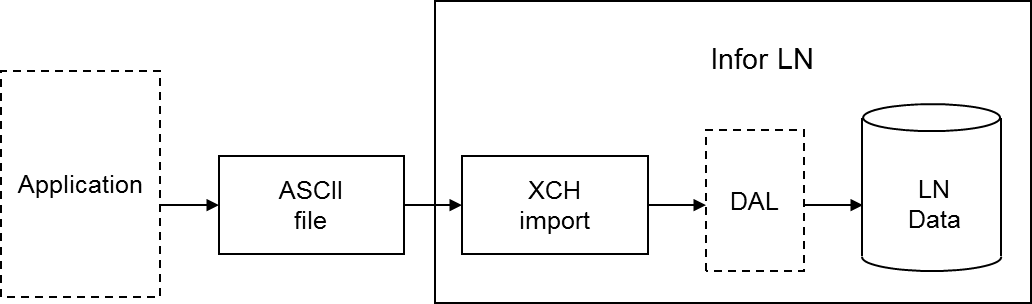
During an Exchange import, you can use all the functionality programmed into the Data Access Layer (DAL). If you use the DAL, Exchange carries out all the constraint checks, integrity checks, and side effects, for example, updates on other tables, that are programmed into the DAL. Database integrity is guaranteed automatically.

Using the DAL reduces the costs of interface development. You can use the DAL to import standard interfaces developed by Infor for partner products, as well as for specific interfaces built by customers, for example, to integrate LN with legacy systems. You can use the DAL in both single site and multisite environments.

The checks or additional actions specified in the DAL are carried out for each row that is imported. Database errors are logged in the same way for DAL and non-DAL import. DAL hook errors are also logged. You can specify whether the DAL property checks are or are not carried out.

If you specify the use of the DAL for a table relation for an import, the dal.new, dal.update, and dal.destroy functions are used instead of db.insert, db.update, and db.delete. You can choose to use DAL for particular tables and not for other tables, therefore, an import batch can contain both types of table relations simultaneously. The import through DAL works for both the import based on audit or indicators (inserts, updates, deletes), and the full import (inserts only).

DAL settings are run time aspects, which means you can change these aspects without having to regenerate the import program. DAL settings are also logged in the log table at batch line level, to enable you to find out what the DAL settings were when the import was run.

Important to realize is that an update through the DAL can result in a number of side effects. Actions performed by the DAL must not be carried out twice. For example, if the DAL updates the available to promise (ATP) quantity for an item when importing order data, the ATP quantity must not be updated in a condition script as well.

For this reason, you must not add any actions in condition scripts, or import additional data, that are already handled in the DAL.
Previous Article Infor LN & Baan Tips & Tricks for EXECUTIVES
Next Article Infor LN & Baan Tips & Tricks for FINANCE: Set Up and Calculate Currency Differences
Print
5386 Rate this article:
5.0
Kathy Barthelt

Kathy BartheltKathy Barthelt

Other posts by Kathy Barthelt

Contact author

x

Categories