Please Wait a Moment
X

Infor LX Tips, Infor LN Tips, BPCS Tips, Baan Tips, Infor M3 Tips & Infor ERP News

Crossroads Connections

Infor ERP Tips & News from the Experts

Infor LX | Infor LN | BPCS | Baan | Infor M3

WEBINAR: Partnering for Success – ERPLX Utilization Review

Thursday, May 15, 2025, from 1:00 pm to 1:30 pm (US/Eastern)

George Moroses 0 8388 Article rating: 5.0

Your ERP system needs to be well-understood to be an effective business tool, and your first step is to look at how the backbone of your company's operation is being utilized. 

Partner with Crossroads RMC for Success

Thursday, May 15, 2025, from 1:00 pm to 1:30 pm (US/Eastern)

Join Frank Petrasio and George Moroses to learn how Crossroads RMC partners with Infor clients to:

  • Maximize ERP Utilization
  • Enhance Productivity
  • Improve Efficiency
  • Optimize ERP Investment
  • Drive Business


Partnering with Crossroads RMC is critical to success.

 →​​Register Here 

Infor LX/BPCS Tips & Tricks for EXECUTIVES:

George Moroses 0 10035 Article rating: 5.0

FINANCE TIP: IDF Ledger Book Journal Line Analysis

TECHNOLOGY TIP: Improve WebTop Grid Support for MRP320D Master Schedule Detail Inquiry

OPERATIONS: Override inspection days lead time at the item-facility

Infor LN & Baan Tips & Tricks for OPERATIONS: Creating a Purchase Order with Subcontracting

Kathy Barthelt 0 53046 Article rating: 5.0

To create a purchase order (with subcontracting) third party outsourcing from purchase order, execute these steps:

  1. Create a purchase order using the same data set defined in the Subcontracting Models (tisub1100m000) session.
  2. In the Purchase Order Intake Workbench (tdpur4601m200) session, click New. The Purchase Order (tdpur4100m900) session is displayed.
  3. ...

Infor LN & Baan Tips & Tricks for FINANCE: Cash Flow Statements (tfgld 0123m100)

Kathy Barthelt 0 51788 Article rating: 5.0

Use this session to define or maintain cash flow statements and hierarchical structures of cash flow reasons for cash flow statement reports. 

On the Cash Flow Reasons by Statement tab, you can select cash flow reason groups and cash flow reasons to build a hierarchical structure of cash flow reasons for the cash flow statement report.

To link a child cash flow reason group to a parent cash flow reason group:

Infor LN & Baan Tips & Tricks for TECHNOLOGY: Data Sharing Methods (Advantages and Disadvantages)

Kathy Barthelt 0 46316 Article rating: 5.0

Depending on the multicompany scenario you choose, an implementation team must decide whether or not tables must be logically linked or if data must be synchronized in another way to achieve availability of data across various companies. 

There are 3 ways in which data may be shared among companies. Here are some advantages and disadvantages of each:

  1. Logical Table Linking -

  2. Data Replication -

  3. Manual Syncronization -

Moving Beyond ERP Customizations: Smarter Solutions for a Future-Ready System

Kathy Barthelt 0 12511 Article rating: 5.0

Transitioning away from ERP customizations can feel like a major hurdle—but with the right strategy, it’s not just possible, it’s powerful. Let’s cut through the noise and look at the real issues... and the smart solutions that pave the way to a leaner, more future-ready ERP.

Common Challenges (and Why They’re Not Dealbreakers)

Reliance on Custom Processes
Custom workflows often become second nature—but are they still serving you? Modern ERPs evolve with industry best practices baked in, and chances are, today’s standard features do what your custom code used to… only better.

Budget & Time Constraints
Testing, retraining, consulting—it all adds up. But the long-term payoff? Reduced technical debt, faster upgrades, and major gains in efficiency and scalability.

User Resistance
Change is hard, especially when teams are comfortable with their tools. But clear communication and a strong change management plan can turn skeptics into champions of a smarter, streamlined system.


Reality Check: Has Your Business Outgrown Its Customizations?

First1112131416181920Last

Tips:  LX | BPCS | M3

Tips: LN | Baan

Kathy Barthelt

Infor LN & Baan Tips & Tricks for TECHNOLOGY: Using the Data Access Layer (DAL)

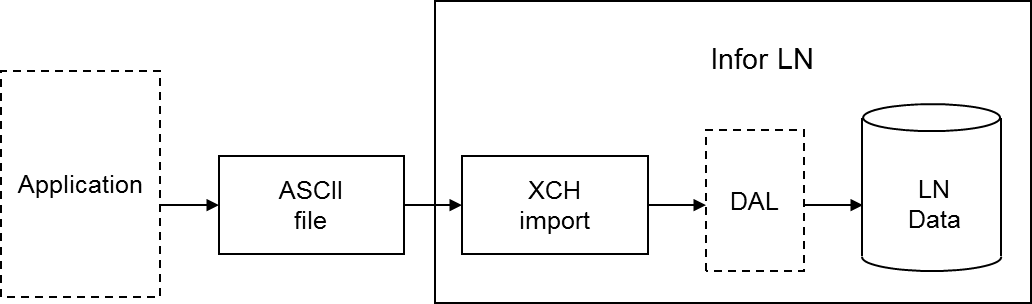
During an Exchange import, you can use all the functionality programmed into the Data Access Layer (DAL). If you use the DAL, Exchange carries out all the constraint checks, integrity checks, and side effects, for example, updates on other tables, that are programmed into the DAL. Database integrity is guaranteed automatically.

Using the DAL reduces the costs of interface development. You can use the DAL to import standard interfaces developed by Infor for partner products, as well as for specific interfaces built by customers, for example, to integrate LN with legacy systems. You can use the DAL in both single site and multisite environments.

The checks or additional actions specified in the DAL are carried out for each row that is imported. Database errors are logged in the same way for DAL and non-DAL import. DAL hook errors are also logged. You can specify whether the DAL property checks are or are not carried out.

If you specify the use of the DAL for a table relation for an import, the dal.new, dal.update, and dal.destroy functions are used instead of db.insert, db.update, and db.delete. You can choose to use DAL for particular tables and not for other tables, therefore, an import batch can contain both types of table relations simultaneously. The import through DAL works for both the import based on audit or indicators (inserts, updates, deletes), and the full import (inserts only).

DAL settings are run time aspects, which means you can change these aspects without having to regenerate the import program. DAL settings are also logged in the log table at batch line level, to enable you to find out what the DAL settings were when the import was run.

Important to realize is that an update through the DAL can result in a number of side effects. Actions performed by the DAL must not be carried out twice. For example, if the DAL updates the available to promise (ATP) quantity for an item when importing order data, the ATP quantity must not be updated in a condition script as well.

For this reason, you must not add any actions in condition scripts, or import additional data, that are already handled in the DAL.
Previous Article Infor LN & Baan Tips & Tricks for EXECUTIVES
Next Article Infor LN & Baan Tips & Tricks for FINANCE: Set Up and Calculate Currency Differences
Print
11216 Rate this article:
5.0
Kathy Barthelt

Kathy BartheltKathy Barthelt

Other posts by Kathy Barthelt

Contact author

x

Categories