Infor ERP Tips and Infor ERP News for Infor LX, BPCS, Infor ERP LX, Infor LN, Infor ERP LN, Baan, Infor M3, and Movex

Please Wait a Moment
X

Infor LX Tips, Infor LN Tips, BPCS Tips, Baan Tips, Infor M3 Tips & Infor ERP News

Crossroads Connections

Infor ERP Tips & News from the Experts

Infor LX | Infor LN | BPCS | Baan | Infor M3

Manage the Complexity of Tax Compliance

Insights from our partner Avalara

Crossroads RMC 0 508 Article rating: 5.0

Sales tax compliance becomes more complex as businesses grow. Expanding into new markets, adding locations, selling online, or integrating systems after an acquisition can quickly introduce new tax obligations.

Many organizations find manual tax processes difficult to manage and scale. Automation can simplify compliance, improve accuracy, and reduce the risk of costly penalties.

When Compliance Gets Complicated

Changes such as the following often create new tax requirements:

• Upgrading or changing ERP systems
• Mergers or acquisitions requiring system integration
• Adding locations or warehouses
• Expanding into e-commerce
• Managing remote employees
• Selling at trade shows across multiple states

Businesses may also struggle with large transaction volumes, exempt products or customers, audit exposure, and tax obligations in complicated states.

Why Avalara & Crossroads RMC

Avalara automates tax registration, calculation, filing, and document management, helping businesses maintain compliance as they grow.

Crossroads RMC integrates Avalara directly with Infor ERP environments, enabling automated tax calculations and reporting within existing ERP workflows.

Avalara supports more than 41,000 businesses and government organizations in over 75 countries, helping organizations manage complex tax requirements while focusing on growth.

800.762.2077 | Contact Us

Infor ERP Tips & Tricks: Already Have Avalara? Integrate It with Your Infor ERP

Infor LN | Baan | Infor LX | BPCS

Crossroads RMC 0 673 Article rating: 5.0

If your company already uses Avalara for tax compliance, you can integrate it directly with your Infor ERP system.

Crossroads RMC has developed integrations that connect Avalara’s automated tax calculation and compliance platform with Infor ERP environments, allowing tax calculations, reporting, and compliance processes to run seamlessly within your existing ERP workflows.

This integration helps eliminate manual tax processing, improve accuracy, and ensure tax compliance as your business grows.

If you’re already using Avalara and want to streamline tax automation within your ERP, Crossroads RMC can help you connect the two.

800.762.2077 | Contact Us

Elevate Your Team's Output with Expert CloudSuite/LN & Baan Help Desk Services

Kathy Barthelt 0 782 Article rating: 5.0

In today’s fast-paced business environment, maintaining an efficient and responsive ERP system is crucial for success. However, managing ERP support internally can be resource-intensive and distract from your core business objectives. That’s where Crossroads RMC comes in. With our on-demand ERP Expert Help Desk Service, your organization can enhance efficiency, boost customer satisfaction, and allow your team to focus on key business goals.

Key Advantages

  • Round-the-Clock Support: Access functional and technical support 24/7, 365 days a year—even on weekends and holidays!
  • In-depth Expertise: As an Infor Partner, we offer extensive knowledge across all Infor CloudSuite/LN & Baan versions, ensuring you get the best possible support.
  • Comprehensive Technical Management: Expert assistance with extensions, personalizations, report development, and system administration to keep your environment optimized and tailored to your needs.
  • Multiple Communication Channels: Reach out via phone, text, email, online portals, Microsoft Teams, web meetings, or in-person visits.
  • Transparent Monitoring: Receive transparent monthly reports to keep track of service utilization.
  • Disaster Recovery Solutions: Benefit from comprehensive ERP disaster recovery solutions tailored to safeguard your operations.
  • Specialized ION Support: Get expert assistance with your ION data flows, workflows, and APIs for seamless integration and management.

Why Crossroads RMC - Partnering for Success

  • Cost Savings: Outsourcing your ERP Help Desk with Crossroads RMC can significantly reduce the overhead costs associated with supporting and maintaining your ERP system.
  • Access to Specialized Expertise: Our team consists of skilled consultants who are deeply familiar with your ERP systems. Their expertise ensures quick and effective resolutions to your issues, minimizing downtime and enhancing overall productivity.
  • Scalability: Adjust the level of support as your business needs change, without the hassle of hiring or training new staff. Whether your company is growing, scaling down, or experiencing seasonal fluctuations, Crossroads RMC provides the flexibility to match your evolving requirements.
  • Focus on Core Business: Free up your internal team to focus on strategic projects that drive growth and innovation. Outsourcing your ERP help desk allows your staff to concentrate on core business functions, leading to better use of time and resources.
  • Comprehensive Partnership: At Crossroads RMC, we are dedicated t

Infor LN & Baan Tips & Tricks for TECHNOLOGY: Audit Configuration Management

Kathy Barthelt 0 1376 Article rating: 5.0

You use LN audit features to fully or partially log changes that users make to the LN database tables when they use LN sessions.

The audit functionality is based on the concept of audit profiles. In an audit profile, you define which tables and fields are audited and when, in the context of an audit profile. To bundle profiles in the same functional area, you can relate the profiles to audit categories. You can export and import audit profiles with various options to enable a quick configuration. The audit trail is stored in sequence files, which are generated for each combination of company and table.

Note: For some important parameter tables it is required that auditing is enabled.

You can view or print the history of modifications.

Infor LN & Baan Tips & Tricks for OPERATIONS: Production Order Parameters

Kathy Barthelt 0 993 Article rating: 5.0

To avoid having to report quantities also at the order level, set the Post to Inventory when Reporting on Last Operation parameter to Yes in these sessions:

  • Production Order Parameters (tisfc0100s000) > Planning tab
  • Production Settings by Site (timfc0180m000) > Production Order tab

With regard to as-built handling, because JobControl acts as a reporting tool similar to the Machine Work List (tisfc4600m000) session, we recommend these settings in the Production Order Parameters (tisfc0100s000) session (Miscellaneous tab) and Production Settings by Site (timfc0180m000) session (Production Order tab):

  • In the Serials section, set the Generate Serial Numbers parameter to On Printing Documents or On Release as the serial number that can be selected in JobControl to report completed or rejected products must have the Valid status in LN.
  • In the Serials section, we recommend setting the As-Built Status Handling parameter to Manual as the serial number assignment is performed in JobControl.

Infor LN & Baan Tips & Tricks for FINANCE: Copy Received Purchase Invoices (tfacp1210m000)

Kathy Barthelt 0 890 Article rating: 5.0

When the invoice is copied, the status in the Invoice Status field in the Received Purchase Invoices (tfacp1500m000) session is set to Registered. The invoice cannot be copied again.

Note: If you have started this session using the browse arrow, you can only find and select a record.

Field Information

  • Invoice-from Business Partner: The invoice-from business partner
  • Document - The document number: The document number is a sequence number under which the invoice is temporarily recorded. When an invoice is registered officially, you must assign the invoice to a different number, in combination with a transaction type.
  • Business Partner Invoice Number: The invoice-from business partner's invoice number is the invoice identification used in LN: This number is printed as the payment reference when the invoice is paid.
  • Invoice Date: The date printed on the invoice. This date is used as a reference date for the term of credit allowed.
  • Currency: The invoice currency
  • Amount: The invoice amount
124678910Last

Tips:  LX | BPCS | M3

Tips: LN | Baan

Kathy Barthelt

Infor LN & Baan Tips & Tricks for EXECUTIVES

TECHNOLOGY: Using the Data Access Layer (DAL)

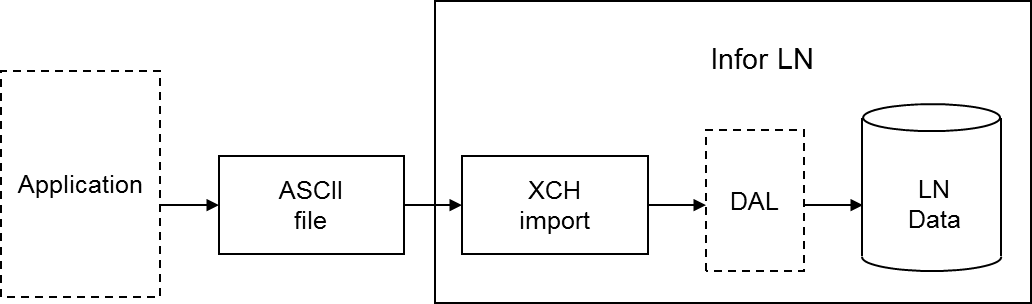
During an Exchange import, you can use all the functionality programmed into the Data Access Layer (DAL). If you use the DAL, Exchange carries out all the constraint checks, integrity checks, and side effects, for example, updates on other tables, that are programmed into the DAL. Database integrity is guaranteed automatically.

Using the DAL reduces the costs of interface development. You can use the DAL to import standard interfaces developed by Infor for partner products, as well as for specific interfaces built by customers, for example, to integrate LN with legacy systems. You can use the DAL in both single site and multisite environments.

The checks or additional actions specified in the DAL are carried out for each row that is imported. Database errors are logged in the same way for DAL and non-DAL import. DAL hook errors are also logged. You can specify whether the DAL property checks are or are not carried out.

If you specify the use of the DAL for a table relation for an import, the dal.new, dal.update, and dal.destroy functions are used instead of db.insert, db.update, and db.delete. You can choose to use DAL for particular tables and not for other tables, therefore, an import batch can contain both types of table relations simultaneously. The import through DAL works for both the import based on audit or indicators (inserts, updates, deletes), and the full import (inserts only).

DAL settings are run time aspects, which means you can change these aspects without having to regenerate the import program. DAL settings are also logged in the log table at batch line level, to enable you to find out what the DAL settings were when the import was run.

Important to realize is that an update through the DAL can result in a number of side effects. Actions performed by the DAL must not be carried out twice. For example, if the DAL updates the available to promise (ATP) quantity for an item when importing order data, the ATP quantity must not be updated in a condition script as well.

For this reason, you must not add any actions in condition scripts, or import additional data, that are already handled in the DAL.
FINANCE: Set Up and Calculate Currency Differences

To set up and calculate currency differences for foreign currencies:

  • Use the Company Parameters (tfgld0503m000) session to specify the profit and loss ledger accounts, 12 profit and loss dimensions, and transaction type for a posting exchange rate differences that is calculated using the FIFO method. To specify this data, use the Currency Diff. FIFO tab. The reports printed from the Print Company Parameters (tfgld0404m000) session, include the Currency Differences FIFO fields.
  • Use the Calculate Currency Differences (tfgld5201m000) session to calculate the currency differences resulting from transactions posted on accounts for which the field Currency Analysis in the session Chart of Accounts (tfgld0508m000) is set to Required.

OPERATIONS: Subcontracting Overview

Companies can decide to involve a subcontractor and subcontract part of their activities. The subcontractor carries out the work and returns the products to your company.

In Infor LN, subcontracting is considered as purchasing labor from a third party. Therefore, if a manufacturer wants to subcontract work, he must generate a purchase order to start the subcontracting process. These are the types of subcontracting:

  • Subcontracting with material flow
    • Operation subcontracting: For operation subcontracting, a part of the production process (one or more operations) is subcontracted.
    • Item subcontracting: For item subcontracting, an item's entire production process is subcontracted. Therefore, it is always used with material flow support.
  • Subcontracting without material flow: The simplest form of subcontracting is to generate a subcontracting purchase order to record the operations outsourced to a subcontractor. The subcontracting purchase order only represents the administrative handling of the subcontracting process. When the subcontracted item is received back from the subcontractor, you must close the subcontracting purchase order, which initiates the production process.
  • Unplanned subcontracting: Unplanned subcontracting is applicable when you subcontract after generating a production order. For unplanned subcontracting, a purchase order is generated from the production order and the material supply lines are populated by Shop Floor Control.
  • Service subcontracting: For service subcontracting, work on an item to be maintained or repaired is subcontracted. This work entails the entire repair process, or only a part of it. Service subcontracting can be used with or without material flow support.

To start the subcontracting process, a purchase order is required.

Previous Article Infor LN & Baan Tips & Tricks for FINANCE: Moving calendar periods
Next Article Infor LN & Baan Tips & Tricks for TECHNOLOGY: Using the Data Access Layer (DAL)
Print
3657 Rate this article:
5.0
Kathy Barthelt

Kathy BartheltKathy Barthelt

Other posts by Kathy Barthelt

Contact author

x

Categories