Please Wait a Moment
X

Infor LX Tips, Infor LN Tips, BPCS Tips, Baan Tips, Infor M3 Tips & Infor ERP News

Crossroads Connections

Infor ERP Tips & News from the Experts

Infor LX | Infor LN | BPCS | Baan | Infor M3

BPCS/LX TIP OF THE WEEK: REGULATORY ENHANCEMENTS

Anthony Etzel 0 46722 Article rating: No rating

In LX 8.3.5, a new report has been added that meets the regulatory reporting requirement for purchase and sales transactions (invoices, debit notes, credit notes) of a company. The report refers to transactions from the previous year (January – December). The report is available in an eFile layout.

The enhancement provides a new display and batch programs to extract the data and format the reports. New logs are provided in addition to the extraction report.

This enhancement will assist the user in meeting the regulatory requirement for reporting transactions.

Baan/LN Tip of the Week: Restricted User Access

Kathy Barthelt 0 148178 Article rating: No rating

Administrators are able to restrict access in Baan in several ways – including Companies, Packages, Modules, Sessions, and Tables – using the Authorization capabilities of the system.

In Baan IV, access can be given or denied on a user by user basis.

In Baan V and LN, the Authorization Management System can provide or deny access based upon roles to which users are assigned.

BPCS/LX TIP OF THE WEEK: INVENTORY MANAGEMENT

Anthony Etzel 0 37025 Article rating: No rating

Establishing the Quantity On-Hand and the Quantity Available.

LX maintains buckets for information associated with the following inventory transactions for each item:

  • Opening Balance
  • Issues
  • Receipts
  • Adjustments
  • Allocations for the Customer
  • Allocations for Manufacturing

The on hand quantity does not include any allocations. To arrive at the on hand quantity, start with the opening balance, less any issues, plus any receipts, then add or subtract any adjustments. Available inventory is the on-hand less any allocations.

Baan/LN Tip of the Week: Old Porting Set

Kathy Barthelt 0 137988 Article rating: No rating

Here are some issues that you might run into if you stay on an old porting set too long:

  • Incompatibility because of operating system patches
  • Printing issues because of out-of-date libraries
  • Potential performance issues if binaries are not updated
  • Updating third party products may not be possible because of dependencies
  • Limited support from Infor
  • Issues with updating database software/patches because of dependencies (if database is also running on same server as application)

Need help getting on a newer porting set? Let us know! We’d be happy to help.

Crossroads RMC Moves Arrowhead from 4.0.05CD to Infor LX

Crossroads RMC 0 35223 Article rating: 5.0

Arrowhead Products, a world leader in the design, development and manufacture of ducting systems for aircraft and propulsion lines for rocks, has partnered with Crossroads RMC to move from BPCS 4.0.05CD to Infor LX. Crossroads RMC is providing financial business consulting as part of this project. Go live is expected in Q4 of 2017.

Baan/LN Tip of the Week: What Could go Wrong With GRINYA?

Kathy Barthelt 0 216025 Article rating: No rating

One common GRINYA issue would be incorrectly entered Integration Setups.

Check the Baan/LN manual for recommended Integration setups. If such a mistake were to occur, it is important to know for what period of time the Integration was in error.

It is recommended that the Integrations Setup tables be audited either through Baan or Database Auditing. Corrections can be quickly calculated when an exact timeframe can be determined.

Still have GRINYA questions you need answered?
Contact us. We’d be happy to help.

Optimize Your Manufacturing Today!
 

BPCS/LX Tip of the Week: Efficiency– The What & How

Anthony Etzel 0 52997 Article rating: No rating

Efficiency is something we all strive for in our personal lives and at work. How can manufacturers increase their efficiency? Take a hard look at the 4 key areas:

  1. Planning
  2. Bill of Material and Job Accuracy
  3. Inventory Planning
  4. Real Time Reporting / Processing 

Need help figuring out how to become more efficient in each of these areas? Contact us, we’d be happy to help.

Optimize Your Manufacturing Today!

First9495969799101102103Last

Tips:  LX | BPCS | M3

Tips: LN | Baan

Kathy Barthelt

Infor LN & Baan Tips & Tricks for TECHNOLOGY: Using the Data Access Layer (DAL)

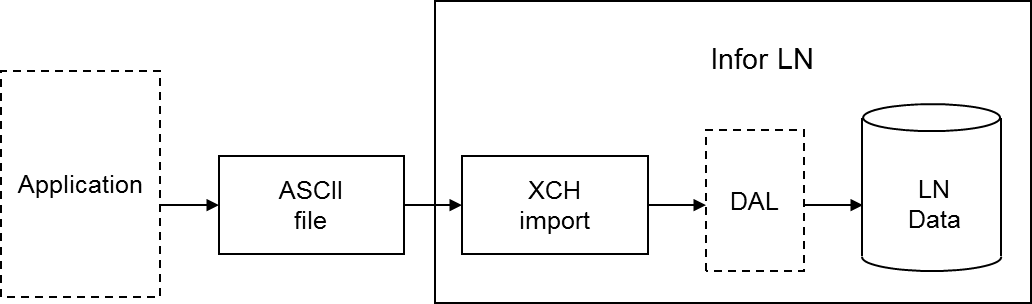
During an Exchange import, you can use all the functionality programmed into the Data Access Layer (DAL). If you use the DAL, Exchange carries out all the constraint checks, integrity checks, and side effects, for example, updates on other tables, that are programmed into the DAL. Database integrity is guaranteed automatically.

Using the DAL reduces the costs of interface development. You can use the DAL to import standard interfaces developed by Infor for partner products, as well as for specific interfaces built by customers, for example, to integrate LN with legacy systems. You can use the DAL in both single site and multisite environments.

The checks or additional actions specified in the DAL are carried out for each row that is imported. Database errors are logged in the same way for DAL and non-DAL import. DAL hook errors are also logged. You can specify whether the DAL property checks are or are not carried out.

If you specify the use of the DAL for a table relation for an import, the dal.new, dal.update, and dal.destroy functions are used instead of db.insert, db.update, and db.delete. You can choose to use DAL for particular tables and not for other tables, therefore, an import batch can contain both types of table relations simultaneously. The import through DAL works for both the import based on audit or indicators (inserts, updates, deletes), and the full import (inserts only).

DAL settings are run time aspects, which means you can change these aspects without having to regenerate the import program. DAL settings are also logged in the log table at batch line level, to enable you to find out what the DAL settings were when the import was run.

Important to realize is that an update through the DAL can result in a number of side effects. Actions performed by the DAL must not be carried out twice. For example, if the DAL updates the available to promise (ATP) quantity for an item when importing order data, the ATP quantity must not be updated in a condition script as well.

For this reason, you must not add any actions in condition scripts, or import additional data, that are already handled in the DAL.
Previous Article Infor LN & Baan Tips & Tricks for EXECUTIVES
Next Article Infor LN & Baan Tips & Tricks for FINANCE: Set Up and Calculate Currency Differences
Print
5427 Rate this article:
5.0
Kathy Barthelt

Kathy BartheltKathy Barthelt

Other posts by Kathy Barthelt

Contact author

x

Categories