Please Wait a Moment
X

Infor LX Tips, Infor LN Tips, BPCS Tips, Baan Tips, Infor M3 Tips & Infor ERP News

Crossroads Connections

Infor ERP Tips & News from the Experts

Infor LX | Infor LN | BPCS | Baan | Infor M3

The Security Model in IDF

Anthony Etzel 0 35580 Article rating: 5.0

By applying security to an object, you can control which users can view the object and which users can create, change, delete or copy the object.

Basic object security allows you to control who can display or maintain an object. Advanced object security allows you to control selectively who can create, change, delete, or copy an object.

In the basic model, all of the maintenance activities are permitted to those users who are authorized to maintain the object. Use the basic security model if you want a user who can change an object to also be able to create or delete the object. Use the advanced security model if you need to restrict some users to changing the object but not creating or deleting the object.

Upgrading from BPCS 6.1 to LX 8.3

Anthony Etzel 0 42311 Article rating: 5.0

It's always great to hear nice words from our customers!

"Our upgrade from BPCS 6.1 to LX 8.3 was greatly aided by Crossroads RMC. Their extensive knowledge of the financial system was a saving grace for us since we had a system that was set up over 15 years ago by people no longer in the company. The patience and professionalism of Hugh Carty made the transition much less complicated and frustrating. There is no doubt in my mind that it would have taken a much longer period and a substantially more painful path if it was not for Crossroads RMC bending over backward to accommodate our processes and time constraints.

Crossroads RMC was also able to help us with AS400 technical training, MRP production system design, and pricing using Promotions and Deals. This large swath of knowledge was very helpful in management discussions. Thanks to the Crossroads RMC team and in particular Hugh Carty, Yupo was able to bring this implementation under budget and on time."

Tim Knight — IS Manager, Yupo Corporation, USA

Learn More: Crossroads RMC Consulting Services

Infor LX & BPCS Tip of the Week: Partial Search in Item Description List

Anthony Etzel 0 61611 Article rating: 5.0

Previously, if a user performed a partial search for an item by using a double byte language, no matches were found. Regardless of whether the MLS module is used, this enhancement allows a user to use a double byte language to perform partial or full item description searches. This enhancement resolves an issue with partial searches on screens where the Item Master Lookup (WINIIM) screen is used, such as Material Status Inquiry, INV300D-01, Item Master Selection INV100D1-01, Facility Planning Selection, MRP140D1-01, and Purchasing Inquiry, PUR300D1).

The user selects the F4 prompt from these screens to open the Item Description List. In the prompt window, the user specifies option 10 to perform a partial or full search on an item description.

What does OTTO do that finite scheduling doesn’t?

Anthony Etzel 0 34749 Article rating: 5.0

Finite scheduling identifies what constraints need to be overcome and it provides the best schedule given the constraints. But the objective is not only to overcome or remove the constraint but to prevent the constraint from even occurring. Only people can anticipate and overcome current constraints, and this requires time for analysis and people to apply their knowledge to the data. OTTO removes the non-value-added tasks of extracting and manipulating data and provides visibility to support people in solving near-term, complex problems. 

Crossroads RMC welcomes MBL (USA) Corporation

Anthony Etzel 0 33845 Article rating: 5.0

Crossroads RMC welcomes MBL (USA) Corporation as our newest Data Collection and Warehouse Management client.

MBL (USA) Corporation, with headquarters located in Ottawa, Illinois, manufactures all types of V-Belts, V-Ribbed Belts, Timing Belts, and Variable Speed Belts for both original equipment and service parts in the automotive, recreational, and industrial markets. In addition to supplying North, Central and South America markets, products are exported to countries worldwide. Their corporate parent is Mitsuboshi Belting LTD located in Japan.

MBL (USA) Corporation’s objective was to improve inventory visibility, eliminate paperwork, and use a bar code scanning solution to manage warehouse inventory and eliminate the manual process for inventory warehouse transactions.

Our discovery was able to highlight improvements to streamline the process in the warehouse and improve inventory visibility. Crossroads RMC is a reseller and support partner for TouchPath Warehouse Management which is integrated to MBL (USA) Corporation’s ERP/LX software. TouchPath Warehouse Management provides the insight into your inventory and the warehouse management tools to help you increase customer satisfaction and reduce costs.

We are proud to have MBL (USA) Corporation as our newest client and look forward to being a strategic partner and support their company growth and success.

Infor LX & BPCS Tip of the Week: Inventory Transfers for Outside Operations

Anthony Etzel 0 62249 Article rating: 5.0

This enhancement allows users who currently perform outside operation processing in shop floor programs to manage the transfer of components used in the outside operations to the vendor’s designated warehouse.

This enhancement provides modified and new INV511D screens and adds new logic to allow the user to identify all shop orders that have components linked to outside operations or to identify all the components linked to an outside operation on a shop order. The shop orders can be filtered by either a date range or by a specific vendor.

Inventory Transfers for Outside Operations enhances the management of external operations by providing screens that simplify the selection of the shop orders or items to transfer to a vendor.

Transfers to the vendor warehouse are performed in the Inventory Transfers, INV511D, screens.

First7576777880828384Last

Tips:  LX | BPCS | M3

Tips: LN | Baan

Kathy Barthelt

Infor LN & Baan Tips & Tricks for TECHNOLOGY: Using the Data Access Layer (DAL)

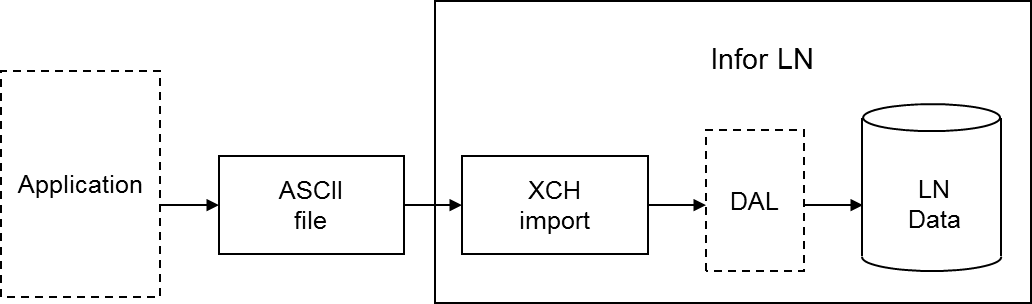
During an Exchange import, you can use all the functionality programmed into the Data Access Layer (DAL). If you use the DAL, Exchange carries out all the constraint checks, integrity checks, and side effects, for example, updates on other tables, that are programmed into the DAL. Database integrity is guaranteed automatically.

Using the DAL reduces the costs of interface development. You can use the DAL to import standard interfaces developed by Infor for partner products, as well as for specific interfaces built by customers, for example, to integrate LN with legacy systems. You can use the DAL in both single site and multisite environments.

The checks or additional actions specified in the DAL are carried out for each row that is imported. Database errors are logged in the same way for DAL and non-DAL import. DAL hook errors are also logged. You can specify whether the DAL property checks are or are not carried out.

If you specify the use of the DAL for a table relation for an import, the dal.new, dal.update, and dal.destroy functions are used instead of db.insert, db.update, and db.delete. You can choose to use DAL for particular tables and not for other tables, therefore, an import batch can contain both types of table relations simultaneously. The import through DAL works for both the import based on audit or indicators (inserts, updates, deletes), and the full import (inserts only).

DAL settings are run time aspects, which means you can change these aspects without having to regenerate the import program. DAL settings are also logged in the log table at batch line level, to enable you to find out what the DAL settings were when the import was run.

Important to realize is that an update through the DAL can result in a number of side effects. Actions performed by the DAL must not be carried out twice. For example, if the DAL updates the available to promise (ATP) quantity for an item when importing order data, the ATP quantity must not be updated in a condition script as well.

For this reason, you must not add any actions in condition scripts, or import additional data, that are already handled in the DAL.
Previous Article Infor LN & Baan Tips & Tricks for EXECUTIVES
Next Article Infor LN & Baan Tips & Tricks for FINANCE: Set Up and Calculate Currency Differences
Print
5504 Rate this article:
5.0
Kathy Barthelt

Kathy BartheltKathy Barthelt

Other posts by Kathy Barthelt

Contact author

x

Categories