Please Wait a Moment
X

Infor LX Tips, Infor LN Tips, BPCS Tips, Baan Tips, Infor M3 Tips & Infor ERP News

Crossroads Connections

Infor ERP Tips & News from the Experts

Infor LX | Infor LN | BPCS | Baan | Infor M3

Infor will no longer support LX or BPCS on IBM i 7.2 after April 30, 2021

George Moroses 0 50850 Article rating: 5.0

On September 10, 2019, IBM® announced the end of support of IBM i 7.2 effective April 30, 2021. In line with IBM’s support policy, Infor will no longer support LX, BPCS, SSAEAM, PRMS, BOSS and related products on IBM i 7.2 after April 30, 2021.

All releases, patches, and solutions are expected to be delivered and compiled for IBM i 7.3 effective May 1, 2021. These deliverables should install and function on version 7 release 3 (IBM i 7.3) and above. This will require that your operating system be at a minimum release level of IBM i 7.3.

This policy extends to other Infor LX related technologies including WebTop, System i Workspace (SIW), and Infor Development Framework (IDF).

If you have not done so already, we recommend you start planning and completing your upgrade to IBM i 7.3 or above prior to April 30, 2021. After this date, if you register a support call with Infor Support, and your application still runs on IBM i 7.2, you may be requested to upgrade to a supported version of the IBM i operating system.

In addition, we invite you to log on to Infor Concierge to view and download important information regarding Infor LX, BPCS, and Infor SSAEAM. General KB Articles have been created to proactively provide you with information regarding this Announcement (1397381) and the Infor BPCS/LX Product Lifecycle Policy (1947086).

Infor LX & BPCS Tip of the Week: Journal Upload – EGLi

George Moroses 0 53434 Article rating: 5.0

EGLi users who maintain journal entries in a Microsoft Excel spreadsheet can use this utility to upload journal entries to EGLi. The Journal Upload installation program adds an Add-Ins tab to Microsoft Excel. This tab includes options to connect to the server where EGLi is installed and to open a spreadsheet template to use for manual journal entry. When the spreadsheet is complete, the Add-Ins tab is used to upload the spreadsheet.

To install Journal Upload:

  1.  The Power-Link Installation page has links to the Client installation programs and a link to download and install the Journal Upload utility. To access this page, use this link with your own values for system and NetLinkport: http://system:NetLinkport/Installs/ClientInstall/Install.html  where system is the server where IDF is installed and NetLinkport is the Net-Link port, typically 36001
     
  2. On the Power-Link Installation page, click the link provided to download and install EGLi Journal Upload.
     
  3. Follow the screen prompts to complete the installation on your PC.
     
  4. To verify the installation, open an Excel spreadsheet. Confirm that the Add-Ins tab is on the spreadsheet. 


See the Infor Enterprise General Ledger for System i Journal Upload Installation and Infor LX Configuration Guide.

Infor LN & Baan Tip: Open Transactions Check – LN 10.7

Kathy Barthelt 0 96268 Article rating: 5.0

When closing a project, users were informed about open transactions blocking the closure process. To proactively check on open transactions, the Show Open Transactions option has been introduced in the Project Status (tppdm6107s000) session. With this option, issues can be resolved before changing the status.

Infor LX & BPCS Tip of the Week: LX 8.4 Enhancement – Company Security for ACR510

George Moroses 0 18332 Article rating: 5.0

This enhancement provides LX Company Security to Invoice Maintenance, ACR510. Only users authorized to the invoice company can view or maintain invoices.

User must be authorized to ACR as a product or ACR510 as an individual program in Security Master Maintenance, SYS600. Additionally, ACR510-01, displays all records, but if the user tries to revise or display a transaction record for a company the user is not authorized to, this error message is displayed: “User is not authorized to the transaction company.”

Infor LX & BPCS Tip of the Week: Item Deletion Option in IDF Enterprise Items

George Moroses 0 22498 Article rating: 5.0

Previously, users were unable to delete items in IDF Enterprise Items when they have inventory balances or the item is connected to ancillary records, such as sales history records. This feature added in LX 8.4 provides the ability to delete an item when sales history records are found but all sales history activity is zero.

When the user attempts to delete an item in IDF Enterprise Items that is tied to a sales history record, the panel displays a message that the item cannot be deleted. The user can then run the Delete Validation Report to determine which records are tied to this item that prevents the validation. If the item no longer has manufacturing activity but had old sales history, the item can be deleted.

First5657585961636465Last

Tips:  LX | BPCS | M3

Tips: LN | Baan

Kathy Barthelt

Infor LN & Baan Tips & Tricks for TECHNOLOGY: Using the Data Access Layer (DAL)

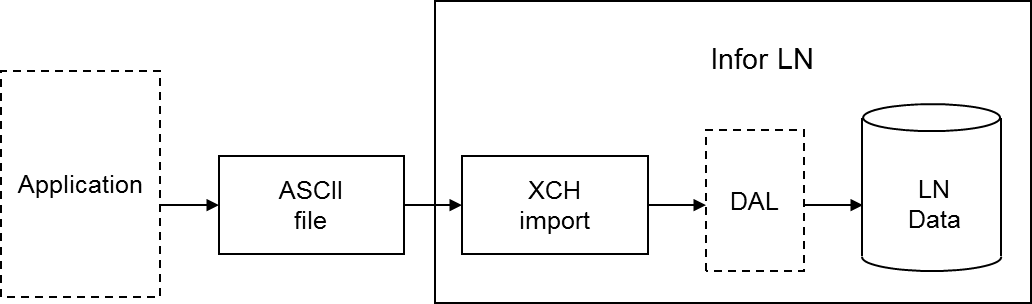
During an Exchange import, you can use all the functionality programmed into the Data Access Layer (DAL). If you use the DAL, Exchange carries out all the constraint checks, integrity checks, and side effects, for example, updates on other tables, that are programmed into the DAL. Database integrity is guaranteed automatically.

Using the DAL reduces the costs of interface development. You can use the DAL to import standard interfaces developed by Infor for partner products, as well as for specific interfaces built by customers, for example, to integrate LN with legacy systems. You can use the DAL in both single site and multisite environments.

The checks or additional actions specified in the DAL are carried out for each row that is imported. Database errors are logged in the same way for DAL and non-DAL import. DAL hook errors are also logged. You can specify whether the DAL property checks are or are not carried out.

If you specify the use of the DAL for a table relation for an import, the dal.new, dal.update, and dal.destroy functions are used instead of db.insert, db.update, and db.delete. You can choose to use DAL for particular tables and not for other tables, therefore, an import batch can contain both types of table relations simultaneously. The import through DAL works for both the import based on audit or indicators (inserts, updates, deletes), and the full import (inserts only).

DAL settings are run time aspects, which means you can change these aspects without having to regenerate the import program. DAL settings are also logged in the log table at batch line level, to enable you to find out what the DAL settings were when the import was run.

Important to realize is that an update through the DAL can result in a number of side effects. Actions performed by the DAL must not be carried out twice. For example, if the DAL updates the available to promise (ATP) quantity for an item when importing order data, the ATP quantity must not be updated in a condition script as well.

For this reason, you must not add any actions in condition scripts, or import additional data, that are already handled in the DAL.
Previous Article Infor LN & Baan Tips & Tricks for EXECUTIVES
Next Article Infor LN & Baan Tips & Tricks for FINANCE: Set Up and Calculate Currency Differences
Print
5504 Rate this article:
5.0
Kathy Barthelt

Kathy BartheltKathy Barthelt

Other posts by Kathy Barthelt

Contact author

x

Categories