Please Wait a Moment
X

Infor LX Tips, Infor LN Tips, BPCS Tips, Baan Tips, Infor M3 Tips & Infor ERP News

Crossroads Connections

Infor ERP Tips & News from the Experts

Infor LX | Infor LN | BPCS | Baan | Infor M3

DATA: See it. Understand it. Discuss it.

Crossroads RMC 0 17052 Article rating: 5.0

We’ve all heard author and management consultant Peter Drucker’s famous quote “If you can’t measure it, you can’t manage it.”  

What’s the right way to manage “It” though? Is it enough to put the data in the hands of the responsible manager and wait for change to occur? Does the manager have a pulse on everything that went into those numbers?

Your numbers tell a story, but there is a lot of...

Infor LX & BPCS Tip: Tracking Financial Journal Entries

George Moroses 0 22986 Article rating: 5.0

An 8.4.1 EGL audit enhancement now provides visibility to who and when a financial journal was last maintained and to who and when the journal was approved. The enhancement provides audit attributes for last maintain user, date, time and approval user, date time on the Financial Journal Entry and Financial Journal Entry Lines.  

The programs or areas impacted include:

Is Your ERP System Hurting Your Business?

The Importance of an Integrated System

Kathy Barthelt 0 17800 Article rating: 5.0

It could be if your ERP system isn't integrated with other systems that contain mission-critical business data.

Having data in two (or more) systems that don’t talk to one another is like baking a pizza crust in one oven and the toppings in another. Once baked, you may have food to snack on, but it sure isn’t pizza! Pizza requires the cheese, sauce and spices to bake with the crust, so all the flavors meld together when you take that first delicious bite. 

That’s the value of an integrated ERP system. When you...

Optimize with Infor Development Framework: IDF

Infor LX | BPCS | M3

George Moroses 0 20225 Article rating: 5.0

Why You Need IDF

The Infor Development Framework (IDF) not only helps you modernize the look and feel of your LX software but also the interactions of the IBM i software with other applications in your business.

“The IDF is a multi-user interface, single codebase architecture that’s metadata-driven (and) provides a lot of flexibility to adapt the software for their processes.” says Infor. This is the direction that Infor is going starting...

First3233343537394041Last

Tips:  LX | BPCS | M3

Tips: LN | Baan

Kathy Barthelt

Infor LN & Baan Tips & Tricks for TECHNOLOGY: Using the Data Access Layer (DAL)

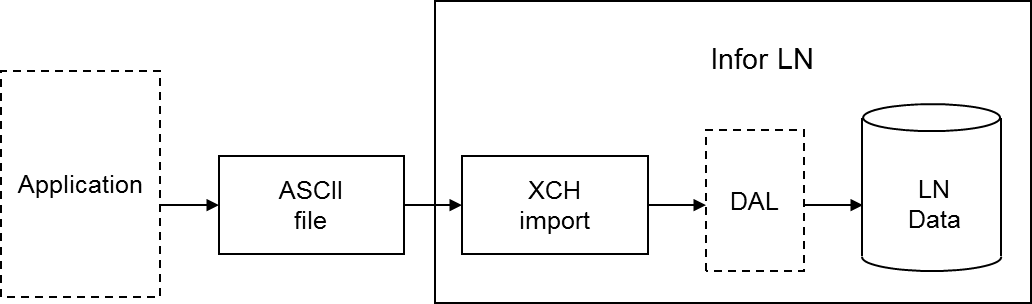
During an Exchange import, you can use all the functionality programmed into the Data Access Layer (DAL). If you use the DAL, Exchange carries out all the constraint checks, integrity checks, and side effects, for example, updates on other tables, that are programmed into the DAL. Database integrity is guaranteed automatically.

Using the DAL reduces the costs of interface development. You can use the DAL to import standard interfaces developed by Infor for partner products, as well as for specific interfaces built by customers, for example, to integrate LN with legacy systems. You can use the DAL in both single site and multisite environments.

The checks or additional actions specified in the DAL are carried out for each row that is imported. Database errors are logged in the same way for DAL and non-DAL import. DAL hook errors are also logged. You can specify whether the DAL property checks are or are not carried out.

If you specify the use of the DAL for a table relation for an import, the dal.new, dal.update, and dal.destroy functions are used instead of db.insert, db.update, and db.delete. You can choose to use DAL for particular tables and not for other tables, therefore, an import batch can contain both types of table relations simultaneously. The import through DAL works for both the import based on audit or indicators (inserts, updates, deletes), and the full import (inserts only).

DAL settings are run time aspects, which means you can change these aspects without having to regenerate the import program. DAL settings are also logged in the log table at batch line level, to enable you to find out what the DAL settings were when the import was run.

Important to realize is that an update through the DAL can result in a number of side effects. Actions performed by the DAL must not be carried out twice. For example, if the DAL updates the available to promise (ATP) quantity for an item when importing order data, the ATP quantity must not be updated in a condition script as well.

For this reason, you must not add any actions in condition scripts, or import additional data, that are already handled in the DAL.
Previous Article Infor LN & Baan Tips & Tricks for EXECUTIVES
Next Article Infor LN & Baan Tips & Tricks for FINANCE: Set Up and Calculate Currency Differences
Print
5427 Rate this article:
5.0
Kathy Barthelt

Kathy BartheltKathy Barthelt

Other posts by Kathy Barthelt

Contact author

x

Categories