Please Wait a Moment
X

Infor LX Tips, Infor LN Tips, BPCS Tips, Baan Tips, Infor M3 Tips & Infor ERP News

Crossroads Connections

Infor ERP Tips & News from the Experts

Infor LX | Infor LN | BPCS | Baan | Infor M3

PDIC selects NextTrack Dashboard for Costa Rica Wire Plant

Anthony Etzel 0 56150 Article rating: No rating

The Analytics Dashboard will be used in combination with the existing Crossroads MES system to provide real time machine status across the plant. In addition, KPI’s like OEE and Downtime % will be monitored and displayed at the wire machines and to the production management.

BPCS/LX Tip of the Week: Changing the Master Schedule

Anthony Etzel 0 76664 Article rating: 4.5

You can change your master schedule by specifying the type of master schedule update to perform. You can run a Net Change or Regenerative Schedule.

You also have the ability to clear the lower level requirements out of the Planned and Firm-Planned Order file.

Baan/LN Tip of the Week: Optionally Include Tax Amounts In Order Balance

Kathy Barthelt 0 113065 Article rating: No rating

In Baan IV, the order balance amount always includes the tax amount. Consequently, the tax amount must be recalculated every time an order line is modified in order to update the balance correctly. If the tax provider is activated, this requires an API call for every re-calculation of tax.

In Infor LN, users can select or clear the new Include Tax in Order Balance check box in the COM Parameters (tccom0000s000) session to indicate whether users want to include tax amounts in the order balance amount. This parameter has an effect on various sessions in Order Management.

Baan/LN Tip of the Week: Default Order Frequency

Kathy Barthelt 0 160512 Article rating: No rating

In Baan IV, requirements for an MPS item with the order method lot-for-lot result in daily planned MPS orders.

For example, if a plan period contains 10 working days and the net requirements for an item in that period is 2000 pieces, an MPS planning run generates one planned MPS order of 200 pieces for each working day in the plan period.

In Infor LN, requirements for a planned item with the order method lot-for-lot result in one planned order per plan period.

For example, if a plan period contains 10 working days and the net requirements for an item in that period is 2000 pieces, a master planning run will generate a single planned order of 2000 pieces for the first working day in that plan period. To influence the order quantity of the planned orders, enter appropriate values in the Maximum Order Quantity field and the Order Interval field in the Items – Ordering (tcibd2500m000) session or choose a fixed order quantity.

BPCS/LX Tip of the Week: What is Lean Make to Order?

Anthony Etzel 0 74956 Article rating: No rating

This is a simple way to go from the customer order to making the order and shipping the order. It involves a few simple steps:

  1. Receive and enter the customer order
  2. Automatic credit review
  3. Automatic release of the shop order tied to the customer order
  4. Issue material, report labor to the production order receipt
  5. Pick the order, ship the order, invoice the customer

With lean, you can skip processing the demand through MRP. You can go directly from the customer order to the shop order creation.

PDIC Goes Live with Crossroads MES

Anthony Etzel 0 54707 Article rating: 5.0

PDIC, a leading producer of wire products, went live with the Crossroads MES solution on June 30th,2014. PDIC needed a better way to deploy and report shop floor information to BPCS 6.02. Their goal was to eliminate all their manual reporting and position themselves to take advantage of the Crossroads Dashboards.

Baan/LN Tip of the Week: Negative Inventory

Kathy Barthelt 0 131258 Article rating: 5.0

If Location Control is turned on in Baan IV, then inventory should never be negative.

If Location Control is not turned on in Baan IV, and the parameter “Negative Inventory Allowed” in INV Parameters is set to “NO”, then inventory should never be negative.

In Baan V and LN, the parameters in Inventory Handling Parameters determine whether you can have negative inventory. If these parameters are set to “NO”, then inventory should never be negative.

BPCS/LX Tip of the Week: Establish Costing For Purchased Items

Anthony Etzel 0 88975 Article rating: No rating

How Does Infor LX Establish Costing For Purchased Items?

In LX, you will establish a standard cost (you define the standard) that LX will use for the purchase items. You also need to establish in LX the Cost Type, the Cost Bucket, and the Cost Set needed for cost accounting.

First130131132133134135136138

Tips:  LX | BPCS | M3

Tips: LN | Baan

Kathy Barthelt

Infor LN & Baan Tips & Tricks for TECHNOLOGY: Using the Data Access Layer (DAL)

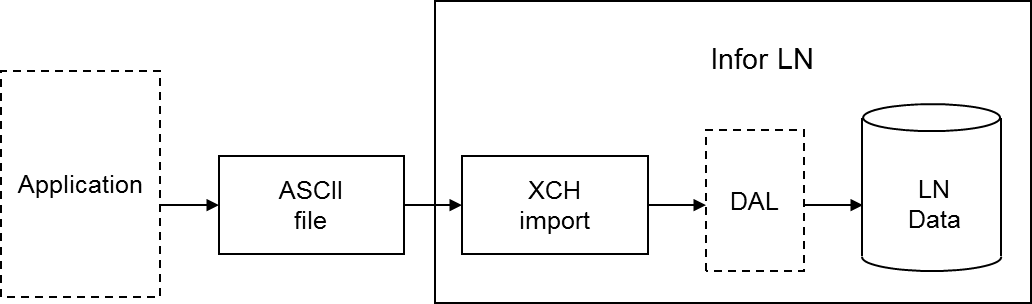
During an Exchange import, you can use all the functionality programmed into the Data Access Layer (DAL). If you use the DAL, Exchange carries out all the constraint checks, integrity checks, and side effects, for example, updates on other tables, that are programmed into the DAL. Database integrity is guaranteed automatically.

Using the DAL reduces the costs of interface development. You can use the DAL to import standard interfaces developed by Infor for partner products, as well as for specific interfaces built by customers, for example, to integrate LN with legacy systems. You can use the DAL in both single site and multisite environments.

The checks or additional actions specified in the DAL are carried out for each row that is imported. Database errors are logged in the same way for DAL and non-DAL import. DAL hook errors are also logged. You can specify whether the DAL property checks are or are not carried out.

If you specify the use of the DAL for a table relation for an import, the dal.new, dal.update, and dal.destroy functions are used instead of db.insert, db.update, and db.delete. You can choose to use DAL for particular tables and not for other tables, therefore, an import batch can contain both types of table relations simultaneously. The import through DAL works for both the import based on audit or indicators (inserts, updates, deletes), and the full import (inserts only).

DAL settings are run time aspects, which means you can change these aspects without having to regenerate the import program. DAL settings are also logged in the log table at batch line level, to enable you to find out what the DAL settings were when the import was run.

Important to realize is that an update through the DAL can result in a number of side effects. Actions performed by the DAL must not be carried out twice. For example, if the DAL updates the available to promise (ATP) quantity for an item when importing order data, the ATP quantity must not be updated in a condition script as well.

For this reason, you must not add any actions in condition scripts, or import additional data, that are already handled in the DAL.
Previous Article Infor LN & Baan Tips & Tricks for EXECUTIVES
Next Article Infor LN & Baan Tips & Tricks for FINANCE: Set Up and Calculate Currency Differences
Print
5350 Rate this article:
5.0
Kathy Barthelt

Kathy BartheltKathy Barthelt

Other posts by Kathy Barthelt

Contact author

x

Categories