Please Wait a Moment
X

Infor LX Tips, Infor LN Tips, BPCS Tips, Baan Tips, Infor M3 Tips & Infor ERP News

Crossroads Connections

Infor ERP Tips & News from the Experts

Infor LX | Infor LN | BPCS | Baan | Infor M3

BPCS/LX Tip of the Day: Cycle Counting Part 2

Anthony Etzel 0 78112 Article rating: No rating

Understanding: The Cycle Count Alternative

The best way to cycle count is to count the same number of items each day and at the same time each day. The goal is to count your “A” items 4 times a year. The “A” items should be those item that are about 80% of the total inventory value and 20% of the total items. Consider creating your own cycle count schedule then instead of using the cycle count transaction, use the inventory adjustment transaction. The item balance is changed at the time the transaction is keyed. The transaction list can be used for the reconciliation process.

Baan/LN Tip of the Day: Company Calendar

Kathy Barthelt 0 110101 Article rating: 5.0

Baan uses the company calendar in the following modules to determine the start and end dates for planned orders:

  • Master Production Scheduling
  • Material Requirements Planning
  • Capacity Requirements Planning
    (All three combined in a single planning module for Baan V and LN)
  • Shop Floor Control

The calendar provides the valid working days, number of shifts per day and the number of hours in a day.

Baan allows for a single calendar for the whole company or for a calendar for each work center.

BPCS/LX Tip of the Week: Cycle Counting Part 1

Anthony Etzel 0 84925 Article rating: No rating

Understanding: The Cycle Count Transaction

If you rely on BPCS to provide you with a cycle count list, the number of items could vary from day to day from a few items to count, to several. So the person doing the cycle counting may spend a few minutes to a few hours counting items. After the cycle count is complete, the balances are not changed until the reconciliation is complete. This process could take some time before the balances are changed.

The cycle count transaction process is similar to the physical inventory transaction process.

Baan/LN Tip of the Week: GRINYA

Kathy Barthelt 0 149838 Article rating: 3.0
GRINYA is one of the more complex issues in ERP Finance. GRINYA is the tracking via ledger account of the value of items received on a purchase order that have not been matched to a supplier invoice.

Baan solutions for Baan IV and V were incomplete. To take full advantage of the current GRINYA reconciliation process, check Infor solution #107147, which contains the GRINYA user manual and a link to download the software for your version of Baan. For ERP LN, look at Document Code U8942C US.

It is called User Guide for Reconciliation and Analysis. If you are not running the latest GRINYA solutions, patching will require a good amount of time in filling the Interim tables this solution runs from. Infor has posted several procedural write ups, so check the Support Site and read up before tackling this for the first time.

BPCS/LX Tip of the Week: Work Center & Machine Locations

Anthony Etzel 0 84497 Article rating: No rating
For either file, you must specify a valid location code as defined in the Location Master File.

If the machine master locations are blank, then the work center locations are used. There are cases where you may want to do a combination between the two in defining the locations.

Let’s say the end item has one operation. The operation is at work center 510 and Machine A is in the work center. You have locations setup in both the Work center file and the Machine master File. You report 100 complete at the work center without specifying the machine.

In this case, the inventory will be processed based on the locations defined in the work center file. If the transaction included the machine number, then the locations in the machine file would be used.

BPCS/LX Tip of the Week: The Item Master Requirements Code

Anthony Etzel 0 80342 Article rating: No rating

In the Item Master File, the requirements code is used to specify the type of demand for the item. Planned order requirements are determined from the type of demand. If the requirements code is left blank, the planning systems treat the item as a sum code (3).
 

Other options for the field are:


1 = Dependent demand that is indirectly generated from the parent item requirements.

2 = Independent demand generated from customer orders and forecasts.

3 = The Sum of both independent and dependent demand.

First126127128129131133134135Last

Tips:  LX | BPCS | M3

Tips: LN | Baan

Kathy Barthelt

Infor LN & Baan Tips & Tricks for TECHNOLOGY: Using the Data Access Layer (DAL)

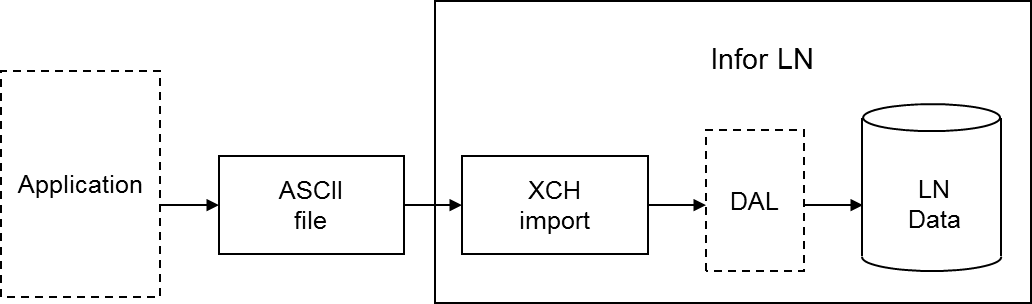
During an Exchange import, you can use all the functionality programmed into the Data Access Layer (DAL). If you use the DAL, Exchange carries out all the constraint checks, integrity checks, and side effects, for example, updates on other tables, that are programmed into the DAL. Database integrity is guaranteed automatically.

Using the DAL reduces the costs of interface development. You can use the DAL to import standard interfaces developed by Infor for partner products, as well as for specific interfaces built by customers, for example, to integrate LN with legacy systems. You can use the DAL in both single site and multisite environments.

The checks or additional actions specified in the DAL are carried out for each row that is imported. Database errors are logged in the same way for DAL and non-DAL import. DAL hook errors are also logged. You can specify whether the DAL property checks are or are not carried out.

If you specify the use of the DAL for a table relation for an import, the dal.new, dal.update, and dal.destroy functions are used instead of db.insert, db.update, and db.delete. You can choose to use DAL for particular tables and not for other tables, therefore, an import batch can contain both types of table relations simultaneously. The import through DAL works for both the import based on audit or indicators (inserts, updates, deletes), and the full import (inserts only).

DAL settings are run time aspects, which means you can change these aspects without having to regenerate the import program. DAL settings are also logged in the log table at batch line level, to enable you to find out what the DAL settings were when the import was run.

Important to realize is that an update through the DAL can result in a number of side effects. Actions performed by the DAL must not be carried out twice. For example, if the DAL updates the available to promise (ATP) quantity for an item when importing order data, the ATP quantity must not be updated in a condition script as well.

For this reason, you must not add any actions in condition scripts, or import additional data, that are already handled in the DAL.
Previous Article Infor LN & Baan Tips & Tricks for EXECUTIVES
Next Article Infor LN & Baan Tips & Tricks for FINANCE: Set Up and Calculate Currency Differences
Print
5373 Rate this article:
5.0
Kathy Barthelt

Kathy BartheltKathy Barthelt

Other posts by Kathy Barthelt

Contact author

x

Categories