Please Wait a Moment
X

Infor LX Tips, Infor LN Tips, BPCS Tips, Baan Tips, Infor M3 Tips & Infor ERP News

Crossroads Connections

Infor ERP Tips & News from the Experts

Infor LX | Infor LN | BPCS | Baan | Infor M3

BPCS/LX TIP OF THE WEEK: GETTING A HANDLE ON DOWNTIME

Anthony Etzel 0 49929 Article rating: No rating

It is essential to capture a reason and duration for each downtime incident to enable the team to effectively prioritize and focus.

Start simple, and make sure every reason is clear (when compared with other reasons) and describes symptoms (as opposed to attempting to diagnose root causes). Remove reasons that aren’t regularly used and add reasons.


Baan/LN Tip of the Week: Getting a Handle on Downtime

Kathy Barthelt 0 88572 Article rating: No rating

It is essential to capture a reason and duration for each downtime incident to enable the team to effectively prioritize and focus.

Start simple, and make sure every reason is clear (when compared with other reasons) and describes symptoms (as opposed to attempting to diagnose root causes). Remove reasons that aren’t regularly used and add reasons.

BPCS/LX Tip of the Week: What Should I Consider When Analyzing my Sales?

Anthony Etzel 0 52729 Article rating: No rating

From a recent article published by M4B Marketing:

When analyzing your sales performance consider the following: 

  • Pricing changes eg. price increases or discounting
  • Competitors – competitors entering or exiting the market
  • New product or service launch growing sales
  • New product or service cannibalizing existing product or service sales
  • Customers moving between products or services
  • Changes in customer demand eg. increasing or decreasing
  • The segments and distribution channels you operate in
 

Baan/LN Tip of the Week: What Should I Consider When Analyzing My Sales?

Kathy Barthelt 0 2763418 Article rating: No rating

From a recent article published by M4B Marketing:

When analyzing your sales performance consider the following: 

  • Pricing changes eg. price increases or discounting
  • Competitors – competitors entering or exiting the market
  • New product or service launch growing sales
  • New product or service cannibalizing existing product or service sales
  • Customers moving between products or services
  • Changes in customer demand eg. increasing or decreasing
  • The segments and distribution channels you operate in

Crossroads MES – The Shining Star of Hoffmaster’s Move to LX

Anthony Etzel 0 37726 Article rating: No rating

When Hoffmaster finally flipped the switch on its ERP migration at the end of February, the IT director was nervous. Not only was the paper-goods supplier consolidating a manufacturing site on Infor ERP LX, but it was also replacing an old shop floor reporting system with a new one from Crossroads RMC. There was a lot that could go wrong for the IBM i shop.

"When we weighed all of our products, Crossroads RMC pretty much convinced us their product was plug and play and their integration back to LX was solid as a rock, and they were right..." the IT director says.

Click Here to Learn about Hoffmaster’s move to Infor LX and their implementation of the Crossroads MES solution.

Tip of the Week: Operational Inefficiencies

Anthony Etzel 0 57341 Article rating: No rating
Two big sources of inefficiencies in manufacturing are paper and spreadsheets. I know that you love ‘em, but they are the cause of more problems than you probably realize. Think of how long it takes you to get paper-based data into the hands of those who can do something valuable with the data.
 
  • Is the information captured correctly?
  • Can everyone access the information?
  • Is this an accurate representation of what’s going on across all operations?

Make your shop floor paperless and put systems in place that talk to one another and automatically pull and push data to and from your ERP so that you can look in one place for all the information you need to run your business effectively.

If you’re not doing this today, you might as well be burning money.

Baan/LN Tip of the Week: Operational Inefficiencies

Kathy Barthelt 0 54342 Article rating: No rating
Two big sources of inefficiencies in manufacturing are paper and spreadsheets. I know that you love ‘em, but they are the cause of more problems than you probably realize. Think of how long it takes you to get paper based data into the hands of those who can do something valuable with the data.
 
  • Is the information captured correctly?
  • Can everyone access the information?
  • Is this an accurate representation of what’s going on across all operations?

Make your shop floor paperless and put systems in place that talk to one another and automatically pull and push data to and from your ERP so that you can look in one place for all the information you need to run your business effectively.

If you’re not doing this today, you might as well be burning money.
 

BPCS/LX Tip of the Week: How's Your MOM?

Anthony Etzel 0 66867 Article rating: No rating

I realize it was just Mother’s Day, but I don’t mean your mother.

I mean... MOM- Manufacturing Operations Management, a suite of manufacturing applications designed to improve efficiencies, without the investment in a costly system.

MOM provides manufacturers with the ability to extend their ERP system by offering specific applications that will streamline their operations at an affordable price.

MOM Suite of Manufacturing Applications:

  • Manufacturing Execution System (MES)
  • Time & Attendance
  • Labor Reporting
  • Data Collection
  • Dashboards
  • Scheduling
  • Shipping & Receiving
  • Supplier Barcoding

So, I ask again… how’s your MOM? Contact Crossroads RMC to learn more.

First108109110111113115116117Last

Tips:  LX | BPCS | M3

Tips: LN | Baan

Kathy Barthelt

Infor LN & Baan Tips & Tricks for TECHNOLOGY: Using the Data Access Layer (DAL)

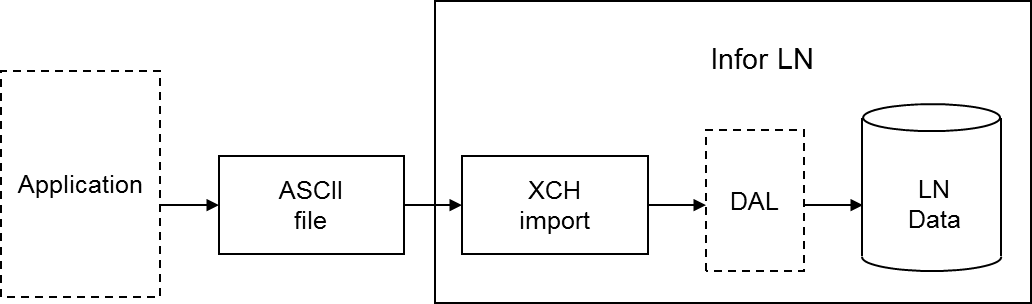
During an Exchange import, you can use all the functionality programmed into the Data Access Layer (DAL). If you use the DAL, Exchange carries out all the constraint checks, integrity checks, and side effects, for example, updates on other tables, that are programmed into the DAL. Database integrity is guaranteed automatically.

Using the DAL reduces the costs of interface development. You can use the DAL to import standard interfaces developed by Infor for partner products, as well as for specific interfaces built by customers, for example, to integrate LN with legacy systems. You can use the DAL in both single site and multisite environments.

The checks or additional actions specified in the DAL are carried out for each row that is imported. Database errors are logged in the same way for DAL and non-DAL import. DAL hook errors are also logged. You can specify whether the DAL property checks are or are not carried out.

If you specify the use of the DAL for a table relation for an import, the dal.new, dal.update, and dal.destroy functions are used instead of db.insert, db.update, and db.delete. You can choose to use DAL for particular tables and not for other tables, therefore, an import batch can contain both types of table relations simultaneously. The import through DAL works for both the import based on audit or indicators (inserts, updates, deletes), and the full import (inserts only).

DAL settings are run time aspects, which means you can change these aspects without having to regenerate the import program. DAL settings are also logged in the log table at batch line level, to enable you to find out what the DAL settings were when the import was run.

Important to realize is that an update through the DAL can result in a number of side effects. Actions performed by the DAL must not be carried out twice. For example, if the DAL updates the available to promise (ATP) quantity for an item when importing order data, the ATP quantity must not be updated in a condition script as well.

For this reason, you must not add any actions in condition scripts, or import additional data, that are already handled in the DAL.
Previous Article Infor LN & Baan Tips & Tricks for EXECUTIVES
Next Article Infor LN & Baan Tips & Tricks for FINANCE: Set Up and Calculate Currency Differences
Print
5427 Rate this article:
5.0
Kathy Barthelt

Kathy BartheltKathy Barthelt

Other posts by Kathy Barthelt

Contact author

x

Categories