Infor ERP Tips and Infor ERP News for Infor LX, BPCS, Infor ERP LX, Infor LN, Infor ERP LN, Baan, Infor M3, and Movex

Please Wait a Moment
X

Infor LX Tips, Infor LN Tips, BPCS Tips, Baan Tips, Infor M3 Tips & Infor ERP News

Crossroads Connections

Infor ERP Tips & News from the Experts

Infor LX | Infor LN | BPCS | Baan | Infor M3

The Far-Reaching Impact of Disconnected Data

Kathy Barthelt 0 7017 Article rating: 5.0

Disconnected data doesn’t just slow you down—it creates bottlenecks across your entire business. When your ERP isn’t connected to the systems you rely on, every department feels it.

How Disconnected Data Hurts Your Organization

  • Operations: Spreadsheets and manual order entry waste valuable time.

  • Finance: Budgets, POs, and invoices stuck in silos cause delays and errors.

  • Technology: Teams burn hours exporting data to stay “up to date.”

  • Executives: No single source of truth makes it hard to see the big picture.

A recent study found that 61% of companies face project delays from slow data integration, while employees waste the equivalent of 19 workdays per year moving data between systems. That’s lost productivity you can’t afford.

Why ERP Integration Matters
Your ERP is the heart of your operations. Connecting it to the rest of your business tools unlocks:

  • Real-time data access → no more outdated spreadsheets.

  • Improved communication → one source of truth for every team.

  • Higher productivity → eliminate duplicate entry and manual reporting.

  • Smarter supply chains → better visibility, fewer delays.

  • Sales enablement → reps get live pricing, inventory, and customer data.


Simplify Integration with Infor ION...

Infor LN & Baan Tips & Tricks for OPERATIONS: Subcontracting Overview

Kathy Barthelt 0 15406 Article rating: 5.0

Companies can decide to involve a subcontractor and subcontract part of their activities. The subcontractor carries out the work and returns the products to your company.

In Infor LN, subcontracting is considered as purchasing labor from a third party. Therefore, if a manufacturer wants to subcontract work, he must generate a purchase order to start the subcontracting process. These are the types of subcontracting:

  • Subcontracting with material flow
    • Operation subcontracting: For operation subcontracting, a part of the production process (one or more operations) is subcontracted.
    • Item subcontracting: For item subcontracting, an item's entire production process is subcontracted. Therefore, it is always used with material flow support.
  • Subcontracting without material flow: The simplest form of subcontracting is to generate a subcontracting purchase order to record the operations outsourced to a subcontractor. The subcontracting purchase order only represents the administrative handling of the subcontracting process. When the subcontracted item is received back from the subcontractor, you must close the subcontracting purchase order, which initiates the production process.
  • Unplanned subcontracting: Unplanned subcontracting is applicable when you subcontract after generating a production order. For unplanned subcontracting, a purchase order is generated from the production order and the material supply lines are populated by Shop Floor Control.
  • Service subcontracting: For service subcontracting, work on an item to be maintained or repaired is subcontracted. This work entails the entire repair process, or only a part of it. Service subcontracting can be used with or without material flow support.

To start the subcontracting process, a purchase order is required.

Infor LN & Baan Tips & Tricks for FINANCE: Set Up and Calculate Currency Differences

Kathy Barthelt 0 7783 Article rating: 5.0

To set up and calculate currency differences for foreign currencies:

  • Use the Company Parameters (tfgld0503m000) session to specify the profit and loss ledger accounts, 12 profit and loss dimensions, and transaction type for a posting exchange rate differences that is calculated using the FIFO method. To specify this data, use the Currency Diff. FIFO tab. The reports printed from the Print Company Parameters (tfgld0404m000) session, include the Currency Differences FIFO fields.
  • Use the Calculate Currency Differences (tfgld5201m000) session to calculate the currency differences resulting from transactions posted on accounts for which the field Currency Analysis in the session Chart of Accounts (tfgld0508m000) is set to Required.

Infor LN & Baan Tips & Tricks for TECHNOLOGY: Using the Data Access Layer (DAL)

Kathy Barthelt 0 8752 Article rating: 5.0

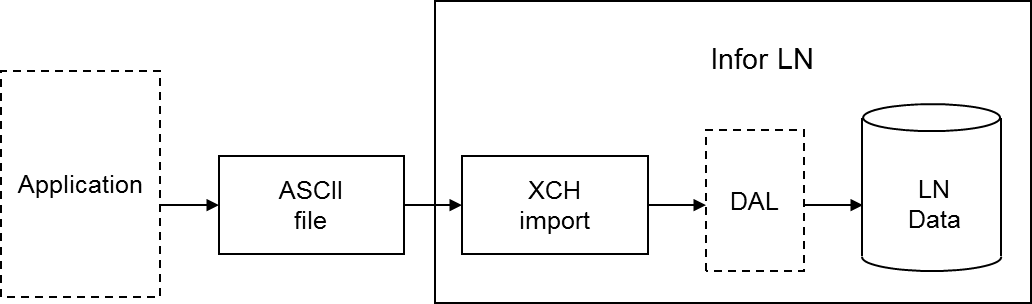
During an Exchange import, you can use all the functionality programmed into the Data Access Layer (DAL). If you use the DAL, Exchange carries out all the constraint checks, integrity checks, and side effects, for example, updates on other tables, that are programmed into the DAL. Database integrity is guaranteed automatically.

Using the DAL reduces the costs of interface development. You can use the DAL to import standard interfaces developed by Infor for partner products, as well as for specific interfaces built by customers, for example, to integrate LN with legacy systems. You can use the DAL in both single site and multisite environments.

The checks or additional actions specified in the DAL are carried out for each row that is imported. Database errors are logged in the same way for DAL and non-DAL import. DAL hook errors are also logged. You can specify whether the DAL property checks are or are not carried out.

If you specify the use of the DAL for a table relation for an import, the dal.new, dal.update, and dal.destroy functions are used instead of db.insert, db.update, and db.delete. You can choose to use DAL for particular tables and not for other tables, therefore, an import batch can contain both types of table relations simultaneously. The import through DAL works for both the import based on audit or indicators (inserts, updates, deletes), and the full import (inserts only).

DAL settings are run time aspects, which means you can change these aspects without having to regenerate the import program. DAL settings are also logged in the log table at batch line level, to enable you to find out what the DAL settings were when the import was run.

Important to realize is that an update through the DAL can result in a number of side effects. Actions performed by the DAL must not be carried out twice. For example, if the DAL updates the available to promise (ATP) quantity for an item when importing order data, the ATP quantity must not be updated in a condition script as well.

For this reason, you must not add any actions in condition scripts, or import additional data, that are already handled in the DAL.
Infor LX/BPCS Tips & Tricks for TECHNOLOGY: Add Last Maintained Audit Fields to SYS600

George Moroses 0 15128 Article rating: 5.0

LX has enhanced the SYS600 User Security Maintenance application by adding the ZXUP audit fields:

  • Last Maintained Date

  • Last Maintained Time

  • Last Maintained User

These fields are updated whenever a user or role is revised, deleted, or reactivated.

This enhancement provides standard audit tracking to identify who modified a User Security record and when. The audit fields can be used for ad hoc tracking, reporting, and analysis.

First567810121314Last

Tips:  LX | BPCS | M3

Tips: LN | Baan

Kathy Barthelt

Moving Beyond ERP Customizations: Smarter Solutions for a Future-Ready System

Transitioning away from ERP customizations can feel like a major hurdle—but with the right strategy, it’s not just possible, it’s powerful. Let’s cut through the noise and look at the real issues... and the smart solutions that pave the way to a leaner, more future-ready ERP.

Common Challenges (and Why They’re Not Dealbreakers)

Reliance on Custom Processes
Custom workflows often become second nature—but are they still serving you? Modern ERPs evolve with industry best practices baked in, and chances are, today’s standard features do what your custom code used to… only better.

Budget & Time Constraints
Testing, retraining, consulting—it all adds up. But the long-term payoff? Reduced technical debt, faster upgrades, and major gains in efficiency and scalability.

User Resistance
Change is hard, especially when teams are comfortable with their tools. But clear communication and a strong change management plan can turn skeptics into champions of a smarter, streamlined system.

Reality Check: Has Your Business Outgrown Its Customizations?
Are workarounds piling up? Are outdated custom features slowing things down? It might be time to re-evaluate. Often, organizations discover that what once required custom code can now be handled with out-of-the-box functionality.


Did You Know?

  • ERP Upgrades Can Eliminate 25%–50% of Customizations.
  • Modern ERP systems, like Infor LN and Baan, now include many features that used to require custom development.


Smart Alternatives to Customization

  • Use Standard APIs & Libraries
    Modernize without disrupting. Refactor your code to integrate cleanly with the ERP’s built-in APIs—no more core modifications.
  • Tap Into Infor Extensibility & LN Studio
    Need to tweak something? Use Extensibility for light changes or LN Studio for deeper custom apps that don’t compromise ERP integrity.
  • Simplify Integrations with Infor ION
    If your customizations are all about connecting systems, ION has you covered with seamless, low-code integration across platforms.
  • Build with RMCgen
    Need custom development? RMCgen lets you create new components without ever touching standard ERP code—flexibility and stability.
  • Get Insights with Dashboards, Not Code
    Custom dashboards deliver actionable insights without bloating your ERP. Use analytics tools to tailor views for every role.
  • Embrace Built-In Reporting Tools
    Skip the custom report scripts. Infor Report Designer, Document Management, and BIRST give you the power to build rich reports—no dev time required.


Your Custom Inventory: Time for a Health Check
Not sure where to begin? Start by assessing your existing custom components. Crossroads RMC can help you pinpoint which ones are still pulling their weight—and which can be retired or replaced with smarter tools.


💡 Let’s Talk Solutions
Ready to unlock the full potential of your ERP—without dragging legacy code along for the ride? Crossroads RMC is here to help.

📞 800.762.2077
📧 solutions@crossroadsrmc.com
💬 Or Request a Consultation to start your journey to a flexible, future-proof ERP.

Print
10862 Rate this article:
5.0
Kathy Barthelt

Kathy BartheltKathy Barthelt

Other posts by Kathy Barthelt

Contact author

x

Categories